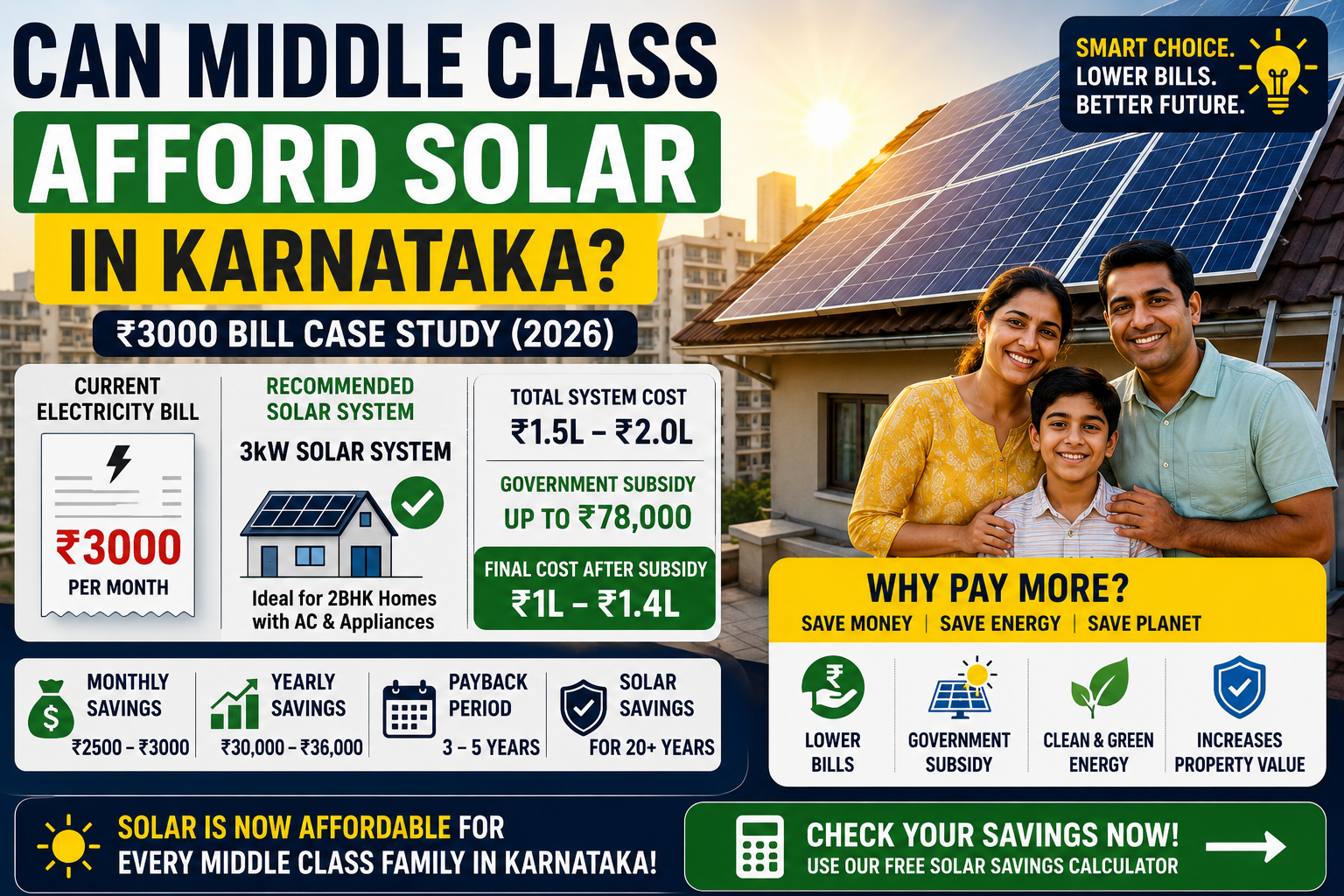
🌞 Can Middle Class Families Really Afford Solar in Karnataka?
For many middle-class families in Karnataka, electricity bills are becoming a serious monthly expense.
With rising electricity prices, AC usage, and appliance consumption, a ₹3000 monthly electricity bill is now common in cities like Bangalore, Mysuru, Mangaluru, and Hubballi.
This raises an important question:
👉 Can middle-class families actually afford rooftop solar in 2026?
The short answer:
👉 Yes — and in many cases, solar can save money from the very first year.
⚡ Real ₹3000 Electricity Bill Case Study
Let’s take a practical example of a typical middle-class family in Karnataka.
🏠 House Profile
- 2BHK independent house
- 4 family members
- 1 AC
- Refrigerator
- Washing machine
- TV + fans + lights
💸 Monthly Electricity Bill
Average bill:
👉 ₹3000/month
Yearly electricity cost:
👉 ₹36,000/year
And with electricity prices increasing, this cost is expected to rise further.
🌞 Recommended Solar System
For a ₹3000 monthly electricity bill:
👉 Recommended system:
3kW Rooftop Solar System
⚙️ What Can a 3kW Solar System Run?
A 3kW system is enough for:
- Lights & fans
- Refrigerator
- Washing machine
- TV
- 1 AC (moderate use)
- Kitchen appliances
💰 3kW Solar System Cost in Karnataka (2026)
Typical pricing:
| Item | Approx Cost |
|---|---|
| Solar panels | ₹90,000 – ₹1.2L |
| Inverter | ₹25,000 – ₹40,000 |
| Installation | ₹20,000 – ₹30,000 |
| Structure & wiring | ₹20,000+ |
👉 Total cost:
₹1.5L – ₹2L
🏦 Government Subsidy Benefit
Under PM Surya Ghar Yojana:
👉 Subsidy available:
Up to ₹78,000
This reduces actual cost significantly.
💵 Final Cost After Subsidy
| System | Approx Final Cost |
|---|---|
| 3kW Solar | ₹1L – ₹1.4L |
For many middle-class families, this becomes much more affordable.
📉 Monthly Savings After Solar
Before solar:
👉 ₹3000/month bill
After solar:
👉 ₹200–₹500/month
💰 Monthly Savings
👉 ₹2500–₹3000 saved every month
📈 Yearly Savings
👉 ₹30,000 – ₹36,000/year
⏱ Payback Period
Most middle-class homes recover solar investment in:
👉 3–5 years
After that:
👉 Electricity savings continue for 20+ years.
⚡ Check Your Solar Savings Instantly
Not sure which solar system is right for your home?
👉 Use the free calculator below to estimate:
- Solar system size
- Installation cost
- Subsidy amount
- Monthly savings
- Payback period
🔢 Solar Subsidy & Savings Calculator
👉 ADD YOUR CALCULATOR HERE
(Paste your Solar Savings Calculator code)
🏠 Is Solar Better Than Paying Electricity Bills Forever?
Let’s compare:
| Without Solar | With Solar |
|---|---|
| Bills increase every year | Fixed energy cost |
| ₹36K yearly electricity cost | Huge reduction |
| No long-term asset | Property value increases |
For many middle-class homeowners, solar is now seen as a long-term investment rather than an expense.
⚡ What About EMI Options?
Many companies now offer:
- Solar EMI plans
- Low down payment
- Monthly installment options
In some cases:
👉 EMI ≈ electricity bill
Meaning families can switch to solar without major financial burden.
🔌 Net Metering Advantage
With net metering:
- Extra electricity goes to grid
- Bill credits reduce monthly expenses further
📊 Solar Panel Prices in Karnataka
If you want detailed pricing:
👉 Read:
Solar Panel Price in Karnataka
⚡ Related Helpful Guides
👉 Also check:
- Solar for ₹3000 Electricity Bill
- Solar for ₹5000 Electricity Bill
- Solar System Size Calculator India
- Solar Panel Price in Karnataka
- Solar Calculator
❓ FAQs
Is solar affordable for middle-class families?
Yes, especially with subsidy and EMI options.
Can solar completely remove electricity bills?
In many cases, bills reduce by 80–90%.
Is rooftop solar worth it in Karnataka?
Yes, due to good sunlight and rising electricity prices.
🚀 Final Verdict
In 2026, rooftop solar is becoming increasingly affordable for middle-class families in Karnataka.
With government subsidies, EMI options, and rising electricity prices, installing a 3kW solar system can save thousands every year.
👉 Use the calculator above to estimate your savings and find the best solar option for your home.