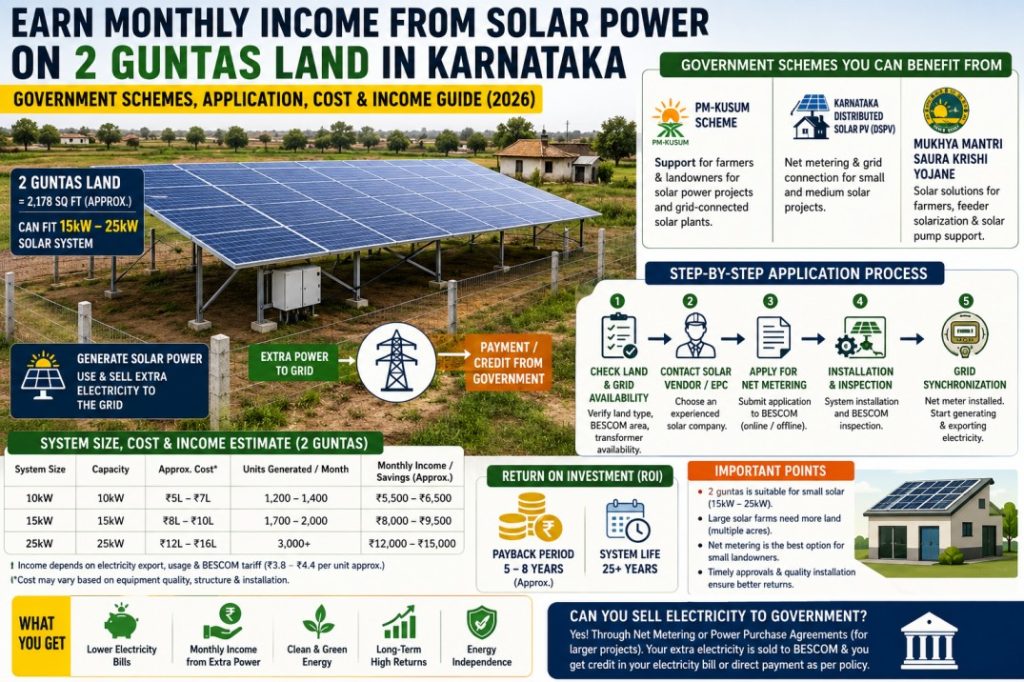
☀️ Can You Earn Money by Selling Solar Electricity to the Government?
Yes — in Karnataka and many other Indian states, landowners and farmers can generate electricity using solar panels and sell power to the electricity grid under government-supported renewable energy programs.
With rising electricity demand, solar expansion, and PM-KUSUM-related schemes, many people are now asking:
👉 “Can I install a solar plant on my empty land and earn monthly income?”
The answer is:
✅ YES — but land size matters a lot.
If you own:
👉 2 guntas of land
you may still be able to install:
- a small grid-connected solar system
- rooftop-style elevated solar setup
- micro solar plant
- net-metered distributed solar project
However, a full commercial MW-scale solar plant generally requires much larger land parcels.
This article explains:
- government schemes
- application process
- investment required
- electricity selling process
- monthly income potential
- ROI & payback period
- practical reality in Karnataka
📏 First Important Question — Is 2 Guntas Enough?
👉 What is 2 guntas?
In Karnataka:
- 40 guntas = 1 acre
- 2 guntas ≈ 2,178 sq ft
⚡ How Much Solar Can Fit in 2 Guntas?
Approximate capacity possible:
| Land Area | Approx Solar Capacity |
|---|---|
| 2 guntas | 15kW – 25kW |
| 10 guntas | 100kW+ |
| 1 acre | 400kW–500kW |
This means:
👉 2 guntas is NOT enough for a large solar farm,
but it CAN support:
- small commercial solar
- net-metering setup
- micro-grid connected project
- solar business usage
🇮🇳 Which Government Schemes Support Solar Projects?
The main schemes relevant for solar power generation are:
🌞 1. PM-KUSUM Scheme
The central government’s PM-KUSUM scheme promotes:
- decentralized solar plants
- feeder solarization
- agricultural solar pumps
- farmer income generation.
Under Component-A:
- farmers can install grid-connected solar plants
- power is sold to DISCOMs (electricity companies)
However:
⚠️ Most Component-A projects are:
- 500kW to 2MW scale
- requiring much larger land parcels
🌞 2. Karnataka Distributed Solar PV (DSPV)
Karnataka has updated rooftop/distributed solar policies allowing:
- ground-mounted systems
- elevated structures
- flexible net metering.
This is more practical for:
👉 smaller landowners.
🌞 3. Mukhya Mantri Saura Krishi Yojane
Karnataka recently launched additional solar feeder and farmer-focused schemes under the KUSUM model.
This shows:
👉 Karnataka is aggressively expanding decentralized solar infrastructure.
⚡ What Is the Best Option for 2 Guntas?
Realistically, you have 3 practical options.
✅ OPTION 1 — Net Metering Solar System (Best Practical Option)
This is the easiest and safest approach.
How It Works
- Install solar panels on land/elevated structure
- Connect system to BESCOM/DISCOM
- Use electricity for home/business
- Extra electricity exported to grid
- Credit adjusted in electricity bill
Best For
✅ Homes
✅ Small commercial buildings
✅ Shops
✅ Rental buildings
✅ Future EV charging
Approx System Size
With 2 guntas:
👉 around 15–25kW system possible.
Approx Cost
| System Size | Approx Cost |
|---|---|
| 10kW | ₹5L–₹7L |
| 15kW | ₹8L–₹10L |
| 25kW | ₹12L–₹16L |
Costs depend on:
- panel quality
- structure type
- battery usage
- inverter brand
💰 Monthly Savings / Income Potential
Estimated generation:
| System | Units/Month |
|---|---|
| 15kW | 1,700–2,000 units |
| 25kW | 3,000+ units |
If exported electricity value is:
👉 ₹3.8–₹4.4/unit in Karnataka.
Possible effective value:
- ₹8K–₹15K/month equivalent savings/income
🏦 Payback Period
Typical ROI:
| System | Payback |
|---|---|
| 10–15kW | 5–7 years |
| 20–25kW | 6–8 years |
Panels may last:
👉 25+ years.
⚡ OPTION 2 — Lease Land to Solar Developer
If your land is in:
- high solar potential area
- near transmission infrastructure
- rural agricultural zone
developers sometimes lease land for solar projects.
However:
⚠️ 2 guntas is usually too small for utility-scale developers.
Large developers typically want:
- multiple acres
- contiguous land
⚡ OPTION 3 — Future Micro Solar Business
You could also use 2 guntas for:
- EV charging + solar
- solar-powered cold storage
- battery charging
- solar-powered irrigation
- solar gadget business
This may generate:
👉 higher long-term income than only selling electricity.
🏗 Step-by-Step Procedure to Apply
✅ STEP 1 — Check Land Type
Verify:
- agricultural/non-agricultural status
- BESCOM jurisdiction
- nearby transformer/grid access
✅ STEP 2 — Contact Solar Vendor/EPC
Choose experienced EPC companies familiar with:
- BESCOM approvals
- KREDL process
- net metering
✅ STEP 3 — Site Feasibility Survey
Vendor checks:
- sunlight availability
- shadow analysis
- structure feasibility
- transformer capacity
✅ STEP 4 — Apply for Net Metering
Application submitted to:
- BESCOM
- HESCOM
- MESCOM
- CESC
(depending on area)
Karnataka now has improved online solar approval systems.
✅ STEP 5 — Installation & Inspection
After approval:
- panels installed
- inverter connected
- safety inspection completed
✅ STEP 6 — Grid Synchronization
DISCOM installs:
👉 bidirectional net meter.
Now excess electricity can be exported.
⚡ Can You Sell Electricity Directly to Government?
For small systems:
👉 usually through net metering credits.
For large MW-scale projects:
👉 via Power Purchase Agreements (PPAs).
⚠️ Important Reality Check
Many YouTube videos exaggerate solar farm income.
Actual challenges include:
❌ approval delays
❌ transformer limitations
❌ subsidy delays
❌ financing problems
❌ payment cycles
Recent studies also mention:
- grid infrastructure issues
- land access problems
- tariff challenges slowing PM-KUSUM expansion.
📈 Realistic Income Expectations
For 2 guntas:
❌ You will NOT become rich from power sales alone.
But you CAN:
✅ reduce electricity bills heavily
✅ generate modest passive income
✅ increase property utility
✅ support EV charging/business
🚗 Smart Future Strategy (Highly Recommended)
The BEST future use of small solar land:
🌞 Solar + EV Charging
Future setup:
- rooftop/ground solar
- EV charging station
- battery backup
- smart AI energy system
This may generate:
👉 much higher future income.
🌾 What About Agricultural Land?
If agricultural:
- PM-KUSUM-related opportunities may exist
- feeder solarization projects are expanding.
But commercial plant eligibility depends on:
- land size
- DISCOM tender
- feeder demand
- policy availability
⚡ Check Your Solar Savings
Planning rooftop or land-based solar?
👉 Use the calculator below to estimate:
- system size
- installation cost
- subsidy
- ROI & payback
🔢 Solar Subsidy & Savings Calculator
👉 ADD YOUR CALCULATOR HERE
(Paste your Solar Calculator code)
🔗 Related Articles
👉 Also read:
- Solar Panel Price in Karnataka
- Can Solar Panels Charge EV Cars in India?
- AI is Changing Solar in India
- PM Kusum Yojana 2026
- Agrivoltaics in India
- Solar for ₹3000 Electricity Bill
- Solar for ₹5000 Electricity Bill
- Best Solar Battery in India 2026
- Best Solar Inverter in India 2026
❓ FAQs
Is 2 guntas enough for solar farm?
Not for large commercial solar farms, but enough for small distributed solar systems.
Can I sell solar electricity to BESCOM?
Yes, through net metering or approved solar agreements.
How much can I earn monthly?
Roughly ₹8K–₹15K equivalent savings/income depending on system size and usage.
Is subsidy available?
Some subsidy/net metering support may apply depending on system type and scheme eligibility.
🔥 Final Verdict
If you own 2 guntas of empty land in Karnataka, the smartest solar strategy is usually:
👉 a small distributed grid-connected solar system.
While it may not generate huge passive income like large solar farms, it can still provide:
- long-term electricity savings
- modest monthly returns
- future EV charging opportunities
- energy independence
As Karnataka aggressively expands renewable energy infrastructure, even small landowners may benefit from the growing solar ecosystem over the next decade.