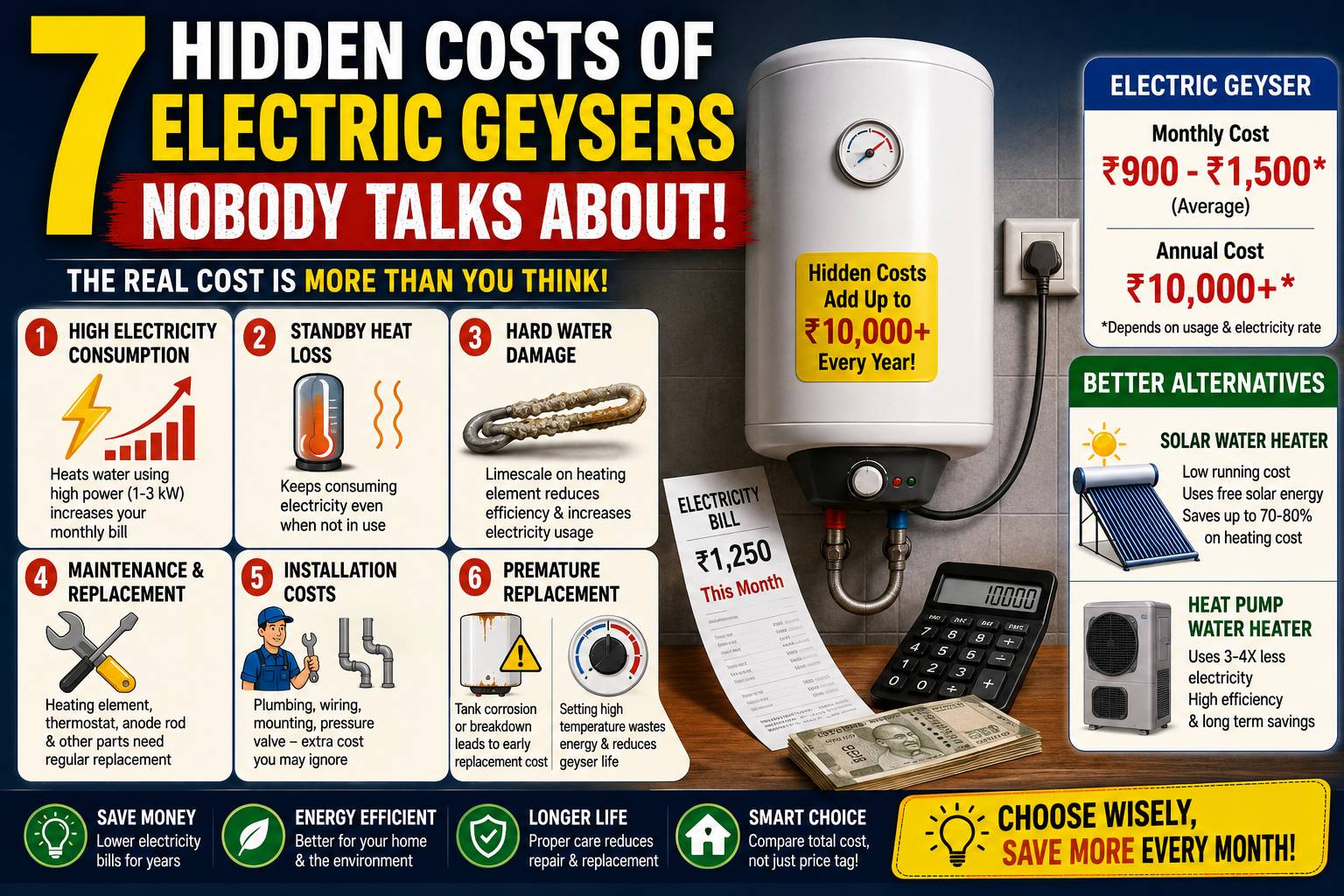
Electric geysers look cheap when you see the price tag. But the purchase price is only one part of what you actually pay.
A ₹10,000–₹20,000 electric geyser can end up costing considerably more over its lifetime because of electricity consumption, standby losses, hard-water damage, maintenance, installation, replacement parts and premature replacement.
For Indian households—especially families using hot water every day—the real question should not be:
“How much does an electric geyser cost?”
It should be:
“How much will this geyser cost me over 5–10 years?”
According to the Bureau of Energy Efficiency (BEE), stationary storage-type electric water heaters are covered under India’s mandatory Standards & Labelling programme. Their energy performance is reflected through the BEE star rating, and consumers are encouraged to consider energy efficiency and lifetime operating costs when choosing appliances.
In this article, we reveal 7 hidden costs of electric geysers and compare them with alternatives such as solar water heaters and heat-pump water heaters.
Quick Answer: What Are the 7 Hidden Costs of an Electric Geyser?
The seven major costs are:
- ⚡ High electricity consumption
- 🔥 Standby/heat-loss electricity consumption
- 💧 Hard-water scale and heating-element damage
- 🔧 Maintenance and replacement parts
- 🚿 Installation, plumbing and electrical costs
- ♻️ Premature replacement and depreciation
- 🌡️ Energy wasted through overheating and poor usage
For households using an electric geyser every day, electricity is usually the biggest lifetime cost.
1. ⚡ Hidden Cost #1: The Electricity Bill
This is the biggest cost—and the easiest one to underestimate.
An electric geyser converts electricity directly into heat.
For example, suppose a geyser has a:
2 kW heating element
and operates for:
2 hours/day
Its simple maximum-use calculation would be:
2 kW × 2 hours = 4 kWh/day
Over 30 days:
4 × 30 = 120 kWh/month
If your effective electricity cost is ₹8 per unit:
120 × ₹8 = ₹960/month
That works out to:
₹11,520/year
This is only an illustration. Actual consumption depends on:
- water temperature entering the tank
- required hot-water temperature
- quantity of water heated
- thermostat settings
- insulation
- number of heating cycles
- family usage
The BEE has published an example of a 25-litre, 3-star geyser using 946 kWh/year under specific assumptions, including 600 operating hours/year and a ₹6/kWh tariff. That example is useful for understanding the calculation, but it should not be treated as today’s electricity cost or the consumption of every geyser.
The important point
The ₹12,000 you spend buying the geyser may be less important than the electricity you spend operating it for years.
2. 🔥 Hidden Cost #2: Standby Heat Loss
Here’s something many buyers don’t think about.
You heat the water.
Then you don’t use it immediately.
The tank gradually loses heat to the surrounding environment.
This is known as standing loss or standby heat loss.
The BEE specifically uses standing loss (kWh/24 hours) as the energy-performance indicator for stationary storage-type electric water heaters.
That means an insulated tank can still consume electricity simply to maintain the temperature of stored water.
Example
Suppose a particular geyser has a standing loss of approximately:
1 kWh/day
At ₹8/unit:
₹8/day
Annual cost:
₹2,920/year
That’s electricity spent without you actually taking a shower.
The actual standing loss varies by:
- tank capacity
- insulation
- ambient temperature
- thermostat setting
- product design
What should you do?
When comparing geysers, don’t look only at:
“2 kW heating element”
Look at:
BEE star rating + standing loss + capacity.
The BEE recommends using its energy-labelling information to compare appliance efficiency and potential cost savings.
3. 💧 Hidden Cost #3: Hard Water Can Become an Expensive Problem
This is particularly important in many parts of India.
Water containing significant mineral content can contribute to scaling inside water-heating equipment.
Over time, deposits can accumulate around:
- heating elements
- tank surfaces
- valves
- pipes
This can affect heat transfer and increase maintenance requirements.
Why does this matter?
Imagine the heating element has to work harder because deposits have accumulated.
The consequences can include:
- slower heating
- higher energy consumption
- reduced performance
- element failure
- service expenses
This is why water quality should be considered before purchasing a geyser.
Why Hard Water Matters Even More for a Geyser
An electric geyser has a heating element directly responsible for transferring heat into the water.
If scaling develops around the element, heat transfer can become less efficient.
Eventually, the component may need cleaning or replacement.
Potential expenses
Depending on the model and service provider:
- descaling/service
- heating-element replacement
- thermostat replacement
- valve replacement
- labour charges
The exact cost varies widely, so don’t assume a fixed national maintenance price.
4. 🔧 Hidden Cost #4: Maintenance and Replacement Parts
A geyser isn’t completely maintenance-free.
Depending on the design and water quality, components can eventually require attention.
Possible parts include:
Heating element
Responsible for heating the water.
Thermostat
Controls water temperature.
Safety valve
Helps manage pressure and prevent unsafe operating conditions.
Anode rod
Some storage water heaters use an anode-based corrosion protection system.
Temperature/pressure components
These can require inspection or replacement depending on the system.
Tank
Tank corrosion or leakage can eventually turn a repair into a replacement decision.
The Problem With Cheap Geysers
A cheap geyser may have an attractive purchase price.
But ask:
Are spare parts easily available?
And:
Will the manufacturer/service network still support the model several years from now?
A slightly more expensive model from an established manufacturer can sometimes make more sense if:
- spare parts are available
- service technicians are accessible
- warranty support is reliable
- the tank has better corrosion protection
- insulation is better
5. 🚿 Hidden Cost #5: Installation Isn’t Always Included
People often compare:
Geyser A = ₹10,999
vs.
Geyser B = ₹13,999
and assume the cheaper product is automatically better.
But installation can involve additional requirements.
Depending on the home, you may need:
- plumbing work
- inlet/outlet connections
- electrical wiring
- suitable socket/isolator
- earthing
- mounting hardware
- pressure-control components
- old geyser removal
If the bathroom is far from the existing plumbing point, costs can increase further.
Important
Never compromise on electrical safety just to save installation money.
A high-power appliance should be installed according to the manufacturer’s requirements and applicable electrical-safety practices.
6. ♻️ Hidden Cost #6: Replacement After Several Years
This cost is often completely ignored when comparing geyser prices.
Suppose you purchase a geyser for:
₹15,000
and eventually replace it after several years.
Then you have to purchase another one.
Now add:
- new installation
- plumbing modifications
- transportation
- disposal/removal
- accessories
The lifetime cost becomes considerably higher than the original purchase price.
Electric Geyser vs Long-Life Alternatives
A properly maintained electric geyser can provide years of service, but the exact lifespan varies significantly by:
- water quality
- usage
- product construction
- maintenance
- operating pressure
- installation quality
A solar water-heating system can have a much longer useful life, although its components also require maintenance and eventual replacement.
Therefore, compare total cost of ownership, not simply product price.
7. 🌡️ Hidden Cost #7: Heating More Water Than You Actually Need
This is one of the most overlooked problems.
Suppose your family needs:
60 litres of hot water
but you repeatedly heat:
100 litres
You are paying to heat water you may not need.
The same problem occurs when you set the thermostat unnecessarily high.
More heating means:
More energy → higher electricity consumption → higher bill.
How Much Water Does Your Family Actually Need?
A rough starting point is:
| Family Size | Typical Storage Size to Evaluate |
|---|---|
| 1–2 people | 10–15 L |
| 2–3 people | 15–25 L |
| 3–4 people | 25–50 L |
| 4–6 people | 50–100 L |
These are starting points, not universal prescriptions.
Actual capacity depends on:
- bathing habits
- number of bathrooms
- shower vs bucket use
- simultaneous usage
- climate
- incoming water temperature
Buying the largest geyser available isn’t automatically the most economical decision.
🚨 The Hidden Cost Nobody Calculates: Your Time
Imagine a family has to:
- Switch on the geyser.
- Wait for heating.
- Check the water.
- Switch it off.
- Repeat the process.
If hot water is required multiple times a day, this becomes a routine household task.
Modern smart controls, timers and temperature management can reduce unnecessary operation.
The BEE has specifically examined smart-home strategies such as temperature control, scheduling and remote operation as ways to reduce unnecessary geyser energy consumption.
The Real Cost of an Electric Geyser
Let’s build a simple example.
Suppose:
Purchase
Geyser:
₹15,000
Electricity
Illustrative annual electricity cost:
₹12,000
Maintenance
Suppose you spend an average of:
₹1,500/year
Lifetime
Assume:
8 years
Electricity:
₹12,000 × 8 = ₹96,000
Maintenance:
₹1,500 × 8 = ₹12,000
Purchase:
₹15,000
Total:
₹1,23,000
This is an illustrative example, not a prediction of actual geyser lifetime cost.
The important lesson is:
The electricity bill can easily become several times larger than the original purchase price.
What If Electricity Prices Rise?
This is where the long-term calculation becomes even more important.
If your electricity tariff increases over the years, the cost of electrically heating water can increase too.
A ₹1,000/month heating expense today may not remain ₹1,000 indefinitely.
That’s one reason energy-efficient appliances matter.
5-Star Geyser: Is It Worth Paying More?
Usually, energy efficiency deserves serious consideration if you use the geyser frequently.
BEE’s Standards & Labelling programme exists specifically to help consumers compare energy performance and potential energy-cost savings.
For storage water heaters, the star rating is linked to standing-loss performance.
Don’t make this mistake:
5-star = automatically cheapest overall
Not necessarily.
You should compare:
- purchase price
- capacity
- standing loss
- warranty
- water compatibility
- service
- expected usage
A 5-star 50-litre geyser may still cost more to operate than a smaller, appropriately sized efficient model if you’re heating far more water than necessary.
How to Reduce Electric Geyser Costs
If you already own an electric geyser, you don’t necessarily need to replace it immediately.
Try these measures first.
1. Choose the right temperature
Avoid unnecessarily high thermostat settings.
2. Don’t heat water unnecessarily
If nobody needs hot water, don’t keep reheating the tank.
3. Use a timer or smart controller
Scheduling can prevent unnecessary operation.
4. Insulate hot-water pipes
Long exposed hot-water pipes can lose heat before the water reaches the tap.
5. Service the geyser
Follow the manufacturer’s maintenance recommendations.
6. Check for leaks
A leaking hot-water system can waste both water and energy.
7. Check the BEE rating before replacement
Use the BEE label as one of the comparison factors.
BEE’s consumer tools also allow users to compare star ratings, energy consumption and cost-saving information.
Electric Geyser vs Solar Water Heater
Now comes the bigger question.
Electric Geyser
Advantages
✅ Low initial cost
✅ Easy installation
✅ Hot water available anytime electricity is available
✅ Suitable for apartments
Disadvantages
❌ Continuous electricity cost
❌ Standby losses
❌ Heating-element maintenance
❌ Hard-water scaling
❌ Replacement costs
Solar Water Heater
Advantages
☀️ Uses solar energy
☀️ Very low electricity requirement for heating
☀️ Long-term savings
☀️ Suitable for independent homes
☀️ Can reduce dependence on electric geysers
Disadvantages
❌ Higher initial investment
❌ Requires rooftop space
❌ Installation is more complex
❌ Performance depends on solar availability
❌ Backup may be needed during extended cloudy periods
What About a Hybrid Solar Water Heater?
This may be the most interesting option for many homeowners.
A hybrid system can combine:
☀️ Solar heating
⚡ Electric backup
The solar system does most of the heating when sunlight is available.
The electric backup handles periods when solar energy isn’t sufficient.
This provides a compromise between:
low running costs
and
reliable hot-water availability.
What About Heat-Pump Water Heaters?
A heat pump is another alternative worth considering.
Instead of directly converting electricity into heat through a resistance element, a heat pump moves heat from the surrounding air into the water.
That can make it substantially more efficient than conventional resistance heating, although the upfront cost is generally higher.
For homes with high hot-water demand, hotels, villas and commercial applications, the economics can be worth evaluating.
Hidden Cost Comparison
| Cost | Electric Geyser | Solar Water Heater | Heat Pump |
|---|---|---|---|
| Initial cost | 🟢 Low | 🔴 High | 🔴 High |
| Electricity consumption | 🔴 High | 🟢 Very low | 🟢 Low |
| Standby loss | 🟡 Yes | 🟡 Yes | 🟡 Yes |
| Hard-water concerns | 🟡 | 🟡 | 🟡 |
| Roof required | ❌ | ✅ | ❌ |
| Backup required | ❌ | Sometimes | Usually not solar-dependent |
| Long-term running cost | 🔴 High | 🟢 Very low | 🟢 Low |
| Best for apartments | 🟢 | 🟡 | 🟢 |
| Best for independent homes | 🟡 | 🟢 | 🟢 |
| Best for high hot-water demand | 🟡 | 🟢 | 🟢 |
Who Should Continue Using an Electric Geyser?
An electric geyser can still be the right choice if:
✅ You live in an apartment.
✅ You rent your home.
✅ Your hot-water consumption is low.
✅ You don’t have rooftop access.
✅ You need hot water at irregular times.
✅ The upfront budget is limited.
In these situations, buying an efficient, appropriately sized geyser can be perfectly sensible.
Who Should Consider Solar Water Heating?
Consider solar if:
☀️ You own an independent house.
☀️ You have a suitable roof.
☀️ Your family uses hot water every day.
☀️ Your electricity bill is relatively high.
☀️ You plan to remain in the house for many years.
In these circumstances, the higher initial investment can potentially be recovered through lower energy costs.
Is an Electric Geyser Actually “Cheap”?
At the shop:
Yes.
Over its lifetime:
Not necessarily.
This is the key lesson.
A ₹10,000–₹20,000 appliance can create a much larger lifetime expense because electricity is consumed every time water is heated.
The ₹10,000 Geyser Trap
Imagine two products:
Geyser A
Purchase price:
₹10,000
Geyser B
Purchase price:
₹16,000
At first glance:
A looks cheaper by ₹6,000.
But suppose B has:
- better insulation
- lower standing losses
- better energy efficiency
- better warranty
- better service support
If B saves even a modest amount of electricity every year, the initial ₹6,000 difference may eventually be recovered.
That’s why:
Purchase price ≠ total cost.
Electric Geyser Buying Checklist
Before purchasing your next geyser, check:
- BEE star rating
- Standing loss information
- Correct tank capacity
- Heating-element type
- Tank material
- Corrosion protection
- Warranty
- Service network
- Spare-parts availability
- Maximum working pressure
- Safety features
- Installation requirements
Frequently Asked Questions
What is the biggest hidden cost of an electric geyser?
Electricity consumption is usually the biggest lifetime cost. The purchase price is paid once, but electricity is consumed every time the geyser heats or maintains the temperature of stored water.
Does a geyser consume electricity even when nobody uses hot water?
Yes. Storage-type geysers can experience standing heat loss, meaning energy is lost from stored hot water over time. BEE uses standing loss as an energy-performance measure for storage electric water heaters.
Does hard water increase geyser maintenance?
Hard-water minerals can contribute to scale formation in water-heating systems. Depending on the system and water quality, scaling can affect heating performance and increase servicing requirements.
Is a 5-star geyser worth buying?
For frequent use, a higher-efficiency model can be worth considering. However, compare the actual BEE label information, standing loss, capacity, purchase price and expected usage rather than choosing based on the star rating alone.
How can I reduce my geyser electricity bill?
Use an appropriately sized geyser, avoid unnecessarily high temperatures, switch it off when hot water isn’t required, consider scheduling/timers, maintain the system and choose an efficient BEE-labelled model when replacing it.
Is a solar water heater cheaper than an electric geyser?
A solar water heater generally has a higher upfront cost but much lower energy costs because sunlight provides the primary heating energy. For homeowners with suitable rooftop space and regular hot-water demand, it can be cheaper over the long term.
Should I replace my electric geyser with a solar water heater?
If you own a house with suitable rooftop space and use hot water every day, it is worth comparing the 10–20-year total cost of both options. For renters and apartment residents without roof access, an efficient electric geyser may remain more practical.
AEO Quick Answer
What are the hidden costs of electric geysers?
The hidden costs of electric geysers include high electricity consumption, standby heat losses, hard-water scaling, heating-element and thermostat replacement, installation and plumbing expenses, premature replacement, and energy wasted by overheating or heating more water than necessary. The BEE’s energy-labelling programme specifically covers stationary storage-type electric water heaters and uses energy-performance information such as standing loss to help consumers compare products.
Final Verdict: Is an Electric Geyser Still Worth It?
Yes—but don’t judge it only by its purchase price.
An electric geyser can be an excellent solution when you need:
- low upfront cost
- simple installation
- reliable hot water
- apartment-friendly operation
But for a family using hot water every day, the electricity bill can become the largest lifetime expense associated with the appliance.
Before buying your next geyser, calculate:
Purchase price + electricity + maintenance + repairs + replacement = real cost
And compare that with alternatives such as:
Electric Geyser vs Solar Water Heater vs Heat Pump Water Heater.
For homeowners with adequate rooftop space, a solar water heater can turn one of the home’s recurring energy expenses into an opportunity to use free solar heat instead.
The real lesson:
Don’t ask, “Which geyser is cheapest?” Ask, “Which hot-water system will cost my family the least over the next 10–20 years?”
Suggested Internal Links (SolarKarnataka.com)
Best Solar Water Heater Brands in India (2026)
Nuetech vs EMMVEE vs Racold vs V-Guard Comparison
ETC vs FPC Solar Water Heater: Which Is Better?
Solar Battery vs Generator: Which Saves More Money?
Solar Powered Home + EV: No Petrol Bill, No Electricity Bill?
1 thought on “🔥 7 Hidden Costs of Electric Geysers Nobody Talks About in India (2026)”