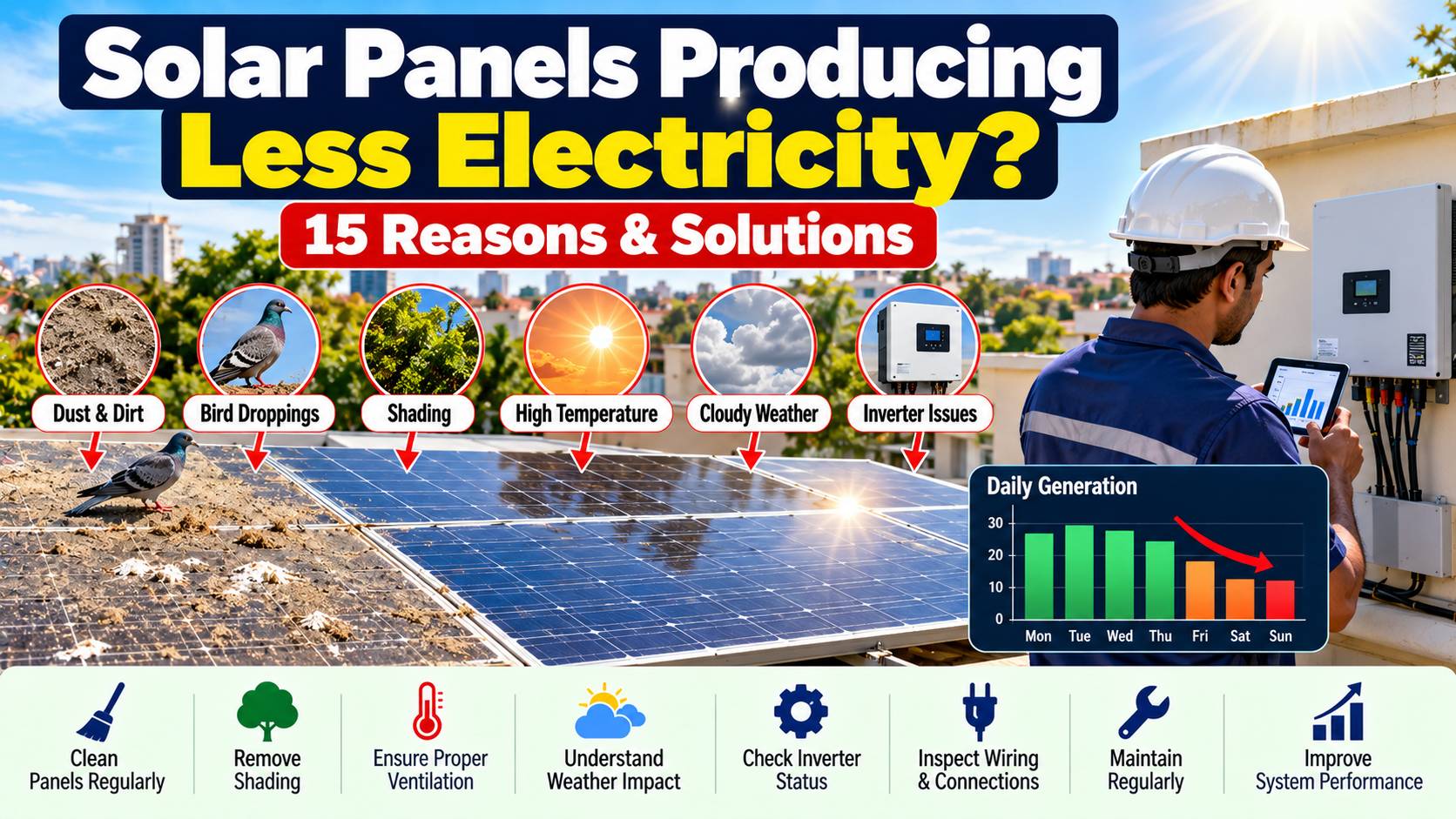
Is your solar panel system producing less electricity than expected? The most common causes are dirty panels, partial shading, high panel temperatures, cloudy weather, inverter faults, wiring problems and incorrect system design. Start by comparing your daily generation with previous days under similar weather conditions. Then check your solar monitoring app, inspect the panels safely from the ground and contact a qualified solar technician if the drop continues.
A sudden fall in solar generation should not be ignored. It may indicate a simple maintenance issue or a fault that needs professional attention.
This guide explains 15 reasons why solar panels produce less electricity, how to identify each problem and what you can do to improve your system’s performance.
Quick Answer: Why Are My Solar Panels Producing Less Electricity?
Solar panels may produce less electricity because of:
- Dust, dirt and bird droppings on the panels.
- Shadows from trees, buildings or nearby structures.
- Cloudy weather, rain or seasonal changes.
- High panel temperatures.
- Inverter faults or shutdowns.
- Loose, damaged or faulty wiring.
- Incorrect panel orientation or tilt.
- Panel degradation as the system ages.
- Cracked panels or damaged solar cells.
- Grid voltage problems or power outages.
- Battery charging or energy-management issues.
- Incorrect system sizing or installation.
- Poor ventilation or mounting conditions.
- Incorrect monitoring readings or communication failures.
- Loose connections, corrosion or other electrical faults.
Important: A lower electricity bill saving does not always mean your solar panels are generating less power. Your household consumption, export arrangement, billing cycle, battery behaviour and utility meter readings can also affect the result.
1. Dust, Dirt and Bird Droppings on Solar Panels
Why does it reduce electricity production?
Dust and dirt block or scatter sunlight before it reaches the solar cells. Bird droppings, leaves and stubborn deposits can cover individual areas of a panel and reduce its output. This problem can be significant in dusty locations, agricultural areas and places near construction sites or busy roads.
In Karnataka, panels may accumulate dust during dry periods, particularly around farmland and roads. Rain can remove some dirt, but it does not guarantee that the panels are completely clean. Research by the US National Renewable Energy Laboratory identifies soiling as a cause of reduced photovoltaic energy production.
How to identify the problem
- Look for visible dust, bird droppings or dry mud from the ground.
- Compare generation before and after a safe, proper cleaning.
- Check whether the production drop developed gradually after a long dry spell.
Solution
Clean the panels when needed, following the manufacturer’s instructions. Use suitable water and a soft cleaning tool where permitted. Avoid abrasive brushes, harsh chemicals and pressure washing unless the manufacturer explicitly allows them.
Never walk on solar panels or climb onto a roof without appropriate safety equipment. If the roof is difficult to access, hire a trained solar cleaning service.
Related tip: Cleaning frequency should depend on local dust, rainfall and measured performance—not a fixed schedule that ignores actual conditions.
2. Partial Shading from Trees, Buildings or Other Objects
Why does shading matter?
Solar panels need sunlight to generate electricity. A shadow from a tree, water tank, chimney, neighbouring building or overhead cable can reduce output.
The effect depends on the panel layout, the size and duration of the shadow, and the electrical configuration. In some string-inverter systems, shading on one panel can affect the performance of other panels connected to the same string.
How to identify the problem
- Check whether the generation drop happens at the same time each day.
- Observe shadows in the morning, at noon and in the afternoon.
- Use panel-level monitoring, if available, to identify underperforming modules.
Solution
Trim vegetation where lawful and safe, remove avoidable obstructions and ask a solar designer to review the layout if the shading is permanent. Optimisers or microinverters may help in suitable installations, but they add cost and do not eliminate every shading loss.
Do not cut trees or alter rooftop structures without considering safety, permissions and structural requirements.
3. Cloudy Weather, Rain and Seasonal Changes
Why does weather affect solar generation?
Solar panels generate electricity from sunlight, including diffuse light on cloudy days. However, thick clouds, heavy rain, haze and reduced sunshine can substantially lower production.
Solar generation also changes with the seasons. Day length, the sun’s angle, cloud cover and rainfall patterns influence how much sunlight reaches your panels.
How to identify the problem
- Compare output with days that had similar weather.
- Review monthly generation rather than judging the system from one cloudy day.
- Check whether nearby weather conditions explain the reduction.
Solution
There is no maintenance fix for naturally reduced sunlight. Compare actual generation against a realistic estimate that accounts for location, system size, orientation, weather and seasonal variation.
Do not assume that a solar system is faulty simply because its output is lower during monsoon weather.
4. High Solar Panel Temperature
Why can hot weather reduce output?
Solar panels need sunlight, but their electrical output generally decreases as cell temperature rises above the reference temperature used for their rated specifications.
This distinction matters in Karnataka: a bright, very hot afternoon does not necessarily produce more electricity than a cooler, equally sunny period.
How to identify the problem
- Check whether output falls during the hottest part of the day despite strong sunlight.
- Compare performance under similar sunlight conditions at different temperatures.
- Review the panel datasheet’s temperature coefficient.
Solution
Ensure that the panels are installed with the ventilation clearance required by the mounting system and manufacturer. Avoid blocking airflow beneath the modules.
Do not spray hot panels with cold water to cool them suddenly. Thermal shock and unsafe roof access can create additional risks. High temperatures alone do not prove that the system has a fault.
5. Solar Inverter Problems
What happens when an inverter fails?
The inverter converts the DC electricity produced by solar panels into usable AC electricity. If it shuts down, develops a fault or repeatedly disconnects, the system may produce little electricity or none at all.
Common warning signs include fault lights, error codes, unexpected shutdowns and a production graph that suddenly drops to zero.
How to identify the problem
- Open the inverter’s monitoring app or display.
- Record any error code or warning message.
- Check whether the system is reporting zero production during daylight.
- Note when the problem began and whether it occurs repeatedly.
Solution
Contact the installer or an authorised inverter service provider with the error code and monitoring screenshots. The technician can inspect the inverter, electrical connections and operating conditions.
Do not open the inverter enclosure, touch internal components or repeatedly reset a system that is tripping. The underlying cause must be identified.
6. Loose, Damaged or Faulty Wiring
Why can wiring reduce solar output?
Solar systems use DC wiring between panels and the inverter, as well as AC wiring between the inverter and the electrical system. Damaged cables, loose connectors, poor terminations or faulty connections can cause power losses or trigger protective shutdowns.
Cable damage may result from weather, animals, poor installation or physical wear.
Warning signs
- Intermittent production.
- Repeated inverter faults.
- Visible cable damage or exposed conductors.
- Burning smells, unusual heat or discolouration near electrical equipment.
Solution
Arrange a professional electrical inspection. The technician may check connectors, cable sizing, insulation, continuity and protective devices.
If you notice smoke, burning smells, sparks or exposed live wiring, keep away from the equipment and contact a qualified professional immediately. Do not touch or disconnect solar DC cables yourself.
7. Incorrect Panel Orientation or Tilt
Why does panel direction matter?
The direction and tilt of solar panels affect how much sunlight they receive throughout the day and year. Poor placement can reduce annual generation, particularly when combined with shading or roof obstructions.
In India, south-facing installations often provide strong annual generation in many locations, but the best configuration depends on the roof, latitude, shading, consumption pattern and design objectives.
Solution
If the system is already installed, ask a solar professional to assess its orientation and compare actual generation with a location-specific estimate.
Changing the panel angle or direction is not automatically worthwhile. The additional cost, roof structure and expected energy gain should be evaluated before modifying the installation.
8. Solar Panel Degradation as the System Ages
Do solar panels lose efficiency over time?
Yes. Solar modules gradually lose some of their ability to generate electricity as they age. This process is called degradation.
A modest long-term decline can be normal. A sudden, substantial drop is not adequately explained by ordinary ageing alone and deserves investigation.
How to identify the problem
- Compare annual generation across multiple years.
- Account for changes in weather, shading, cleaning and downtime.
- Review the manufacturer’s performance warranty.
- Check whether the inverter or other equipment was replaced or repaired.
Solution
If generation has fallen much faster than expected, arrange a performance assessment. The installer may compare measured output with expected production and inspect the modules and electrical system.
Do not assume that every drop is panel degradation: monitoring errors, soiling and equipment faults can produce similar symptoms.
9. Cracked Panels or Damaged Solar Cells
Can a physically damaged panel still work?
Yes. A cracked panel may continue producing electricity, but its output and long-term reliability can be affected. Damage can also create electrical safety risks or allow moisture to enter the module.
Potential causes include impact from objects, hail, incorrect handling, poor installation or mechanical stress.
Warning signs
- Visible cracks or chipped glass.
- Discolouration or unusual marks on a module.
- A panel that consistently underperforms others.
- Physical damage following severe weather or an impact.
Solution
Do not touch cracked glass or attempt a DIY repair. Ask the installer to inspect the module and determine whether it needs replacement under the applicable product warranty or insurance terms.
A professional may need specialised testing to identify damage that cannot be seen from the ground.
10. Grid Voltage Problems or Power Outages
Why can the electricity grid affect solar generation?
Many rooftop solar systems are grid-connected. Their inverters must operate within specified electrical conditions. If the grid voltage or frequency moves outside the inverter’s permitted range, the inverter may reduce output or disconnect for safety.
During a grid outage, a standard grid-tied system generally shuts down to prevent electricity from being fed into a disconnected grid. This is an important safety function.
How to identify the problem
- Check whether the inverter reports a grid-voltage or grid-frequency error.
- Note whether shutdowns occur during periods of strong sunlight.
- Ask the installer to review the inverter’s event log.
- Record whether the problem coincides with local power interruptions.
Solution
Ask a qualified technician to verify the inverter settings, AC cable sizing, connections and grid conditions. If the supply voltage is outside the permitted range, raise the issue with your electricity distribution company.
Never bypass grid-protection settings to force the inverter to operate.
11. Battery Charging and Energy-Management Issues
Why can a solar battery make generation appear lower?
A hybrid solar system may divide available solar energy between household consumption, battery charging and grid export. A battery that is charging can absorb energy that would otherwise be exported to the grid.
Consequently, low grid export does not necessarily mean that the panels are producing less electricity.
A battery fault, incorrect operating mode or energy-management setting can also affect how solar energy is used.
How to identify the problem
Check these separate figures in your monitoring system, where available:
- Total solar generation.
- Household electricity consumption.
- Battery charging and discharging.
- Electricity imported from the grid.
- Electricity exported to the grid.
Solution
Compare total solar generation rather than relying only on export readings. Ask the installer to inspect battery settings, charging limits and system configuration if the readings do not make sense.
A battery stores energy; it does not increase the amount of sunlight reaching the panels.
12. Incorrect System Sizing or Poor Installation Design
Why might a new solar system produce less electricity than expected?
A system can be installed correctly and still fail to meet an unrealistic production estimate. The original calculation may have ignored shading, roof orientation, local weather, system losses or the customer’s electricity needs.
Poor workmanship, an unsuitable equipment configuration or an incorrect inverter setup can also reduce performance.
Solution
Request the original design and generation estimate from the installer. Check the assumed system capacity, orientation, shading, expected monthly generation and system losses.
Compare the estimate with actual readings over a meaningful period, accounting for weather. If the difference remains significant, obtain an independent technical assessment.
Before buying a new system, use the Solar System Size Calculator and Solar Savings Calculator on SolarKarnataka.com to estimate your needs and expected savings.
13. Poor Ventilation or Incorrect Mounting Conditions
Why does installation quality matter?
Panels require a suitable mounting arrangement, adequate structural support and the clearances specified by the manufacturer. Poor mounting can restrict airflow, put mechanical stress on modules or create maintenance and drainage problems.
Roof leaks, loose mounting hardware and water pooling around poorly designed structures also need attention.
Solution
Have a qualified installer inspect mounting hardware, clearances, drainage and structural condition. Any correction should follow the module and mounting-system instructions.
Do not modify roof supports or mounting structures without a professional assessment.
14. Monitoring App or Communication Failure
Can solar panels work when the app shows zero production?
Yes. A monitoring app may stop receiving data even when the panels and inverter are operating. Wi-Fi failure, a disconnected data logger, a communication fault or a monitoring-platform outage can make the display incomplete or misleading.
How to identify the problem
- Compare the app with the inverter’s local display.
- Check the last time the monitoring system updated.
- Look for communication or offline alerts.
- Review the electricity meter or production meter where available.
Solution
Restore the monitoring connection using the manufacturer’s instructions or ask the installer for help. If the inverter itself displays a fault or there is no generation, investigate that separately.
Remember: A missing app reading is not proof of zero electricity production.
15. Loose Connections, Corrosion and Other Electrical Faults
What causes these problems?
Outdoor solar equipment is exposed to heat, rain, humidity and dust. Over time, poor terminations, corrosion, damaged connectors and faults in electrical protection equipment can lead to losses or shutdowns.
These problems may not be visible during a simple rooftop inspection.
Warning signs
- Repeated trips or shutdowns.
- Inverter warnings that return after a reset.
- Unusual heat, burning smells or discolouration.
- Production that fluctuates unexpectedly without a clear weather explanation.
Solution
Arrange an electrical inspection by a qualified solar technician. Depending on the system, the technician may inspect protective devices, connectors, insulation, grounding and the inverter’s fault history.
Do not repeatedly reset tripping equipment or replace electrical components without identifying the root cause.
How to Check Whether Your Solar Panels Are Underperforming
Follow this practical troubleshooting sequence before spending money on repairs.
Step 1: Check total daily generation
Open your inverter monitoring app and record the electricity generated in kilowatt-hours (kWh). Do not confuse instantaneous power in kilowatts (kW) with total daily energy in kWh.
Step 2: Compare similar days
Compare the current day’s output with days that had similar sunshine, cloud cover and operating conditions. Comparing a sunny day with a heavily overcast day can give a misleading result.
Step 3: Look for dirt and shading
Inspect the panels from a safe location. Check for accumulated dust, bird droppings, new tree growth or objects casting shadows.
Step 4: Check inverter status
Record any warning lights, error codes or grid-related alerts. Do not open the inverter or touch electrical wiring.
Step 5: Separate generation from consumption and export
For systems with batteries or grid export, check total generation, household consumption, battery charging and exported energy separately.
Step 6: Contact the installer if the problem persists
Provide the system capacity, inverter model, recent daily generation figures, error codes and the date the problem started. This information helps the technician diagnose the problem efficiently.
How Much Electricity Should Solar Panels Produce Per Day?
There is no single daily production figure that applies to every solar system. Output depends on location, sunlight, panel orientation, shading, weather, temperature, system condition and conversion losses.
For a rough planning illustration, assume a system produces 3.5–5 kWh per installed kW per day on average over an appropriate period. This is only an indicative range, not a guaranteed output or a substitute for a local generation estimate.
| Solar system size | Illustrative daily generation | Illustrative 30-day generation |
|---|---|---|
| 1 kW | 3.5–5 kWh | 105–150 kWh |
| 2 kW | 7–10 kWh | 210–300 kWh |
| 3 kW | 10.5–15 kWh | 315–450 kWh |
| 5 kW | 17.5–25 kWh | 525–750 kWh |
| 10 kW | 35–50 kWh | 1,050–1,500 kWh |
These figures are simple illustrations based on the assumed daily yield. Actual output can be lower or higher, especially during monsoon periods, prolonged cloudy weather, heavy shading or system downtime. Use a location-specific estimate for planning.
When Should You Call a Solar Technician?
Arrange a professional inspection when:
- Generation suddenly falls substantially without an obvious weather explanation.
- The inverter repeatedly shuts down or shows persistent errors.
- One or more panels appear cracked or physically damaged.
- The system produces no electricity during daylight despite suitable conditions.
- You notice exposed wiring, burning smells, sparks or unusual heat.
- The system continues to underperform after safe cleaning and basic monitoring checks.
For suspected electrical hazards, keep away from the equipment and seek qualified assistance immediately.
Frequently Asked Questions
1. Why are my solar panels producing less electricity than before?
Common causes include dust accumulation, new shading, seasonal weather changes, high temperatures, inverter faults, wiring problems and panel degradation. Compare generation on similar-weather days and check the inverter’s monitoring data before deciding on a repair.
2. Do solar panels produce less electricity during summer?
Not necessarily. Longer sunny days can increase total daily generation, but high module temperatures reduce electrical efficiency. The final result depends on sunlight, heat, cloud cover, shading and the system’s design.
3. Does rain reduce solar panel output?
Heavy rain and thick cloud cover can reduce generation by limiting sunlight. Rain may also wash some dust from the panels. A rainy day with lower output does not automatically indicate a fault.
4. How often should solar panels be cleaned in Karnataka?
There is no universal cleaning interval. Dust levels, nearby roads, agricultural activity, bird droppings, rainfall and local conditions determine how quickly panels become dirty. Monitor performance and clean when needed, following the manufacturer’s instructions.
5. Why is my solar inverter showing zero generation?
Possible causes include an inverter fault, grid outage, protective shutdown, an electrical issue or a monitoring problem. Check the inverter’s status and error message, but do not open the equipment. Contact the installer if the issue persists.
6. Why is my solar generation normal but my electricity bill still high?
Your household may be using more electricity, exporting less energy, importing power at different times, or receiving a bill affected by meter readings and billing rules. Check total generation, household consumption, grid import, export and the bill’s billing period.
7. Can dirty solar panels reduce electricity production significantly?
Yes. Dust and other deposits reduce the sunlight reaching the solar cells. The actual loss varies with the type and amount of dirt, weather and system design. Cleaning is useful when soiling is materially affecting performance, but it will not fix inverter or wiring faults.
8. Do solar panels lose efficiency every year?
Solar modules generally experience gradual performance degradation over time. The rate depends on the module, operating environment and product quality. A sudden large decline should prompt checks for other causes instead of being attributed automatically to ageing.
9. Why does one solar panel produce less electricity than the others?
Possible causes include partial shading, dirt, physical damage, a faulty connector or a panel-level electrical issue. Panel-level monitoring can help identify the affected module. A qualified technician should confirm the cause.
10. Can a solar system stop producing electricity even on a sunny day?
Yes. An inverter fault, grid-related shutdown, damaged wiring or a protective trip can stop generation despite strong sunlight. Monitoring and inverter error codes can help narrow down the problem.
11. Does a solar battery reduce solar panel generation?
Not by itself. A battery stores available energy and changes where that energy goes. If the battery is charging, grid export may fall even though the panels are generating normally. Compare total solar generation with battery and grid readings.
12. How do I know whether my solar panels need replacement?
Do not replace panels based only on a lower electricity bill or a few days of poor output. First rule out weather, dirt, shading, monitoring issues, inverter faults and wiring problems. A professional performance assessment can determine whether a module is defective or has degraded beyond expected levels.
Final Verdict
Solar panels producing less electricity is a problem worth investigating, but it does not automatically mean the panels are defective. Weather-related changes are normal; sudden or persistent underperformance needs a closer look.
Start with these three actions: compare generation on similar-weather days, check the inverter and monitoring data, and inspect the panels for dirt or shading from a safe location. If the drop continues or you notice electrical warnings, arrange a professional inspection rather than attempting a DIY electrical repair.
For more practical guidance, explore SolarKarnataka.com’s solar system sizing, solar savings and solar panel price guides before deciding whether your system needs maintenance, repair or replacement.
Further Reading and Technical References
- US National Renewable Energy Laboratory (NREL): How dust and other deposits affect solar panel output
- US Department of Energy: Solar photovoltaic system design and energy yield
- US Department of Energy: Solar inverters and grid services
- US Department of Energy: Operating and maintaining an existing photovoltaic system
This article provides general educational guidance. Actual diagnosis and repair depend on the system design, equipment specifications and site conditions. Follow the manufacturer’s instructions and use a qualified solar professional for electrical work.