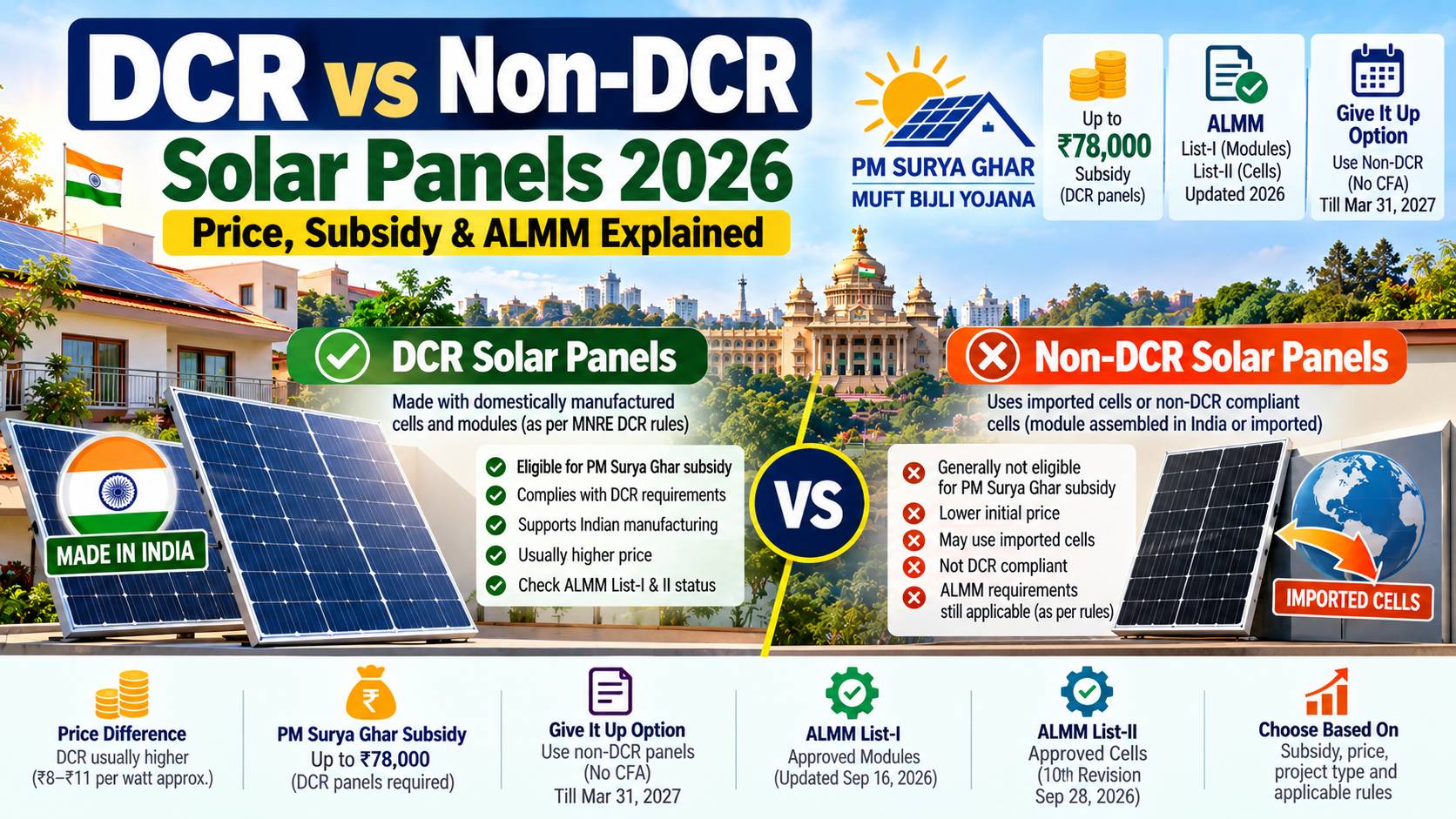
Last Updated: October 1, 2026
If you are buying solar panels in India in 2026, you will increasingly hear three terms from installers:
DCR — Domestic Content Requirement
ALMM — Approved List of Models and Manufacturers
Non-DCR — Solar modules that do not meet the applicable domestic-content requirement
These terms are often used interchangeably, but DCR and ALMM are not the same thing.
The distinction has become particularly important in 2026 because MNRE introduced ALMM List-II for solar PV cells, issued several clarifications, and created a limited transition window for some net-metering and open-access projects. At the same time, residential consumers using PM Surya Ghar’s “Give It Up” option can use non-DCR configurations under specific conditions.
This guide explains the difference, current subsidy rules, price implications, ALMM requirements and what a homeowner in Karnataka should check before signing a solar quotation.
Quick Answer: DCR vs Non-DCR Solar Panels
DCR solar panels use domestically manufactured solar cells and modules where DCR rules apply. Non-DCR panels do not meet those domestic-content requirements.
For a residential consumer claiming PM Surya Ghar central financial assistance (CFA), DCR-compliant domestic modules are required under the scheme’s CFA conditions.
However, MNRE clarified in June 2026 that residential PM Surya Ghar consumers choosing the “Give It Up” option and using net metering can be exempt from the ALMM List-II cell requirement until March 31, 2027, subject to the specified conditions and application through the PM Surya Ghar National Portal.
In simple terms:
| Feature | DCR Solar Panel | Non-DCR Solar Panel |
|---|---|---|
| Domestic cells | Required where DCR applies | Not DCR-compliant |
| Domestic module | Required where DCR applies | Not necessarily |
| PM Surya Ghar CFA | Eligible when all scheme requirements are met | Generally not eligible for CFA |
| Initial price | Usually higher | Often lower |
| Domestic manufacturing | Yes | May use imported cells/components |
| ALMM | Separate requirement | Separate requirement |
| Best suited for | Subsidy-linked projects | Projects not requiring DCR |
| Can it be used under PM Surya Ghar “Give It Up”? | Yes | Yes, subject to current rules |
| Verification | DCR documentation/certification matters | DCR certificate not applicable |
What Is DCR in Solar Panels?
DCR means Domestic Content Requirement.
It is a government requirement under specified MNRE schemes/programmes that requires eligible solar projects to use domestically manufactured solar cells and modules.
For crystalline-silicon technology, MNRE’s DCR clarification states that a domestically manufactured solar cell must be manufactured in India using an undiffused silicon wafer, with the required cell-manufacturing processes carried out in India.
Therefore:
A solar module assembled in India is not automatically a DCR module.
This is one of the biggest misconceptions in the solar market.
If an installer tells you:
“This panel is Indian because the module is made in India.”
that statement alone does not prove DCR compliance.
The cells and the module must satisfy the applicable DCR requirements.
What Is a Non-DCR Solar Panel?
A non-DCR solar panel is a module that does not satisfy the applicable Domestic Content Requirement.
A common configuration can involve:
Imported solar cells → module assembled outside India
or
Imported cells → module manufactured in India
The second configuration can still be non-DCR because Indian module assembly alone does not make the cells domestically manufactured under DCR rules.
What Is ALMM?
ALMM stands for Approved List of Models and Manufacturers.
It is a separate MNRE framework intended to ensure that eligible solar projects use approved solar PV models and manufacturers.
MNRE’s ALMM framework currently contains:
ALMM List-I
Solar PV modules
ALMM List-II
Solar PV cells
MNRE says List-I identifies approved models and manufacturers of solar PV modules, while List-II identifies approved models and manufacturers of solar PV cells. The ministry continues to update both lists.
As of October 1, 2026, MNRE’s ALMM page lists:
- 10th Revision of ALMM List-II for solar PV cells — September 28, 2026
- Updated ALMM List-I for solar PV modules — September 16, 2026
This means ALMM status is a moving compliance issue and should be checked against the latest MNRE list rather than an old installer PDF.
DCR vs ALMM: What Is the Difference?
This is the most important section of the article.
DCR asks:
“Where were the required solar cells and modules manufactured?”
ALMM asks:
“Is this module/cell model and manufacturer approved under the applicable MNRE list?”
They are different compliance systems.
Think of it this way:
DCR = domestic manufacturing requirement
ALMM = approved model/manufacturer requirement
A module can therefore be:
DCR + ALMM
Domestic-content compliant and on the applicable ALMM list.
Non-DCR + ALMM
ALMM-listed but not DCR-compliant.
DCR status alone
Does not automatically answer every ALMM requirement applicable to the project.
That is why an installer saying:
“This is ALMM approved, so you will get the subsidy.”
is not sufficient.
Is DCR Mandatory for PM Surya Ghar Subsidy?
Yes, for CFA-linked residential rooftop solar.
The PM Surya Ghar implementation guidelines specify domestic modules manufactured from domestic cells as a condition for receiving CFA.
The current MNRE rooftop-solar programme provides CFA to eligible residential electricity consumers through the PM Surya Ghar framework.
Therefore, a homeowner who wants the PM Surya Ghar central subsidy should not accept a quotation containing ordinary non-DCR panels on the assumption that the subsidy will still be paid.
How Much Is the PM Surya Ghar Subsidy?
For eligible residential consumers, the current central CFA structure is:
| Solar capacity | Central CFA |
|---|---|
| First 1 kW | ₹30,000 |
| Second 1 kW | ₹30,000 |
| Additional 1 kW | ₹18,000 |
| Maximum CFA | ₹78,000 |
The subsidy is linked to eligible residential rooftop-solar installations and the applicable programme conditions.
Important
The ₹78,000 figure does not mean:
“Any 3kW solar system gets ₹78,000.”
The system must satisfy the scheme’s eligibility, documentation, installation, verification and equipment requirements.
What Is the “Give It Up” Option?
This is one of the most important 2026 changes for consumers comparing DCR and non-DCR panels.
MNRE introduced a “Give It Up” option under PM Surya Ghar.
A residential consumer can voluntarily give up the central financial assistance.
For eligible consumers using the specified net-metering + Give It Up route, MNRE clarified that the project can be exempt from the ALMM List-II solar-cell requirement until March 31, 2027. The application must be submitted through the PM Surya Ghar National Portal.
But understand the trade-off:
You give up the central CFA.
You should therefore compare:
DCR system + ₹78,000 CFA
against
non-DCR system + no CFA
rather than assuming non-DCR automatically means cheaper overall.
Can You Use Non-DCR Panels Under PM Surya Ghar?
Yes — under the specific “Give It Up” route.
MNRE’s June 2026 clarification applies to residential rooftop consumers under PM Surya Ghar who:
- choose the Give It Up option,
- use net metering,
- apply through the PM Surya Ghar National Portal,
- and satisfy the conditions of the clarification.
The exemption from ALMM List-II applies until March 31, 2027.
This does NOT mean:
“Non-DCR panels are now eligible for PM Surya Ghar subsidy.”
They are not eligible for the central CFA merely because the Give It Up option exists.
The whole point of Give It Up is that the consumer forgoes CFA.
DCR Solar Panel Price vs Non-DCR Price in 2026
There is no single official national retail price for DCR or non-DCR solar panels.
The actual quotation depends on:
- module technology
- wattage
- efficiency
- manufacturer
- cell technology
- DCR availability
- ALMM status
- order volume
- dealer margin
- location
- transportation
- warranty
- installation package
However, 2026 market reporting clearly shows that DCR modules have been trading at a premium to non-DCR alternatives.
Mercom reported that Indian DCR modules were at the higher end of solar project costs and that the price gap between DCR and non-DCR modules had widened because of domestic cell constraints.
Some industry quotations reported in 2026 have put the DCR premium at roughly ₹8–₹11 per watt, but this is a market-indicative figure rather than a government-fixed price. Actual quotations vary considerably.
Example only
Suppose a quotation shows a DCR premium of ₹10/W.
For a:
3kW system
the module-level difference would be approximately:
3,000W × ₹10 = ₹30,000
For a:
5kW system
it would be approximately:
5,000W × ₹10 = ₹50,000
That does not mean a 3kW DCR system necessarily costs exactly ₹30,000 more than a non-DCR system. It only illustrates how a per-watt premium affects the module portion of a quotation.
Is DCR Worth Paying More For?
For a homeowner claiming PM Surya Ghar CFA, the answer is straightforward from a compliance perspective:
If you want the central subsidy:
Use the required DCR-compliant equipment.
If you are voluntarily giving up the CFA:
A non-DCR option may be available under the current Give It Up framework, subject to its conditions.
The financial decision should compare the total project cost after subsidy, not simply the panel price.
Example: DCR vs Non-DCR for a 3kW Home
Suppose a homeowner receives two quotations.
Option A — DCR
System quotation:
₹X
Central CFA:
₹78,000
Approximate net cost:
₹X − ₹78,000
Option B — Non-DCR
System quotation:
₹X − ₹30,000
Central CFA:
₹0
Approximate net cost:
₹X − ₹30,000
The non-DCR system is cheaper before subsidy, but the DCR system could still have the lower net purchase cost after the CFA.
That is why:
Never compare DCR and non-DCR panels only on ₹/watt.
Compare the complete installed system after applicable subsidy.
Are DCR Panels Better Quality?
Not automatically.
DCR primarily addresses where the required cells/modules are manufactured, not a universal ranking of panel quality.
A DCR panel is not automatically:
- more efficient
- longer-lasting
- better at high temperatures
- more resistant to degradation
- better in low light
Likewise, a non-DCR panel is not automatically poor quality.
For technical quality, compare:
- efficiency
- temperature coefficient
- degradation warranty
- product warranty
- power warranty
- mechanical-load rating
- fire classification where applicable
- module technology
- manufacturer track record
- inverter compatibility
- installation quality
DCR vs Non-DCR: Efficiency
DCR status and efficiency are separate characteristics.
For example, a buyer might compare:
DCR TOPCon
against:
Non-DCR TOPCon
Both can use the same broad cell technology while differing in domestic-content compliance.
Therefore:
Don’t choose a panel simply because it says DCR. Compare the complete technical datasheet.
DCR vs Non-DCR: TOPCon
TOPCon has become an important module technology in India’s 2026 market.
Market reports indicate that domestic TOPCon DCR modules have been among the more expensive module categories because domestic cell availability remains constrained.
This makes:
DCR TOPCon vs non-DCR TOPCon
a particularly useful comparison for buyers.
When comparing them, check:
| Specification | What to compare |
|---|---|
| Cell technology | TOPCon |
| Module efficiency | Higher isn’t automatically better without roof-space context |
| Temperature coefficient | Lower magnitude is generally preferable |
| Warranty | Product + performance |
| Degradation | Year 1 + annual degradation |
| Power rating | 500W / 550W / 580W / etc. |
| Manufacturer | Verify current status |
| DCR | Required for subsidy-linked project |
| ALMM | Verify applicable list |
| Price/W | Compare complete quotation |
What Is ALMM List-I?
ALMM List-I is the list for approved solar PV module models and manufacturers.
MNRE states that only models/manufacturers included in ALMM List-I are eligible for government, government-assisted, government-scheme, open-access and net-metering projects covered by the ALMM Order, subject to applicable provisions and exemptions.
This is extremely important for a grid-connected rooftop project.
Ask your installer:
“Give me the exact module model number and manufacturer name.”
Then verify that exact model against the current MNRE ALMM List-I.
Don’t verify only the brand name.
What Is ALMM List-II?
ALMM List-II covers solar PV cells.
MNRE issued the first List-II in 2025 and has continued revising it.
As of September 28, 2026, MNRE’s ALMM page lists the 10th Revision of ALMM List-II.
This is especially important because 2026 introduced major changes around cell-level ALMM requirements.
What Changed With ALMM List-II in 2026?
ALMM List-II became a major compliance issue in 2026.
MNRE’s current notices include a limited transition window under which eligible net-metering and open-access renewable-energy projects commissioned on or before December 31, 2026 can receive relief from ALMM List-II requirements for cells, while applicable ALMM List-I module requirements continue.
This is an important deadline.
December 31, 2026
is therefore a date that installers and project owners should pay attention to when evaluating the applicability of ALMM List-II.
Does the December 31, 2026 ALMM Deadline Mean DCR Ends?
No.
This is a critical distinction.
ALMM List-II transition ≠ DCR exemption.
DCR and ALMM are separate requirements.
The August 2026 MNRE clarification specifically states that changes around ALMM List-II do not simply eliminate existing DCR obligations.
So don’t let an installer tell you:
“ALMM List-II has an exemption, so DCR is not required for PM Surya Ghar subsidy.”
That is incorrect.
DCR vs ALMM vs BIS
Solar buyers often hear all three terms together.
| Term | What it means |
|---|---|
| DCR | Domestic Content Requirement |
| ALMM | Approved Models and Manufacturers |
| BIS | Product/quality certification framework |
| ALMM List-I | Solar PV modules |
| ALMM List-II | Solar PV cells |
These are not interchangeable certificates.
A panel can be:
BIS compliant
without necessarily satisfying every DCR or ALMM requirement for your project.
Likewise:
ALMM-listed
does not automatically mean:
DCR-compliant.
How to Verify a DCR Solar Panel Before Buying
This is one of the most important parts of the article.
Step 1 — Ask for exact module details
Get:
- manufacturer
- model number
- wattage
- cell technology
- serial-number range where applicable
Step 2 — Ask for DCR documentation
Do not accept only:
“Yes, it is DCR.”
Ask for the applicable DCR certificate/documentation.
Step 3 — Verify the module
Check the current MNRE/NISE documentation applicable to the project.
Step 4 — Check ALMM List-I
Verify the exact manufacturer/model where ALMM applies.
Step 5 — Check the quotation
The quotation should clearly identify the panel.
Avoid quotations saying only:
“550W DCR panel”
without identifying the manufacturer and model.
How to Verify a Non-DCR Panel
For a non-DCR installation, you still need to verify:
- manufacturer
- model
- warranty
- efficiency
- technical datasheet
- ALMM applicability
- project-specific regulatory requirements
- installer authorization
- serial numbers
- invoice
Non-DCR does not mean “anything goes.”
A project can still have ALMM, DISCOM, safety and technical requirements.
Can DCR Panels Be Used Without PM Surya Ghar?
Yes.
DCR is a project-compliance characteristic, not a requirement that every private homeowner must use DCR panels regardless of the project.
A private project that does not claim a subsidy can evaluate DCR and non-DCR equipment according to the regulations and requirements applicable to that installation.
For grid-connected projects, however, ALMM and DISCOM requirements still need to be checked.
Can Non-DCR Panels Be Used for a Private Solar System?
Potentially, depending on the project type and applicable rules.
The answer changes according to whether the system is:
- grid-connected
- net-metered
- open access
- captive
- government-supported
- subsidy-linked
- behind-the-meter
This is why the statement:
“Non-DCR panels are illegal.”
is incorrect as a general statement.
Likewise:
“Non-DCR panels can be used everywhere.”
is also incorrect.
The project structure determines the applicable requirements.
What About PM-KUSUM?
PM-KUSUM projects can also have DCR requirements depending on the applicable component and programme conditions.
Therefore, a farmer should not apply the residential PM Surya Ghar rules directly to PM-KUSUM.
For a solar pump or PM-KUSUM project, check the specific component guidelines, tender conditions and MNRE/state implementation requirements.
What Should Karnataka Homeowners Do?
For a Karnataka residential rooftop-solar installation, use this decision process.
Want PM Surya Ghar CFA?
→ Choose equipment that satisfies the current CFA requirements, including DCR.
Want to give up the CFA?
→ Non-DCR options may be available under the current Give It Up framework, subject to its conditions.
Want net metering?
→ Check current BESCOM/KERC requirements and applicable ALMM rules.
Buying from an installer?
→ Get the exact manufacturer + model number before paying an advance.
Comparing two quotes?
→ Compare total installed cost after subsidy, not panel ₹/W alone.
DCR vs Non-DCR: Which One Should You Choose?
The answer depends primarily on your project.
For a homeowner claiming PM Surya Ghar subsidy:
DCR-compliant equipment is the relevant route.
For a homeowner voluntarily giving up CFA:
A non-DCR option can be considered under the current Give It Up framework.
For a commercial/industrial project:
Evaluate:
- DCR applicability
- ALMM List-I
- ALMM List-II
- commissioning date
- net metering/open access status
- captive status
- state/DISCOM rules
- project tender requirements
There is no universal “DCR is better” conclusion.
2026 Buyer Checklist
Before signing a solar quotation, ask your installer these 10 questions:
1.
What is the exact solar panel manufacturer?
2.
What is the exact model number?
3.
Is the module DCR compliant?
4.
Can you provide the DCR documentation?
5.
Is the exact module listed in the current ALMM List-I where applicable?
6.
What cell technology does it use?
7.
What is the module efficiency?
8.
What are the product and performance warranties?
9.
Will my project claim PM Surya Ghar CFA?
10.
Which exact rules apply to my net-metering/DISCOM connection?
If an installer cannot clearly answer these questions, do not sign the quotation until the equipment and compliance status are documented.
2026 DCR/ALMM Timeline
2024
MNRE issued clarification on DCR norms for solar PV cells and reiterated domestic manufacturing requirements for applicable MNRE schemes.
2025
ALMM List-II for solar PV cells was introduced and subsequently revised.
June 1, 2026
ALMM List-II requirements became a major compliance issue for applicable projects.
June 2026
MNRE clarified the special PM Surya Ghar Give It Up treatment for residential consumers, including exemption from ALMM List-II cell requirements until March 31, 2027, subject to the stated conditions.
July 2026
MNRE announced a limited window for certain net-metering/open-access projects to be commissioned by December 31, 2026 in relation to ALMM List-II.
August 2026
MNRE issued additional clarification on ALMM List-II applicability across project categories.
September 16, 2026
MNRE’s ALMM page lists an updated List-I for solar PV modules.
September 28, 2026
MNRE’s ALMM page lists the 10th Revision of List-II for solar PV cells.
Frequently Asked Questions
What does DCR mean in solar panels?
DCR means Domestic Content Requirement. It requires eligible projects under specified government schemes/programmes to use solar cells and modules meeting India’s domestic-content rules.
What is a non-DCR solar panel?
A non-DCR solar panel does not satisfy the applicable domestic-content requirement. It may use imported cells or otherwise fail the specified DCR criteria.
Is DCR mandatory for PM Surya Ghar subsidy?
Yes, DCR-compliant domestic modules are a condition for CFA under the PM Surya Ghar residential subsidy framework.
Can I use non-DCR panels under PM Surya Ghar?
A residential consumer can use the Give It Up route under the specified 2026 MNRE conditions, but that means giving up the central financial assistance. The ALMM List-II exemption for this route is currently available through March 31, 2027.
Is ALMM the same as DCR?
No. DCR concerns domestic content, while ALMM concerns approved solar PV models/manufacturers.
Is an ALMM panel automatically DCR?
No. ALMM listing and DCR compliance are separate requirements.
Are DCR solar panels more expensive?
They have generally carried a price premium in the 2026 Indian market, partly because domestic cell supply remains constrained. The actual premium varies by technology, manufacturer, order size and market conditions.
Are DCR panels better quality?
Not automatically. DCR primarily addresses domestic-content compliance. Technical quality must be evaluated using efficiency, degradation, warranties, temperature coefficient, manufacturer reliability and other specifications.
What is ALMM List-I?
ALMM List-I contains approved solar PV module models and manufacturers. MNRE’s current ALMM framework applies List-I to specified government, government-assisted, government-scheme, open-access and net-metering projects, subject to applicable rules and exemptions.
What is ALMM List-II?
ALMM List-II contains approved solar PV cell models and manufacturers. MNRE continues to revise the list. The current ALMM page lists the 10th revision dated September 28, 2026.
Can non-DCR panels be used for net metering?
The answer depends on the project, commissioning date, applicable ALMM provisions, subsidy status and current DISCOM/MNRE rules. For certain net-metering projects, MNRE has provided a limited ALMM List-II transition window through December 31, 2026, while other requirements remain applicable.
Can I get ₹78,000 PM Surya Ghar subsidy with non-DCR panels?
No, not through the normal CFA route. The current Give It Up mechanism specifically involves voluntarily foregoing the central financial assistance.
Final Takeaway
The easiest way to remember the 2026 solar rules is:
DCR = domestic-content requirement.
ALMM = approved models and manufacturers.
They are different.
For a homeowner claiming PM Surya Ghar subsidy, DCR compliance is critical.
For someone giving up the subsidy under PM Surya Ghar’s Give It Up option, MNRE has created a specific exemption from ALMM List-II cell requirements through March 31, 2027, subject to the stated conditions.
And for any grid-connected project, don’t stop at the words “DCR panel” or “ALMM panel.”
Get the exact manufacturer, model number, DCR documentation, ALMM status and project-specific compliance requirements in writing.
That is the safest way to compare solar quotations in 2026.
1 thought on “DCR vs Non-DCR Solar Panels 2026: Price, Subsidy & ALMM Explained”