Last Updated: September 29, 2026
Karnataka has introduced a new regulatory framework for grid-connected rooftop solar in 2026. The Karnataka Electricity Regulatory Commission (KERC) notified the KERC (Grid Interactive Distributed Solar Photovoltaic Plants) Regulations, 2026 in August 2026, replacing the earlier 2016 rooftop-solar regulatory framework. BESCOM has subsequently published the 2026 DSPV regulations, tariff order and updated application/PPA procedures on its rooftop-solar portal.
The changes affect homeowners, apartments, commercial establishments, industries, institutions and other electricity consumers installing grid-connected solar systems in Karnataka.
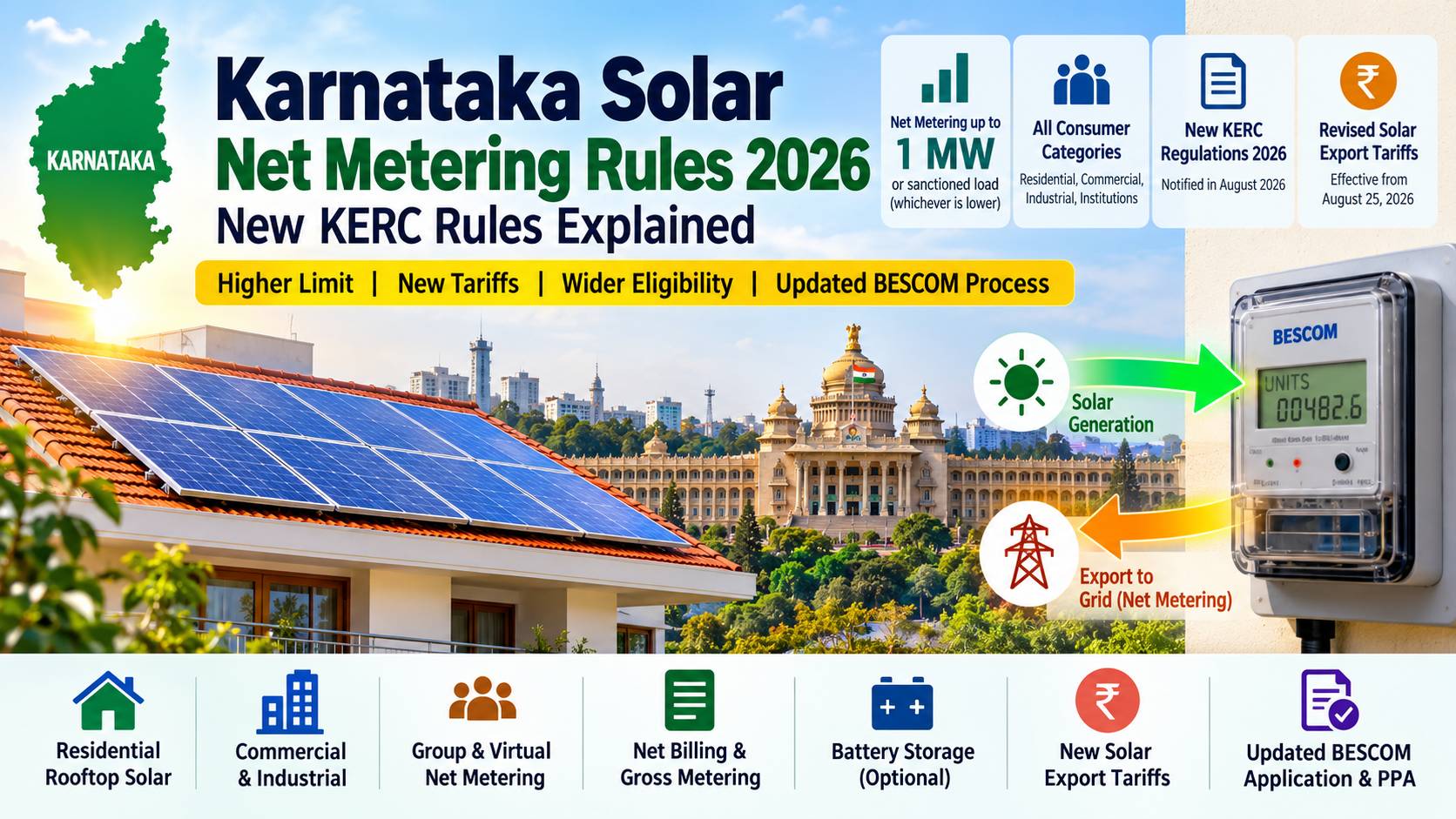
The most important changes include a 1 MW net-metering ceiling, wider consumer eligibility, new metering options, revised solar tariffs, updated PPA procedures and new rules concerning distributed solar capacity.
Quick Answer: What Changed in Karnataka Solar Net Metering in 2026?
The major changes are:
- Net metering is available across consumer categories under the new DSPV framework.
- The net-metering capacity ceiling is 1,000 kW (1 MW) or the sanctioned load, whichever is lower, subject to the regulations.
- Karnataka now has multiple distributed-solar settlement mechanisms, including net metering, net billing, gross metering, group net metering, virtual net metering and behind-the-meter systems.
- The new regulations came into force after publication in the Karnataka Gazette in August 2026.
- KERC issued a separate tariff order on August 25, 2026, covering the applicable tariff period through June 30, 2029, unless changed earlier by further orders.
- BESCOM’s current portal provides separate application/PPA procedures for net metering and gross metering.
What Is Net Metering?
Net metering allows a consumer with a grid-connected solar system to:
- Generate electricity from rooftop solar.
- Use the electricity in the premises.
- Export surplus electricity to the grid.
- Have the applicable exported electricity accounted for under the KERC/BESCOM framework.
For example, during the afternoon your solar system may produce more electricity than your home is consuming. The surplus can flow into the electricity grid.
When solar generation is lower than your consumption, electricity can be drawn from the grid.
BESCOM’s current application system specifically provides for consumers to connect distributed solar PV systems to the BESCOM LT/HT distribution system under net metering.
What Are the New Karnataka Solar Rules for 2026?
1. Net Metering Capacity Can Go Up to 1 MW
One of the biggest changes is the new capacity ceiling.
Under the 2026 framework, net metering can cover a distributed solar PV plant up to:
1,000 kW / 1 MW or the sanctioned load, whichever is lower.
This is particularly important for larger commercial, industrial and institutional consumers.
For an ordinary residential consumer, the household’s sanctioned load and actual electricity requirement remain much more important than the theoretical 1 MW ceiling.
2. More Consumer Categories Can Use Distributed Solar
The new framework is not restricted to ordinary residential rooftop systems.
It covers distributed solar arrangements for different consumer categories, including:
- Residential
- Commercial
- Industrial
- Educational institutions
- Other eligible consumers
BESCOM’s rooftop-solar portal explicitly invites applications from residential, commercial, industrial and educational consumers.
3. Karnataka Now Has Multiple Solar Metering Options
The 2026 DSPV framework covers several mechanisms.
Net Metering
Solar generation is used against electricity consumption, with surplus electricity handled according to the applicable regulatory/tariff framework.
Net Billing
Electricity imported from the grid and electricity exported from the solar plant are valued separately under the applicable rates.
Gross Metering
The solar generator sells the generated electricity to the distribution licensee under the applicable tariff arrangement.
Group Net Metering
Solar generation can be allocated among eligible electricity connections under the applicable rules.
Virtual Net Metering
Solar generation can be credited among participating consumers according to the applicable framework.
Behind-the-Meter Solar
Solar electricity is primarily consumed behind the consumer’s meter rather than being exported under a conventional export arrangement.
The introduction/recognition of these different mechanisms is one of the significant changes in the 2026 framework.
4. What Is the New Karnataka Solar Export Tariff?
KERC issued a new DSPV/SPV tariff order on August 25, 2026.
For the relevant categories, the new order changed the rates applicable to solar power supplied/exported to the grid. BESCOM’s current application system refers specifically to the KERC order dated 25-08-2026 for the tariff applicable to net-metered projects.
For example, the reported tariff for domestic consumers without PM Surya Ghar subsidy in the 1–10 kW category is ₹3.89 per unit under the new order.
For PM Surya Ghar-supported domestic systems, the applicable rates are different:
| Solar capacity | Reported KERC tariff |
|---|---|
| 1–2 kW | ₹1.96/unit |
| Above 2–3 kW | ₹2.14/unit |
| Above 3 kW | ₹2.58/unit |
| Domestic 1–10 kW without subsidy | ₹3.89/unit |
These rates come from the KERC tariff order effective from August 25, 2026; the exact applicability depends on the consumer category, project structure and applicable conditions.
Important
Do not calculate your solar ROI simply by multiplying total solar generation by the export tariff.
A rooftop system’s economics depend on:
- self-consumption
- exported electricity
- electricity tariff
- fixed charges
- solar generation
- system price
- subsidy
- financing
- maintenance
- applicable metering arrangement
For most homeowners, using solar electricity directly inside the house can be more important than maximizing exported electricity.
5. Is Net Metering Available for a 5kW Solar System?
Yes, a 5kW rooftop solar system can fall under the net-metering framework, subject to the consumer’s sanctioned load, technical feasibility and applicable BESCOM/KERC requirements.
A 5kW system is particularly relevant for households with higher electricity consumption.
For example, a household using:
- air conditioners
- refrigerators
- washing machines
- water heaters
- pumps
- EV charging
may require more solar capacity than a basic household.
However, solar capacity should be selected from actual electricity consumption and sanctioned load, not simply because a particular system size is popular.
6. Can Apartments Use Solar Net Metering?
The 2026 framework includes group and virtual net-metering mechanisms, which are particularly relevant to apartments, housing societies and multi-consumer arrangements.
However, the practical implementation depends on the applicable BESCOM procedure and SOP.
BESCOM’s portal currently identifies separate arrangements for virtual and group net metering, including specific accounting provisions.
Therefore, apartment associations should not assume that installing panels automatically means every flat will receive an individual credit.
The allocation mechanism and required documentation matter.
7. What Happens to Excess Solar Electricity?
This is one of the most important questions for homeowners.
Under net metering, electricity generated by the solar system is first used for consumption at the premises.
Surplus electricity can be exported to the grid.
The treatment and financial settlement of surplus electricity depend on the applicable KERC tariff and metering mechanism.
The new framework uses monthly settlement, rather than treating the arrangement as unlimited annual banking.
Therefore:
Do not design a rooftop solar system simply to maximize the amount of electricity exported to BESCOM.
The better starting point is your actual electricity consumption.
8. Does the New Rule Mean You Can Install 1 MW Solar at Home?
No.
The 1 MW figure is the maximum ceiling under the relevant net-metering framework, not a recommendation for residential consumers.
Your actual permissible capacity is affected by:
- sanctioned load
- connection type
- technical feasibility
- transformer capacity
- distribution-system conditions
- applicable KERC/BESCOM rules
- rooftop/land availability
- safety requirements
For a normal house, a system such as 2kW, 3kW, 5kW or 10kW is far more relevant than 1 MW.
9. New Transformer Capacity Rules Matter
The 2026 framework introduces technical constraints concerning distributed solar hosting capacity.
For smaller plants connected to the distribution transformer, transformer capacity becomes an important consideration.
The detailed regulations include an 80% hosting limit for relevant distributed-solar connections at the transformer level.
This means that even when a consumer wants to install solar, local grid capacity can become an important part of project feasibility.
This is particularly relevant for:
- high-density residential areas
- apartment complexes
- commercial buildings
- industrial areas
- areas with substantial existing rooftop solar
10. What Happens If You Want to Increase Your Solar Capacity Later?
This is an important issue that homeowners often overlook.
Adding solar capacity later can affect the existing PPA and tariff arrangement.
The 2026 framework includes provisions dealing with additional capacity installation and the execution of a fresh PPA in applicable circumstances. BESCOM’s published SOP also contains provisions concerning additional capacity and tariff treatment.
Practical advice
Before installing 3kW today with the intention of increasing to 5kW next year, calculate the required system size carefully.
Do not assume:
“I can simply add another 2kW later under exactly the same agreement.”
The regulatory and tariff consequences need to be checked before expansion.
11. What Happens If Solar Installation Is Delayed?
The new BESCOM net-metering consent/PPA documentation states that where commissioning is delayed, the tariff payable can be affected.
The current BESCOM application terms specify that the applicable tariff in such circumstances can become the lower of:
- The tariff agreed in the agreement
- The revised tariff prevailing on the commissioning date
- 90% of the agreed tariff
subject to the applicable conditions.
Why this matters
Don’t treat the PPA date and commissioning date as administrative details.
They can affect the economics of the project.
12. Is Battery Storage Mandatory Under the New Karnataka Rule?
The final 2026 framework does not impose the battery-storage requirement that appeared in the earlier draft proposal for larger distributed solar systems.
Current analysis of the final regulations indicates that battery storage is presently optional, while the Commission has provided for a future review of storage requirements.
This is an important distinction:
Solar system ≠ automatically solar battery system.
A homeowner can evaluate:
Grid-connected solar without battery
versus
Solar + battery storage
based on:
- power-cut frequency
- backup requirement
- electricity consumption pattern
- battery cost
- inverter type
- desired backup duration
13. Do You Still Pay an Electricity Bill After Installing Solar?
Yes.
Installing rooftop solar does not necessarily make the electricity bill zero.
You can still have:
- fixed charges
- demand charges where applicable
- electricity taxes
- statutory charges
- other applicable levies
BESCOM’s current PPA documentation also states that statutory electricity taxes and other applicable levies can continue to apply.
Therefore, avoid advertisements claiming:
“Install solar and your electricity bill becomes permanently ₹0.”
That is not a reliable general statement.
14. What Is the Difference Between Net Metering and Gross Metering?
| Feature | Net Metering | Gross Metering |
|---|---|---|
| Solar electricity | Used by consumer + surplus exported | Generation sold to grid |
| Main purpose | Reduce electricity consumption | Sell generated electricity |
| Consumer uses solar directly | Yes | Arrangement depends on project structure |
| Export settlement | Under applicable net-metering rules | Under applicable gross-metering tariff |
| Suitable for | Consumers wanting to offset consumption | Consumers choosing generation-sale model |
BESCOM currently provides separate net-metering and gross-metering application/PPA arrangements.
15. How to Apply for Solar Net Metering in Karnataka
For BESCOM consumers, the current online process starts through the BESCOM Solar Rooftop PV portal.
Basic process
Step 1: Check your electricity consumption and sanctioned load.
Step 2: Decide the approximate solar capacity.
Step 3: Check the applicable PM Surya Ghar subsidy eligibility if you are a residential consumer.
Step 4: Apply through the relevant BESCOM rooftop-solar process.
Step 5: Provide the required consumer and rooftop information.
Step 6: Complete payment/application requirements.
Step 7: Complete the applicable agreement/PPA/e-sign process.
Step 8: Install the solar system according to the approved technical requirements.
Step 9: Complete inspection/commissioning requirements.
Step 10: Metering is completed according to the applicable arrangement.
BESCOM’s current online application specifically instructs applicants to complete rooftop details, payment and e-sign the PPA and verify details such as consumer name, address, proposed capacity, RR number and tariff before signing.
16. Documents You May Need
The exact requirements depend on the project and application route, but applicants should be prepared with information such as:
- BESCOM account/consumer ID
- electricity bill
- sanctioned-load information
- property/rooftop details
- solar-system capacity
- applicant details
- installation documents
- required agreements/PPA
- technical documents
- photographs/documents requested through the application
Always follow the latest BESCOM application checklist rather than relying on an old blog article.
17. What Does the 2026 Rule Mean for a Typical Homeowner?
For a typical Karnataka homeowner, the most important factors are not the 1 MW ceiling.
Focus on these five:
1. Your monthly electricity consumption
Look at the previous 12 months rather than one electricity bill.
2. Your sanctioned load
Your solar capacity cannot simply be selected independently of the electricity connection.
3. PM Surya Ghar subsidy
Check the current central subsidy rules separately from the KERC export tariff.
4. Your self-consumption
Using solar electricity directly can materially affect savings.
5. Your future electricity demand
Consider:
- EV
- air conditioner
- heat pump
- induction cooking
- electric water heater
- additional appliances
before finalizing system capacity.
18. What Does the 2026 Rule Mean for Businesses?
The changes are more significant for commercial and industrial consumers.
The 1 MW net-metering ceiling provides a larger regulatory envelope for eligible distributed-solar projects, while the new metering mechanisms create additional ways to structure solar generation and consumption.
Businesses should evaluate:
- sanctioned load
- contract demand
- daytime electricity consumption
- rooftop area
- transformer capacity
- net metering vs net billing
- gross metering
- DCR/non-DCR implications
- tariff
- financing
- solar generation
- future load growth
A solar system sized only from rooftop area is not sufficient.
19. Karnataka Solar Net Metering 2026: What Changed From the Old System?
| Issue | Earlier framework | 2026 framework |
|---|---|---|
| Main rooftop regulation | 2016 framework | 2026 DSPV Regulations |
| Net-metering ceiling | Earlier framework | Up to 1 MW or sanctioned load, whichever is lower, subject to rules |
| Consumer coverage | Existing framework | Expanded framework across consumer categories |
| Metering mechanisms | Mainly net/gross | Net, net billing, gross, group, virtual, behind-the-meter |
| Tariff | Previous KERC orders | New August 2026 tariff order |
| Battery | No general final mandate | No general final mandate in the final regulations |
| PPA/process | Earlier BESCOM procedures | Updated 2026 procedures |
| Tariff period | Previous orders | New order from Aug. 25, 2026 through Jun. 30, 2029, unless changed earlier |
The new regulations and tariff order work together: the regulations define the framework, while the tariff order determines applicable rates.
20. Frequently Asked Questions
Is net metering available in Karnataka in 2026?
Yes. Karnataka’s 2026 DSPV regulations continue to provide for net metering, and BESCOM currently accepts applications through its rooftop-solar system.
What is the maximum solar capacity for net metering in Karnataka?
The 2026 framework provides a ceiling of 1,000 kW (1 MW) or the sanctioned load, whichever is lower, subject to the applicable regulations and technical conditions.
Can residential consumers install rooftop solar under net metering?
Yes. Residential consumers are covered by BESCOM’s grid-connected rooftop solar process.
Can commercial consumers use solar net metering?
Yes. The 2026 DSPV framework covers multiple consumer categories, including commercial consumers.
What is the 2026 Karnataka solar tariff?
The applicable tariff depends on the consumer category, capacity, subsidy status, metering mechanism and other conditions. For example, the reported domestic 1–10 kW non-subsidy rate is ₹3.89/unit under the August 25, 2026 order.
Is battery storage compulsory for rooftop solar?
The final 2026 framework does not impose the battery-storage requirement that appeared in the earlier draft proposal for larger systems.
Can I install 5kW solar on my house?
A 5kW system can be installed under the applicable rooftop-solar framework when the consumer’s sanctioned load, technical feasibility and other requirements permit it.
Does solar make my electricity bill zero?
No. Fixed charges, taxes and other applicable charges can remain payable even after installing rooftop solar.
Can I increase my solar capacity later?
Additional capacity is possible under the applicable rules, but it can affect the existing PPA and tariff arrangement. Check the current BESCOM/KERC procedure before expanding.
Does BESCOM still provide net-metering applications?
Yes. BESCOM’s current rooftop-solar portal provides an online DSPV application process, including net-metering arrangements.
21. Bottom Line
Karnataka’s 2026 solar rules are significantly broader than the previous rooftop-solar framework.
For homeowners, the practical priorities are:
Electricity consumption → sanctioned load → solar size → PM Surya Ghar subsidy → self-consumption → net-metering arrangement → BESCOM approval.
For businesses, the analysis is more detailed because capacity, sanctioned load, transformer capacity, metering mechanism, tariff and project economics become increasingly important.
The most important thing to remember is:
The 1 MW net-metering limit is a regulatory ceiling, not a recommended residential solar-system size.
Karnataka’s new framework was notified in August 2026, and BESCOM has already incorporated the new DSPV regulations and August 2026 tariff order into its rooftop-solar process.
Official resources
BESCOM Solar Rooftop Online Applicatio
Suggested internal links from this article:
1 thought on “Karnataka Solar Net Metering Rules 2026: New KERC Rules Explained”