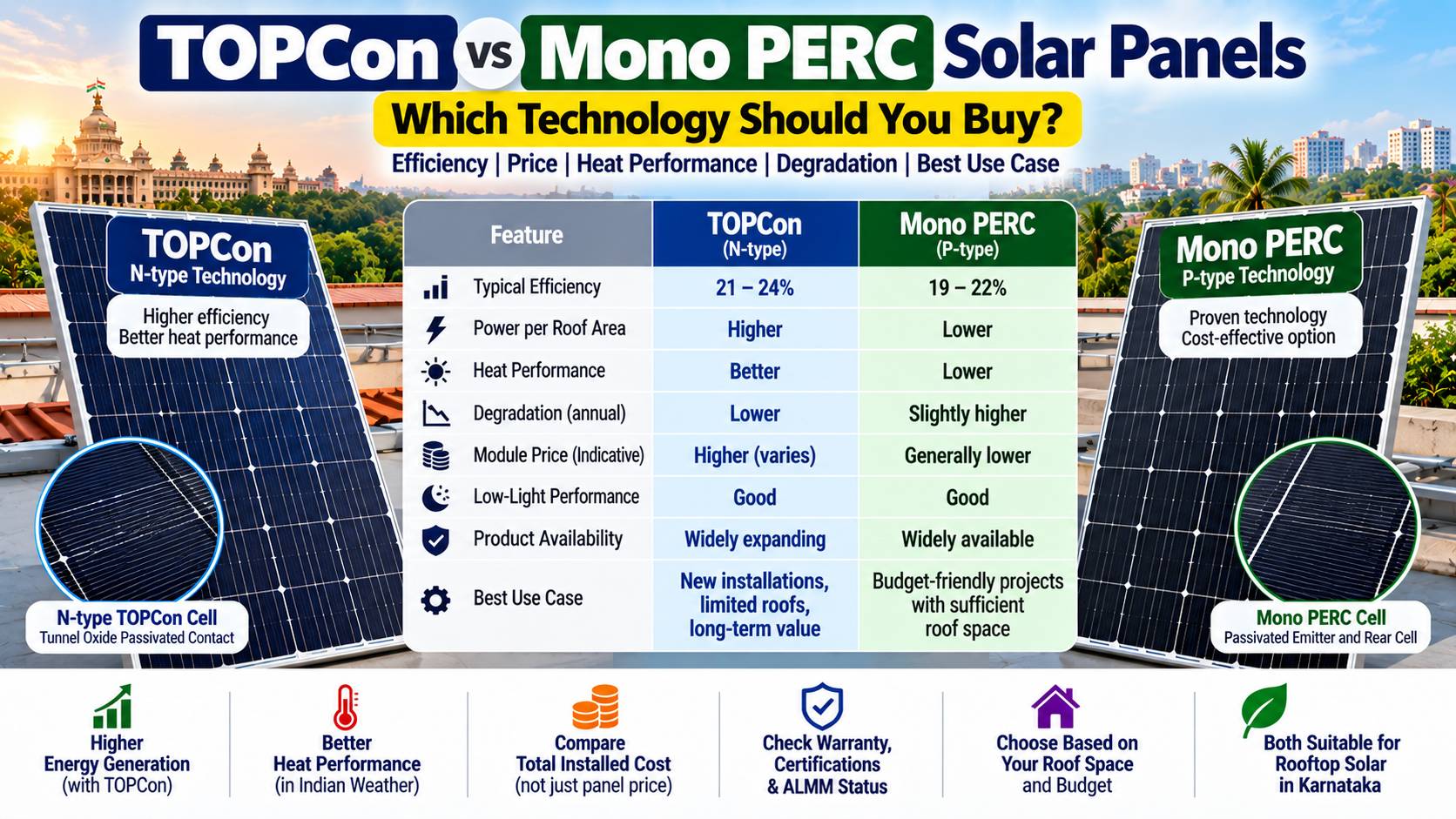
Choosing between TOPCon and Mono PERC solar panels can affect your rooftop system’s cost, electricity generation, performance in hot weather and long-term value. Both technologies use monocrystalline silicon, but they differ in cell design, efficiency potential and degradation characteristics.
Quick answer: TOPCon is generally the better choice for a new rooftop solar installation when the price premium is reasonable, roof space is limited and you plan to use the system for many years. Mono PERC remains a practical option when it is significantly cheaper, roof space is sufficient and the specific panel offers reliable performance and warranty support.
For Indian homeowners, the right decision is not simply about buying the newest technology. Compare the actual module specifications, total installed price, applicable subsidy requirements and expected lifetime electricity generation before choosing.
Quick Comparison: TOPCon vs Mono PERC
| Feature | N-Type TOPCon | Mono PERC |
|---|---|---|
| Full form | Tunnel Oxide Passivated Contact | Passivated Emitter and Rear Cell |
| Silicon type | Usually N-type | Usually P-type |
| Typical module efficiency | Approximately 21–24% | Approximately 19–22% |
| Power generation per roof area | Generally higher | Generally lower |
| Performance in high temperatures | Typically better | Typically lower |
| Degradation | Usually lower, depending on product | Often slightly higher |
| Initial module price | Often higher, but varies | Can be cheaper |
| Low-light performance | Depends on module design; often competitive | Depends on module design |
| Product availability in India | Widely expanding | Still available, but product availability varies |
| Best use case | New installations, limited roofs, long-term ownership | Budget-sensitive projects with adequate roof space |
These are indicative technology-level ranges, not specifications guaranteed for every product. Manufacturer datasheets and warranty terms take priority over general averages. Industry comparisons report typical TOPCon module efficiencies of approximately 21–24% and Mono PERC efficiencies of approximately 19–22%. 2026 technology comparison.
1. What Is TOPCon Solar Panel Technology?
TOPCon stands for Tunnel Oxide Passivated Contact. It uses a specialised contact structure that reduces electrical recombination inside the solar cell, helping more of the energy generated by sunlight become usable electrical power.
TOPCon modules commonly use N-type silicon cells. This cell architecture can support higher efficiency and lower light-induced degradation than conventional P-type PERC technology.
Advantages of TOPCon panels
- Higher efficiency in many current product ranges.
- More installed capacity from a limited roof area.
- Typically better temperature coefficients.
- Generally lower degradation under comparable product specifications.
- Availability in monofacial and bifacial module designs.
- Potentially stronger long-term energy production.
Disadvantages of TOPCon panels
- The initial price can be higher for some models.
- Higher efficiency does not guarantee better value if the product is overpriced.
- Actual output still depends on shading, orientation, installation and temperature.
- Product quality and warranty support vary by manufacturer.
- Bifacial modules require suitable installation conditions to benefit from rear-side generation.
Best for: Homeowners and businesses installing a new solar system who want higher power density and plan to use the system over the long term.
2. What Is Mono PERC Solar Panel Technology?
Mono PERC stands for Monocrystalline Passivated Emitter and Rear Cell. It improves conventional monocrystalline solar-cell design by adding a passivated rear surface that helps capture more usable light and reduce electrical losses.
Mono PERC became widely adopted because it offered an effective balance between efficiency, cost and manufacturing scale.
Advantages of Mono PERC panels
- Potentially lower upfront module cost.
- Established technology with broad market familiarity.
- A wide range of product choices may be available.
- Can be economical where roof area is sufficient.
- Suitable for many residential, agricultural and commercial installations.
Disadvantages of Mono PERC panels
- Generally lower efficiency than comparable modern TOPCon modules.
- Often has a less favourable temperature coefficient.
- Some P-type cells are more susceptible to light-induced degradation.
- Older or discounted stock may have limited availability or less attractive warranty terms.
Best for: Buyers whose primary objective is reducing initial cost and who can install enough capacity without running out of roof space.
3. Which Panel Generates More Electricity?
For panels with the same rated wattage, TOPCon can deliver a modest energy-yield advantage because of its cell characteristics and often better temperature performance. However, the difference depends on the specific modules and installation conditions.
It is important to distinguish between module efficiency and electricity generation.
Module efficiency describes how effectively a panel converts sunlight into electricity per unit of area. Annual electricity generation depends on more than efficiency, including:
- Installed DC capacity.
- Solar irradiance.
- Roof direction and tilt.
- Shading.
- Module temperature.
- Inverter efficiency.
- Wiring and other system losses.
- Cleaning and maintenance.
For example, if two panels are both rated at 550W, the higher-efficiency panel may be physically smaller. It does not automatically produce dramatically more electricity merely because its efficiency percentage is higher; both have the same nominal power rating under standard test conditions.
The advantage of higher efficiency is especially useful when a roof cannot accommodate enough panels to meet the household’s electricity demand.
4. TOPCon vs Mono PERC in Indian Summer Heat
Indian rooftop panels can become much hotter than the surrounding air. As solar-cell temperature rises, a panel’s instantaneous output generally falls.
The temperature coefficient of maximum power, expressed as %/°C, indicates how much rated power changes with cell temperature above the standard reference temperature.
Indicative values for many current modules are:
| Specification | TOPCon | Mono PERC |
|---|---|---|
| Typical power temperature coefficient | Around −0.29% to −0.32%/°C | Around −0.35% to −0.40%/°C |
| Relative heat performance | Generally better | Generally less favourable |
These are indicative ranges. Always compare the exact figures on the two product datasheets.
Example: Why the temperature coefficient matters
Suppose a panel’s cell temperature reaches 65°C, which is 40°C above the standard 25°C reference.
Using illustrative coefficients:
- TOPCon at −0.30%/°C: approximate temperature-related power reduction of 12%.
- Mono PERC at −0.36%/°C: approximate temperature-related power reduction of 14.4%.
This simplified calculation estimates the temperature effect alone. It does not predict total daily or annual generation, and it does not include irradiance changes, shading or other system losses.
Buying tip: When comparing panels for Karnataka’s warm conditions, check the temperature coefficient rather than relying only on marketing claims about high efficiency.
5. TOPCon vs Mono PERC: Price in India
The price difference depends on module wattage, domestic-content requirements, manufacturer, order size, distributor margins and availability.
As an initial comparison, TOPCon modules may carry a modest premium over comparable Mono PERC modules, but the gap can narrow or reverse for particular models and market conditions.
A 2026 industry comparison reported indicative module-level prices of approximately ₹13.8/Wp for a 500Wp Mono PERC module and ₹14.2/Wp for TOPCon in a domestic ex-works comparison. These are market-specific reference prices, not guaranteed retail prices for Karnataka. Source: 2026 Indian solar-module market comparison.
Illustrative price comparison
| Module rating | Mono PERC at ₹14/W | TOPCon at ₹15/W |
|---|---|---|
| 1 panel, 550W | ₹7,700 | ₹8,250 |
| 6 panels, 3.3kW | ₹46,200 | ₹49,500 |
| 10 panels, 5.5kW | ₹77,000 | ₹82,500 |
This table is an illustrative calculation using assumed module prices, not a current supplier quotation. It compares modules only and excludes inverter, mounting structure, installation, wiring, taxes and other system costs.
A higher module price does not automatically make the complete rooftop system proportionately more expensive. Installation labour, inverter and structure costs also contribute to the total.
When requesting a quotation, ask the installer to price both technologies at the same total system capacity and specify the exact model numbers.
6. Which Technology Offers Better Long-Term Value?
Solar panels are long-term equipment, so the initial purchase price is only one part of the decision.
Long-term value depends on:
- Initial installed cost.
- Electricity generated each year.
- Annual degradation.
- Electricity tariff and self-consumption.
- Maintenance and repair costs.
- Warranty terms and the manufacturer’s ability to honour them.
- Inverter replacement and other system expenses.
TOPCon modules often have lower degradation specifications than comparable Mono PERC products. But the difference is not identical across all models, and a manufacturer’s stated degradation schedule should be checked before making a lifetime-cost comparison.
Example: Comparing the extra cost
Assume a TOPCon system costs ₹10,000 more than an otherwise comparable Mono PERC system.
If the TOPCon system produces an additional 150 units of electricity per year and each additional unit offsets electricity costing ₹7, the estimated annual value of that extra generation is:
150 × ₹7 = ₹1,050 per year.
The simple payback on the ₹10,000 premium would be approximately 9.5 years, before accounting for degradation, tariff changes, maintenance and the time value of money.
This is an illustrative scenario, not a prediction of actual performance. The additional generation must be supported by a credible site-specific estimate for the comparison to be useful.
The practical rule: Buy TOPCon when its additional lifetime value justifies its extra cost. Choose Mono PERC when the price advantage is large enough to outweigh its expected performance disadvantage.
7. Which Panel Is Better for a Small Rooftop?
TOPCon is generally the stronger choice when roof area is limited.
Higher module efficiency can allow more installed capacity within the same available area. This matters for households that want to cover a large share of their electricity consumption but have limited unshaded roof space.
For example, a homeowner with a small rooftop may be unable to install enough lower-efficiency panels to reach the desired system size. Higher-efficiency modules may help close that gap.
However, the usable roof area must be calculated after allowing for:
- Shading from nearby buildings and trees.
- Roof access and maintenance pathways.
- Required setbacks and safe working space.
- Mounting structure requirements.
- Water tanks and other rooftop equipment.
A site survey is more reliable than estimating system capacity from total roof area alone.
8. Which Panel Is Better for Karnataka?
For Karnataka homes and businesses, both technologies can work well when the modules are properly selected and installed.
TOPCon is worth prioritising when:
- The roof area is limited.
- You want the highest practical capacity from the available space.
- You plan to retain the system for many years.
- Its price premium is reasonable.
- Its temperature coefficient and degradation warranty are favourable.
Mono PERC is worth considering when:
- The roof has plenty of unshaded area.
- The quoted price is substantially lower.
- The exact module is from a reliable manufacturer.
- The warranty and certification are satisfactory.
- The expected generation meets your requirements.
In Karnataka, local weather, shading and roof orientation can have a significant effect on output. A high-efficiency module cannot compensate for poor system design or persistent shading.
9. Does TOPCon Qualify for PM Surya Ghar Subsidy?
TOPCon technology alone does not determine subsidy eligibility. The module must also satisfy the requirements applicable to the scheme and installation.
For eligible residential rooftop solar installations, the PM Surya Ghar scheme provides central financial assistance under its prescribed rules. The standard central subsidy structure is ₹30,000 for 1kW, ₹60,000 for 2kW and ₹78,000 for 3kW or higher, subject to eligibility and approval. Official PM India scheme announcement.
For a subsidised residential installation, confirm the current domestic-content requirements and the approved module model before signing a contract. Do not assume that every TOPCon module qualifies simply because it uses newer technology.
Check the Ministry of New and Renewable Energy’s Approved List of Models and Manufacturers (ALMM) and follow the current PM Surya Ghar portal and distribution-company requirements.
ALMM and domestic-content requirements are distinct from cell technology: a panel may be TOPCon or Mono PERC, while its eligibility for a particular government-supported project depends on the applicable rules and product listing.
10. What Should You Check Before Buying?
Before choosing either technology, request the following information from the installer:
- Exact manufacturer and module model.
- Rated wattage and module efficiency.
- Temperature coefficient of maximum power.
- Product warranty.
- Linear power-performance warranty.
- First-year and subsequent annual degradation figures.
- Applicable certification and datasheet.
- Current ALMM status where required.
- Domestic-content compliance where required.
- Inverter compatibility.
- Complete installed quotation.
- Expected annual generation and the assumptions behind it.
A panel with an impressive headline efficiency is not necessarily the best purchase if its warranty support is weak or the price is unjustified.
Frequently Asked Questions
Is TOPCon better than Mono PERC?
TOPCon is generally more efficient and often has better temperature performance and lower degradation than comparable Mono PERC modules. Mono PERC can still be the better financial choice when it is substantially cheaper and sufficient roof space is available.
Which solar panel is best for Indian weather?
TOPCon is a strong choice for many Indian rooftops because of its efficiency and generally favourable temperature coefficient. Actual performance depends on the specific panel, local conditions, installation quality and shading.
Are TOPCon solar panels more expensive?
They can be, although the difference varies by manufacturer, wattage, product availability and domestic-content requirements. Compare current quotations for specific models rather than assuming a fixed premium.
Do TOPCon panels generate more electricity than Mono PERC?
They can deliver more electricity under comparable conditions, particularly when higher efficiency and temperature performance are useful. The actual difference depends on the panel specifications and the complete system design.
Which panel lasts longer?
Technology alone does not determine service life. Compare the manufacturer’s product warranty, performance warranty, degradation schedule and service reputation for the exact module.
Can I use TOPCon panels under PM Surya Ghar?
Potentially, provided the exact module and installation meet the scheme’s current eligibility and technical requirements. Verify the module model, domestic-content compliance where applicable, and relevant approved lists before purchasing.
Should I replace my existing Mono PERC panels with TOPCon?
Not automatically. Replacing functioning panels solely because TOPCon is newer may not justify the expense. Consider replacement only after assessing the existing system’s condition, expected remaining life, generation shortfall and full replacement cost.
Which technology is best for a limited rooftop?
TOPCon is generally preferable when you need more installed capacity from a restricted roof area. Compare module dimensions and rated wattage, not just efficiency percentages.
Final Verdict: TOPCon or Mono PERC?
For a new rooftop solar system in 2026, TOPCon is the preferred starting point because it commonly offers higher efficiency and favourable heat and degradation characteristics.
Choose Mono PERC when its verified price advantage is meaningful, roof space is sufficient and the particular module offers reliable performance and warranty support.
Before deciding, compare the exact model datasheets, total installed price, estimated annual generation and applicable subsidy requirements. That will give you a more reliable answer than choosing by technology name alone.
Related guides on SolarKarnataka.com:
- Solar Panel Price Karnataka 2026: 1kW–10kW System Cost
- DCR vs Non-DCR Solar Panels 2026: Price, Subsidy & ALMM Explained
- Solar Installation Cost in Karnataka
- Solar Savings Calculator
- Solar System Size Calculator
Prices and product availability vary by supplier. Confirm current specifications, warranty terms and government eligibility requirements before purchase.
1 thought on “TOPCon vs Mono PERC Solar Panels: Which Technology Should You Buy?”