Last updated: September 30, 2026
India’s rooftop-solar market is entering its next phase. After rapid growth under the PM Surya Ghar: Muft Bijli Yojana, the government is now examining what a possible PM Surya Ghar 2.0 could look like.
One of the biggest questions is:
Will PM Surya Ghar 2.0 include battery storage or a subsidy for home solar batteries?
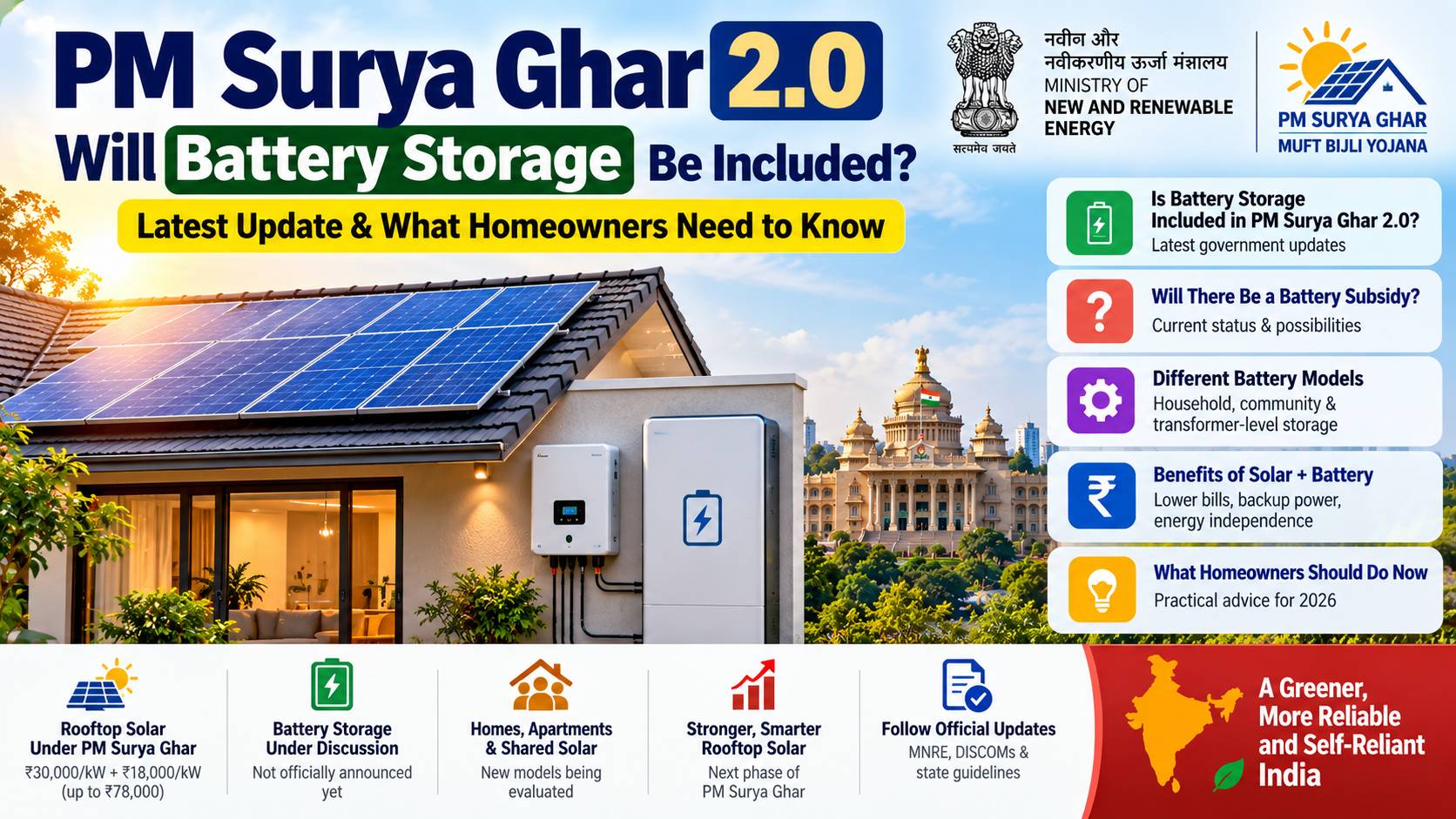
As of September 30, 2026, there is no final government notification launching PM Surya Ghar 2.0 with a mandatory household-battery subsidy. However, battery energy storage is explicitly being discussed as part of the next phase, and the Union Minister for New and Renewable Energy said in June 2026 that battery storage would be integrated as storage costs decline.
This article explains what is confirmed, what is being proposed, what homeowners should do now, and what battery storage could mean for rooftop solar in India and Karnataka.
Quick Answer: Will PM Surya Ghar 2.0 Include Battery Storage?
Battery storage is being considered for the next phase of PM Surya Ghar, but the government has not yet announced a final PM Surya Ghar 2.0 battery-subsidy structure.
MNRE has held consultations on the next phase, with battery energy storage systems (BESS) among the issues being evaluated. Government discussions have included different possible deployment models, including household, neighbourhood-transformer and utility-level storage.
The important distinction is:
| Question | Current status |
|---|---|
| Has PM Surya Ghar 2.0 officially launched? | No final 2.0 framework announced yet |
| Is battery storage being considered? | Yes |
| Has household battery subsidy been officially announced? | No |
| Will every PM Surya Ghar system require a battery? | Not announced |
| Is battery integration being discussed by MNRE? | Yes |
| Can homeowners install solar + battery today? | Yes, subject to applicable technical/DISCOM requirements |
| Is the existing rooftop-solar CFA automatically applicable to batteries? | Do not assume so |
What Is PM Surya Ghar 2.0?
PM Surya Ghar 2.0 is currently best understood as a potential next phase/evolution of the PM Surya Ghar programme, rather than a fully notified new subsidy scheme.
The existing PM Surya Ghar: Muft Bijli Yojana was launched in February 2024 with an outlay of ₹75,021 crore and a target of supporting rooftop solar for 1 crore households. By July 2026, more than 39.7 lakh rooftop systems had been installed, benefiting more than 48 lakh households.
By September 2026, the government reported that the programme had crossed 50 lakh beneficiary households.
The next challenge is no longer simply getting more solar panels onto rooftops.
It is increasingly about:
- storing excess daytime solar
- using solar electricity after sunset
- managing peak demand
- improving grid stability
- maintaining rooftop systems
- improving installation quality
- supporting households without suitable rooftops
- integrating batteries with distributed solar
These issues are now part of the discussion around the next phase.
Why Is Battery Storage Becoming Important?
A rooftop solar system produces most of its electricity during daylight.
But household electricity consumption often continues into:
- evening
- night
- early morning
For example:
12 PM
Solar generation: ☀️ High
Household consumption: Moderate
3 PM
Solar generation: ☀️ High
Household consumption: Moderate
8 PM
Solar generation: ❌ Zero
Household consumption: 🔌 High
Without a battery, the homeowner needs to use the grid when solar generation is unavailable.
With a battery:
Daytime solar → battery charging → evening/night electricity
This is called solar energy shifting.
Why Is the Government Considering Batteries?
The government has already recognised energy storage as an important part of India’s renewable-energy expansion.
In June 2026, the Union Minister for New and Renewable Energy said that the government would look to integrate Battery Energy Storage Systems as storage costs decline.
In the subsequent PM Surya Ghar 2.0 discussions, MNRE and stakeholders examined battery storage alongside:
- grid integration
- DISCOM readiness
- financing
- asset performance
- quality assurance
- long-term maintenance
- consumer access
The government is also considering whether storage should sit at the household, neighbourhood-transformer or utility level rather than automatically putting a battery into every home.
That distinction is extremely important.
Is PM Surya Ghar Battery Subsidy Confirmed?
No.
There is currently no final national announcement confirming a universal household battery subsidy under PM Surya Ghar 2.0.
This is one of the most important facts homeowners should understand.
You will see headlines and industry expectations about:
“PM Surya Ghar 2.0 battery subsidy”
or
“PM Surya Ghar 2.0 may mandate battery storage.”
Those are discussions, expectations or proposals—not the same thing as an officially notified subsidy rule.
In September 2026, industry stakeholders were calling for storage incentives and regulatory clarity, while reporting that battery integration could increase upfront system costs and extend payback periods.
Could Battery Storage Become Mandatory?
There is currently no final rule making household battery storage mandatory under PM Surya Ghar 2.0.
The government is evaluating several possible models.
The current discussion is therefore more complicated than:
Solar panel + mandatory battery.
Possible approaches include:
Model 1 — Household Battery
Each participating household installs its own battery.
Solar → Home → Battery → Home at night
Model 2 — Community Battery
Several households share storage.
Multiple homes → shared battery → participating consumers
Model 3 — Transformer-Level Battery
A battery is installed around a distribution transformer.
This could help manage the local grid without requiring every household to own a battery.
Model 4 — Utility-Scale Storage
Large batteries are deployed at the grid/DISCOM level.
The government has specifically indicated that different storage locations need to be evaluated before determining the most suitable model.
What Is the Current PM Surya Ghar Subsidy?
The existing PM Surya Ghar scheme provides Central Financial Assistance (CFA) for residential rooftop solar systems.
The current structure provides:
- ₹30,000/kW for the first 2 kW
- ₹18,000/kW for the additional 1 kW
- Maximum central subsidy of ₹78,000
The existing programme is designed around rooftop solar generation rather than providing a universal separate household-battery subsidy. MNRE’s current rooftop-solar information confirms that CFA is provided to eligible residential electricity consumers for grid-connected rooftop solar.
Important
Do not calculate your battery purchase assuming that the ₹78,000 rooftop-solar CFA automatically pays for your battery.
That is not how the current scheme should be interpreted.
What Could a PM Surya Ghar 2.0 Battery Subsidy Look Like?
There is no confirmed amount yet.
Several possible structures could theoretically be considered:
Percentage subsidy
For example, government support could cover a percentage of eligible battery costs.
₹/kWh support
The government could provide an incentive based on battery capacity.
For example:
₹X per kWh × eligible battery capacity
Solar + battery package
Instead of separate solar and battery subsidies, the government could establish a combined system benchmark.
Performance-linked incentive
Support could potentially depend on measurable system performance or grid-support services.
DISCOM-managed battery
Instead of paying the consumer directly, a DISCOM could procure/manage storage and compensate participating households.
These are possible policy models, not announced PM Surya Ghar 2.0 rules.
Should You Wait for PM Surya Ghar 2.0 Before Installing Solar?
For a homeowner who needs rooftop solar today, waiting solely for a possible future battery subsidy is not a sound basis for making the decision.
The current PM Surya Ghar programme is already operational, and the government is continuing rooftop-solar deployment.
The right question is:
Do I actually need battery storage?
That depends on your electricity usage pattern.
Who Should Consider Solar + Battery?
Battery storage becomes particularly relevant for households that:
1. Experience frequent power cuts
A grid-connected solar system without a battery normally does not provide conventional backup during a grid outage.
A suitable hybrid/backup configuration can provide electricity during outages.
2. Consume a lot of electricity after sunset
For example:
- air conditioner
- refrigerator
- TV
- lighting
- computers
- water pump
- EV charging
3. Want greater energy independence
A battery can reduce dependence on grid electricity during non-solar hours.
4. Have high daytime solar surplus
Instead of exporting all excess solar electricity, some of it can be stored for later use.
5. Have an unreliable grid connection
Battery backup can become a practical reliability feature.
Who May Not Need a Battery?
A battery is not automatically necessary for every rooftop-solar customer.
A grid-connected solar system without storage can make sense for households that:
- consume substantial electricity during daylight
- have reliable grid supply
- want lower initial investment
- primarily want to reduce electricity bills
- do not require backup power
- can use net-metering/export arrangements effectively
The economics should therefore be calculated separately for:
Solar only
versus
Solar + battery
Solar vs Solar + Battery
| Feature | Solar Only | Solar + Battery |
|---|---|---|
| Daytime solar savings | ✅ | ✅ |
| Uses solar directly | ✅ | ✅ |
| Stores excess solar | ❌ | ✅ |
| Evening solar usage | Limited by grid arrangement | ✅ |
| Backup during outage | Normally no | ✅ with suitable configuration |
| Initial cost | Lower | Higher |
| Battery replacement | Not applicable | Required eventually |
| Maintenance | Lower | Higher |
| Energy independence | Moderate | Higher |
| Payback | Generally simpler | More complex |
The key point is that battery storage provides additional functionality but also adds cost.
Recent industry analysis specifically notes that integrating storage can increase upfront cost and lengthen payback.
What Battery Size Would a Home Need?
Battery size should be based on energy consumption, not simply solar-panel capacity.
For example:
5kW solar system
A homeowner might consider:
5 kWh battery
for limited evening backup,
or:
10 kWh battery
for greater energy shifting and backup.
But a 5kW solar system does not automatically require a 5kWh battery.
These are different measurements:
Solar capacity = kW
Battery storage = kWh
kW vs kWh: Simple Explanation
Solar panel capacity
Measured in:
kW
It describes the power-generating capacity of the solar system.
Battery capacity
Measured in:
kWh
It describes how much energy the battery can store.
For example:
5kW solar + 10kWh battery
means:
- Solar system power capacity = 5kW
- Battery energy storage capacity = 10kWh
How Does Solar + Battery Work?
A typical system works like this:
Morning
☀️ Solar begins generating
↓
Afternoon
☀️ Solar powers appliances
↓
Excess solar
🔋 Battery charges
↓
Evening
☀️ Solar generation falls
↓
🔋 Battery supplies stored energy
↓
Night
🌙 Grid supplies remaining demand after battery discharge
This is called energy shifting.
Will PM Surya Ghar 2.0 Help Apartment Residents?
This is another important potential change.
One challenge with rooftop solar is that many households:
- live in apartments
- don’t control the roof
- have insufficient rooftop area
- have multiple electricity connections
The government is examining group and virtual net-metering models as part of the next phase discussions.
This could potentially allow households without individual suitable rooftops to participate through shared solar arrangements.
However:
The detailed PM Surya Ghar 2.0 rules for this have not been finally notified.
What About Karnataka?
This development is particularly relevant for Karnataka.
Karnataka’s 2026 distributed-solar framework has expanded the regulatory framework for grid-connected distributed solar, including net metering and other settlement mechanisms.
For Karnataka homeowners, a future PM Surya Ghar 2.0 storage component would have to operate alongside:
- KERC regulations
- BESCOM procedures
- metering arrangements
- rooftop-solar technical requirements
- applicable central subsidy rules
Therefore, PM Surya Ghar 2.0 + Karnataka net metering will be an important topic to monitor.
You should not treat a national PM Surya Ghar announcement as automatically replacing Karnataka’s electricity regulations.
Why Battery Storage Could Change Rooftop Solar
The current rooftop-solar model is heavily focused on:
Generate → Consume → Export surplus
Storage changes the model to:
Generate → Consume → Store → Use later → Export remaining surplus
This can potentially reduce the amount of solar electricity exported during high-generation periods and increase consumption of solar electricity during evening hours.
At a system level, this can also help address the mismatch between:
solar generation timing
and
electricity demand timing.
India’s Battery Storage Push Is Bigger Than PM Surya Ghar
The battery discussion isn’t happening in isolation.
The Indian government has been developing broader energy-storage policies, including BESS procurement mechanisms, viability-gap funding and other measures.
The Central Electricity Authority has also projected significant battery-storage requirements as India’s renewable-energy capacity expands.
This means battery storage is likely to become increasingly important in India’s electricity system even beyond residential rooftop solar.
What Should Homeowners Do Right Now?
If you are installing solar in 2026:
Option 1: Solar without battery
Choose this approach when your primary objective is:
reduce electricity bills at the lowest initial cost.
Option 2: Solar + hybrid inverter + battery-ready architecture
This can be useful for homeowners who want the ability to add storage later.
Option 3: Solar + battery now
This is appropriate when:
- backup power is important
- evening consumption is high
- grid reliability is poor
- energy independence is a priority
The correct choice depends on the economics and your electricity-use pattern.
Don’t Make This Mistake
A common mistake is:
“PM Surya Ghar 2.0 will probably give battery subsidy, so I’ll buy a very expensive battery now.”
Don’t make a purchase decision based on an unannounced subsidy.
As of September 30, 2026:
Battery integration is under discussion.
A final household battery subsidy has not been announced.
Mandatory battery installation has not been announced.
That distinction should be kept clear in every solar-buying decision.
PM Surya Ghar 2.0 Latest Update — Timeline
February 2024
PM Surya Ghar: Muft Bijli Yojana launched with a ₹75,021 crore outlay and a target of one crore households.
June 2026
The Union Minister said the government would look toward integrating BESS as storage costs decline.
July 2026
The scheme had reached nearly 39.7 lakh rooftop systems and 48 lakh beneficiary households.
August 2026
MNRE consultations for the next phase included battery storage, maintenance, grid integration, financing and expansion to consumers without suitable rooftops.
September 2026
Industry stakeholders continued calling for storage integration and incentives under the potential next phase.
Current status — September 30, 2026
No final PM Surya Ghar 2.0 battery-subsidy framework has been announced.
Frequently Asked Questions
Is PM Surya Ghar 2.0 officially launched?
A final PM Surya Ghar 2.0 framework has not been officially notified as of September 30, 2026. The government is consulting stakeholders about the next phase.
Will PM Surya Ghar 2.0 include batteries?
Battery energy storage is being considered, but the final design has not been announced.
Will PM Surya Ghar 2.0 give a battery subsidy?
No battery subsidy amount has been officially announced yet.
Will batteries become compulsory?
No compulsory household-battery requirement has been officially announced.
Can I install a solar battery now?
Yes. Homeowners can install suitable solar-plus-storage systems today, subject to system design, safety and applicable electricity/DISCOM requirements.
Does the ₹78,000 PM Surya Ghar subsidy cover batteries?
Do not assume it does. The existing CFA is structured around eligible residential rooftop solar capacity, not as a universal separate battery subsidy.
Is solar without a battery still useful?
Yes. A grid-connected rooftop solar system can reduce electricity purchases without battery storage.
Is a battery worth buying with rooftop solar?
It depends on your electricity-consumption pattern, backup requirement, battery cost, grid reliability and the value of stored solar electricity. A battery should be evaluated separately from the rooftop-solar subsidy.
Will apartments benefit from PM Surya Ghar 2.0?
Potentially. Group and virtual net-metering models are among the concepts being examined for consumers without suitable individual rooftops, but final 2.0 rules have not been notified.
Final Verdict
PM Surya Ghar 2.0 is moving toward a more storage-oriented rooftop-solar model, but battery subsidy details are not final yet.
The clearest confirmed development is that battery energy storage has moved into the government’s policy discussion for the next phase. The Union Minister has already spoken about integrating BESS as storage costs decline, while MNRE consultations have examined household, transformer-level and utility-level storage models.
For homeowners, the practical takeaway is simple:
Don’t buy a battery because you expect a future subsidy. Decide based on your current backup requirement and electricity-use pattern, while choosing equipment that can support future storage where appropriate.
And for Karnataka homeowners, the eventual PM Surya Ghar 2.0 framework will need to be considered together with KERC’s 2026 distributed-solar rules and BESCOM’s rooftop-solar procedures.
Suggested internal links:
1 thought on “PM Surya Ghar 2.0: Will Battery Storage Be Included? Latest Update”