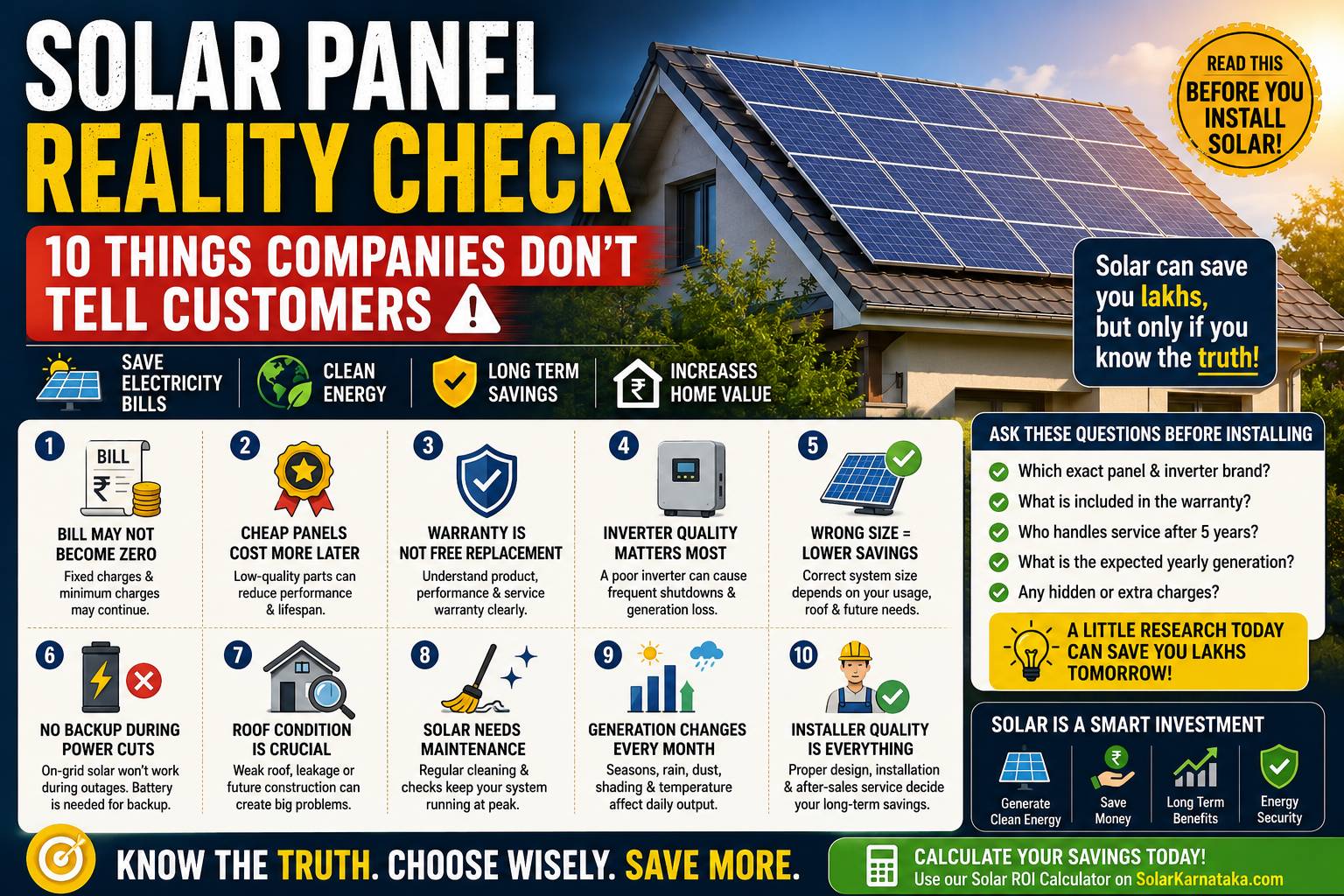
Planning Rooftop Solar? Read This Before Spending ₹1–5 Lakh
Rooftop solar is becoming one of the fastest-growing home investments in India.
With rising electricity bills, government subsidy schemes, EV adoption, and increasing awareness about renewable energy, thousands of homeowners are considering installing solar panels.
Solar can genuinely help families:
✅ reduce electricity bills
✅ generate clean energy
✅ protect against future electricity price increases
✅ achieve long-term savings
But there is another side that many customers discover only after installation.
Solar panels are a 25-year investment — and choosing the wrong system, installer, or design can reduce your savings.
Here are 10 important solar panel realities every customer should know before installation.
1. Your Electricity Bill May Not Become Completely ₹0
One of the biggest misunderstandings is:
“Install solar and never pay electricity bills again.”
Reality:
A solar system can greatly reduce your bill, but a completely zero bill depends on:
- your electricity usage
- system size
- seasonal generation
- net metering rules
- fixed electricity charges
Even after solar installation, many customers may still pay:
- fixed charges
- minimum charges
- additional grid-related fees
Solar reduces energy cost, but it does not always eliminate every charge.
Example:
Before solar:
Monthly bill:
₹5,000
After correct solar installation:
Possible reduction:
₹500–₹1000 remaining charges
(actual results depend on state policies and usage)
2. Cheap Solar Panels Can Become Expensive Later
Many customers compare only price:
Installer A:
₹1.8 lakh
Installer B:
₹1.5 lakh
The cheaper option looks attractive.
But hidden differences may include:
❌ lower-quality panels
❌ cheaper inverter
❌ weak mounting structure
❌ poor wiring
❌ limited service support
A rooftop solar system faces:
- extreme heat
- heavy rain
- wind
- dust
for 20–25 years.
Saving ₹20,000 today could reduce lakhs of rupees of future generation.
3. Solar Panel Warranty Does Not Mean Free Replacement Always
Many advertisements say:
“25 Years Warranty”
Customers assume:
“If anything happens, company replaces everything.”
Reality:
Solar warranties have different parts:
Product Warranty
Covers manufacturing defects.
Usually shorter.
Performance Warranty
Means panels should produce a certain percentage of power after many years.
It does not mean the company replaces panels for every problem.
Always check:
- product warranty
- inverter warranty
- service conditions
- labour charges
before buying.
4. Inverter Quality Matters More Than Many People Think
Customers focus mainly on:
“Which solar panel brand?”
But the inverter is the brain of your solar system.
The inverter:
- converts solar energy
- manages generation
- monitors performance
- protects the system
A poor inverter can cause:
❌ frequent shutdowns
❌ generation loss
❌ maintenance problems
Good panels + bad inverter = poor experience.
5. Wrong Solar Size Reduces Your Savings
Many people ask:
“How many kW should I install?”
The answer is not the same for everyone.
A good installer should check:
- last 12 months electricity bills
- daytime usage
- roof space
- future requirements
Example:
Family A:
₹3000 bill → maybe 3kW system
Family B:
₹8000 bill + EV charging → maybe larger system
Oversizing or undersizing both reduce financial benefits.
6. Solar Does Not Automatically Work During Power Cuts
This surprises many customers.
They think:
“Sun is available, so solar should work when power goes.”
But normal on-grid solar shuts down during power cuts.
Why?
Safety reasons.
To get backup, you need:
- hybrid inverter
- battery storage
or
- off-grid solar system
Battery increases total cost.
On-Grid vs Hybrid Solar
| Feature | On-Grid | Hybrid |
|---|---|---|
| Lower cost | ✅ | ❌ |
| Net metering | ✅ | ✅ |
| Backup | ❌ | ✅ |
| Battery needed | ❌ | ✅ |
7. Your Roof Condition Matters
Solar panels last around 25 years.
But what about your roof?
Before installation check:
- waterproofing
- cracks
- roof strength
- future construction plans
Removing and reinstalling panels later costs extra money.
Prepare your roof first.
8. Solar Needs Maintenance
Solar is low maintenance.
But:
Low maintenance ≠ No maintenance.
You should check:
- dust accumulation
- bird droppings
- wiring condition
- inverter errors
- generation reports
Dirty panels can reduce output.
Regular cleaning helps maintain efficiency.
9. Actual Generation Changes Every Month
Many people expect the same electricity generation daily.
Solar output changes due to:
☀️ summer
🌧️ monsoon
☁️ cloudy days
🌫️ dust
🌳 shadows
Example:
March–May:
Higher generation
Monsoon:
Lower generation
Annual average matters more than daily output.
10. Installer Quality Is More Important Than Marketing
A solar system is not just panels.
Installation quality decides long-term performance.
Before choosing a company, check:
✅ previous installations
✅ customer reviews
✅ after-sales service
✅ component brands
✅ certifications
A professional installation includes:
- proper structure
- correct wiring
- safety devices
- monitoring setup
Bonus: Questions You Must Ask Before Installing Solar
Before paying advance, ask:
1.
Which exact panel brand and model?
2.
Which inverter brand?
3.
What is included in warranty?
4.
Who handles service after 5 years?
5.
Expected yearly generation?
6.
What happens during roof leakage?
7.
Any additional charges?
Is Rooftop Solar Still Worth It in 2026?
Yes.
For many Indian homes, solar remains a strong investment because:
- electricity prices are increasing
- subsidies reduce upfront cost
- panels have long life
- technology is improving
But the biggest mistake is:
❌ Buying the cheapest quotation
Instead focus on:
✅ correct design
✅ quality components
✅ reliable installer
Who Should Install Solar?
Solar is especially suitable if:
✔ Monthly bill above ₹2000–₹3000
✔ Own house
✔ Good rooftop space
✔ Long-term stay planned
✔ High daytime usage
Who Should Think Carefully?
Solar may not be ideal if:
- you live in a rented house
- heavy roof shading exists
- planning demolition soon
- very low electricity usage
Future of Rooftop Solar
The next generation of solar homes will combine:
☀️ Solar Panels
🔋 Battery Storage
🚗 EV Charging
🤖 Smart Energy Management
Future homes may not just consume electricity — they may manage and produce their own power.
Solar Savings Calculator
Before installing solar, calculate:
- Required system size
- Approx investment
- Subsidy
- Payback period
- 25-year savings
Related Articles
Also Read:
- Solar ROI Calculator India 2026
- Solar Panel Price in Karnataka
- Solar for ₹3000 Electricity Bill
- Solar for ₹5000 Electricity Bill
- Solar + EV Setup Cost Explained
- Best Solar Battery for Home
FAQs
Does solar completely remove electricity bills?
Not always. It can significantly reduce bills, but fixed charges may remain.
How long do solar panels last?
Most quality panels are designed for around 25 years of operation.
Do solar panels work in rain?
Yes, but generation reduces during cloudy conditions.
Is the cheapest solar quotation best?
Not necessarily. Component quality and installation are extremely important.
Does rooftop solar need batteries?
For normal bill reduction, usually no. For backup during power cuts, batteries are required.
Final Verdict: Know the Truth Before Installing Solar
Solar power can be one of the smartest investments for homeowners.
But customers should understand the complete picture before spending money.
The best solar system is not the cheapest system.
It is the system that gives reliable electricity generation, good savings, and peace of mind for the next 25 years.
A little research before installation can protect your investment and maximize your solar benefits.