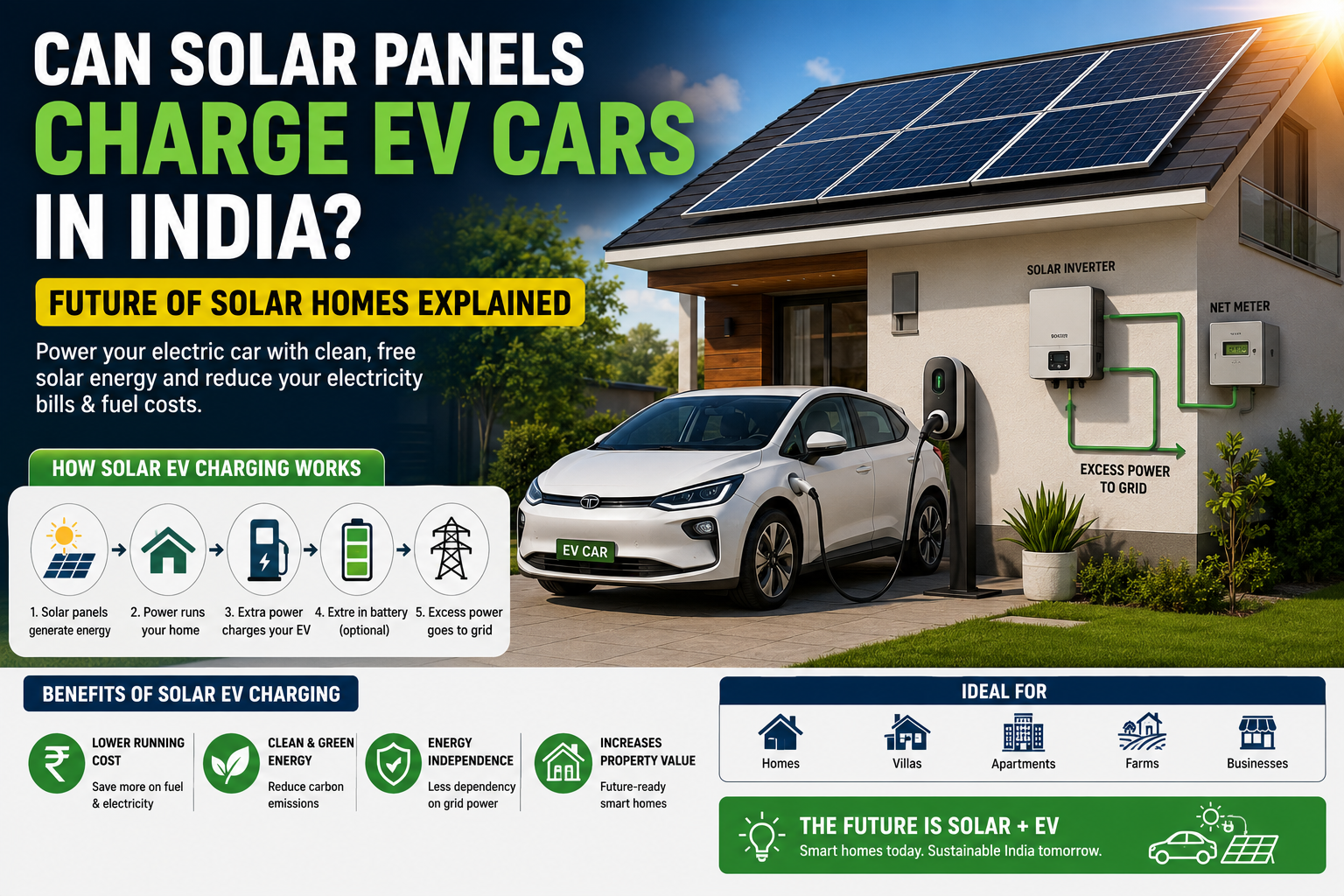
☀️🚗 The Future Indian Dream: A House That Powers Your Car and Reduces Electricity Bills
For decades, Indian families have accepted two unavoidable monthly expenses:
⛽ Petrol bill
⚡ Electricity bill
Every month, a middle-class family may spend thousands of rupees on:
- petrol for daily travel
- electricity for home appliances
- rising energy charges
But a new combination is changing this equation:
☀️ Rooftop Solar + 🚗 Electric Vehicle + 🔋 Smart Energy System
Many homeowners are now asking:
“Can I create a home where I don’t pay petrol bills and almost eliminate electricity bills?”
The answer:
✅ Yes, it is becoming possible.
A properly planned solar-powered home can:
- generate electricity from sunlight
- run home appliances
- charge electric vehicles
- reduce dependence on petrol and grid power
But how much money can it really save?
Let’s calculate the reality.
Why Solar + EV Combination Is Becoming Popular
Individually:
Solar saves electricity cost.
EV saves petrol cost.
Together:
Solar turns your rooftop into a personal fuel station.
Instead of:
Petrol Pump
⛽ → Car
Future homes use:
Sunlight ☀️
⬇️
Solar Panels
⬇️
EV Charger
⬇️
Electric Car 🚗
Petrol Car Cost Reality in India
Let’s take an average family example.
Daily driving:
40 km/day
Monthly driving:
1,200 km
Yearly driving:
14,400 km
Assume petrol car mileage:
15 km/litre
Petrol required yearly:
14,400 ÷ 15
= 960 litres
Petrol price assumption:
₹120/litre
Annual petrol cost:
960 × ₹120
= ₹1,15,200/year
10-Year Petrol Cost
₹1,15,200 × 10 years
= ₹11,52,000
That means many families may spend:
₹10–12 lakh only on fuel in 10 years.
(Actual depends on usage and fuel prices.)
EV Charging Cost Without Solar
Now compare with an electric vehicle.
Example EV efficiency:
Approx 7 km/unit
For 14,400 km:
Electricity needed:
≈ 2,050 units/year
Electricity rate:
₹8/unit
Annual charging cost:
2,050 × ₹8
≈ ₹16,400/year
10-Year EV Charging Cost
≈ ₹1.6 lakh
Compared with petrol:
Petrol:
₹11.5 lakh
EV electricity:
₹1.6 lakh
Difference:
Around ₹10 lakh possible fuel savings.
What Happens If You Add Solar?
Now comes the biggest advantage.
Solar can generate the electricity needed for:
- home usage
- EV charging
A rooftop solar system can reduce charging cost further.
Effectively:
☀️ Sunlight becomes your fuel source.
How Much Solar Needed for EV + Home?
Approx guide:
| Requirement | Solar Size |
|---|---|
| Small home | 3kW |
| Home + scooter EV | 3–5kW |
| Home + electric car | 5–7kW |
| Large home + EV | 7–10kW |
Example: 5kW Solar Powered Home
A 5kW solar system can generate roughly:
20 units/day average (varies by location)
Monthly:
≈600 units
Yearly:
≈7,000 units+
Enough to support:
✔ lights
✔ fans
✔ refrigerator
✔ appliances
✔ EV charging needs
depending on consumption.
Cost of Solar + EV Setup India 2026
Approximate:
5kW Rooftop Solar
₹2.5 lakh – ₹4 lakh
(after subsidy cost varies)
Home EV Charger
₹20,000 – ₹70,000
Optional Battery Storage
₹1 lakh+
Basic solar + EV ready home:
Approx:
₹3–5 lakh investment range
(depends on brands and system design)
10-Year Comparison: Petrol vs Solar EV Lifestyle
| Expense | Petrol Car | Solar + EV |
|---|---|---|
| Fuel source | Petrol | Sunlight |
| Fuel cost | Very high | Very low |
| 10-year fuel expense | ₹10L+ possible | Minimal |
| Home electricity saving | No | Yes |
| Maintenance | Higher | Lower |
Can Solar Completely Remove Electricity Bills?
Sometimes yes.
But depends on:
- system size
- electricity usage
- net metering
- state rules
- EV charging timing
Many homeowners still pay:
- fixed charges
- minimum charges
So realistic goal:
80–95% bill reduction
rather than assuming absolute zero.
Best Charging Method for Solar EV Homes
Daytime Charging
Best option:
☀️ Solar → EV directly
Highest savings.
Night Charging
Needs either:
- grid electricity
- battery storage
Battery increases investment.
Solar EV vs Petrol: Maintenance Savings
Petrol vehicles have:
❌ engine oil
❌ filters
❌ exhaust system
❌ more moving parts
EVs generally have:
✅ fewer moving parts
✅ lower routine maintenance
This adds extra long-term savings.
Future Home Energy Model
The future smart home may look like:
☀️ Solar Roof
+
🔋 Home Battery
+
🚗 EV Charger
+
🤖 AI Energy Management
AI systems can automatically:
- charge cars when solar output is highest
- reduce peak electricity usage
- optimize battery storage
Is Solar EV Practical in Apartments?
Increasingly yes.
Future apartments may use:
- common rooftop solar
- shared EV charging
- group net metering
- smart charging systems
This could become a major trend in cities like:
- Bengaluru
- Mysuru
- Hyderabad
- Pune
Who Benefits Most?
Solar EV combination works best for:
✅ Own house owners
✅ Daily car users
✅ ₹3000+ electricity bills
✅ EV buyers
✅ Long-term planners
Who Should Calculate Carefully?
May not suit:
❌ rented homes
❌ very low driving users
❌ heavily shaded rooftops
❌ short-term ownership plans
Solar + EV Savings Calculator
Before investing calculate:
✔ solar system size
✔ electricity savings
✔ fuel savings
✔ payback period
✔ 10-year benefits
👉 ADD SOLAR ROI CALCULATOR HERE
FAQs
Can solar panels charge an electric car?
Yes. A correctly sized rooftop solar system can generate electricity used for EV charging.
How many solar panels are needed for an EV?
It depends on driving distance. Many homes consider around 5kW systems for combined home + EV usage.
Can solar remove petrol expenses?
Solar cannot change existing petrol cars, but combining solar with an EV can significantly reduce fuel expenses.
Is solar EV charging free?
Sunlight is free, but equipment investment and maintenance costs should be considered.
Can solar charge EV at night?
Only if battery storage is available. Otherwise nighttime charging usually uses grid electricity.
Final Verdict: Is Solar + EV the Future?
For many Indian families, the biggest expenses after housing are:
⚡ electricity
⛽ transportation fuel
Solar + EV attacks both together.
A family shifting from petrol to EV and generating electricity from rooftop solar could potentially save lakhs of rupees over a decade.
The future may not be:
“Find the cheapest petrol pump.”
It may become:
“Generate your own fuel at home.”
☀️ Your rooftop becomes your energy source.
🚗 Your EV becomes your transportation.
🏠 Your home becomes your personal power station.