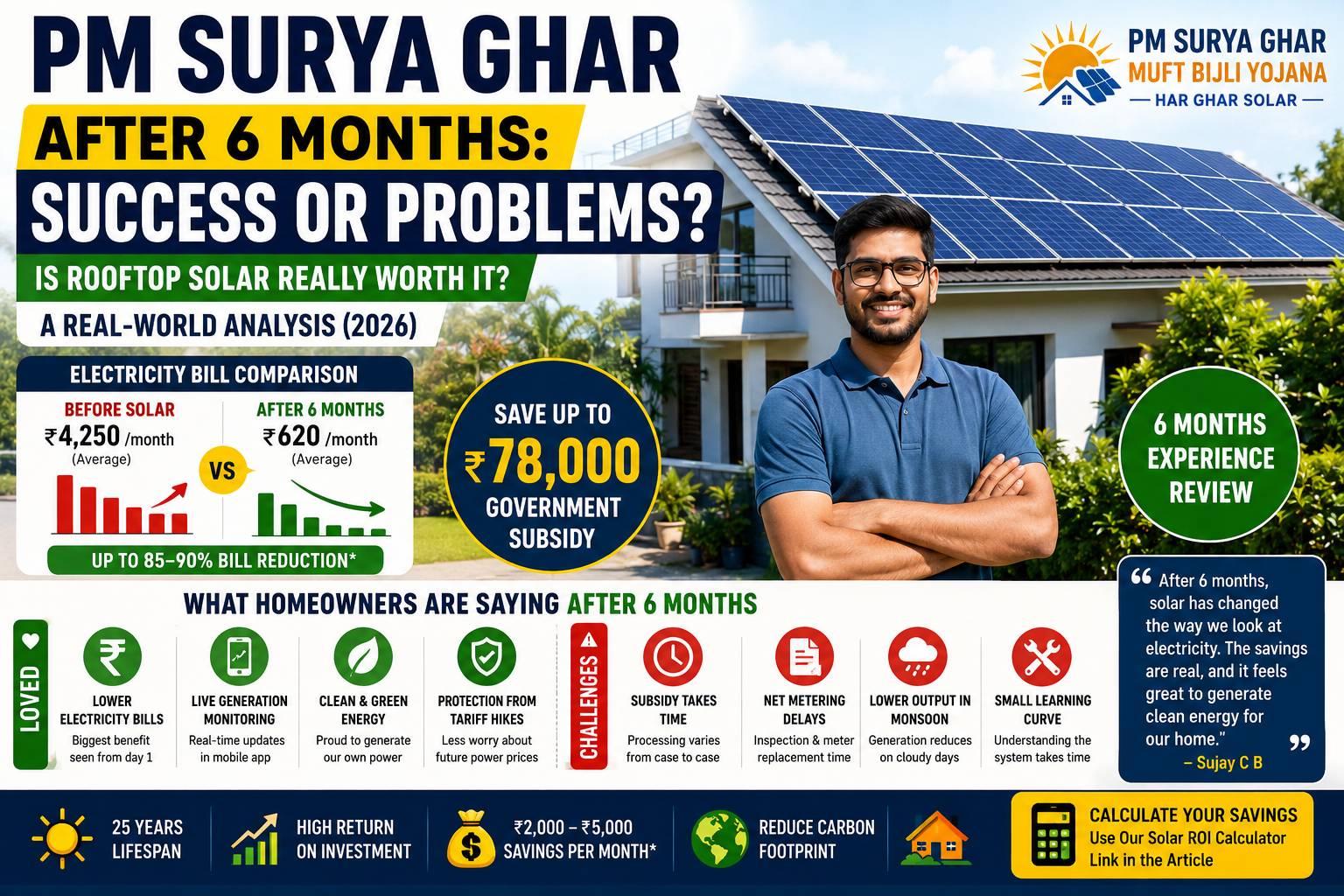
🏡 Six Months Later… Was Installing Rooftop Solar the Right Decision?
Since the launch of the PM Surya Ghar: Muft Bijli Yojana, millions of Indian homeowners have shown interest in installing rooftop solar. The scheme, which offers subsidies of up to ₹78,000 for eligible residential systems, has made solar more affordable than ever.
But after the excitement of installation, an important question remains:
What is it really like to live with rooftop solar after six months?
Does your electricity bill really reduce?
Is the subsidy process smooth?
Does solar work during monsoon?
Are there any hidden maintenance costs?
This article brings together real-world experiences reported by homeowners, installer feedback, public information, and industry observations to help you understand what life with rooftop solar looks like after six months.
Quick Answer
Is PM Surya Ghar Worth It?
For most homeowners:
Yes, if you:
- Own your house
- Have a shadow-free rooftop
- Pay more than ₹2,000–₹3,000 in monthly electricity bills
- Plan to stay in the home for several years
The biggest benefits usually come from long-term electricity savings rather than instant financial returns.
Before Installation vs After Six Months
| Before Solar | After 6 Months |
|---|---|
| High electricity bills | Bills often reduce significantly depending on system size and usage |
| No control over tariff hikes | Greater protection from future tariff increases |
| Dependent only on grid power | Part of electricity comes from your rooftop |
| No energy monitoring | Most modern systems include mobile monitoring apps |
| No renewable energy | Clean electricity generation every sunny day |
What Homeowners Usually Like After Six Months
1. Lower Electricity Bills
This is the biggest benefit.
Most homeowners notice the difference from the very first billing cycle after commissioning.
For example:
Monthly bill before solar:
₹4,000
After properly sized rooftop solar:
May reduce substantially depending on:
- daytime consumption
- system capacity
- net metering
- seasonal generation
Remember:
Every home is different.
2. Watching Solar Generation Becomes Surprisingly Enjoyable
Most modern systems include a mobile monitoring application.
Homeowners can see:
- today’s generation
- monthly production
- yearly savings
- environmental impact
Many people report checking their solar app almost every day during the first few months.
3. Greater Awareness of Electricity Usage
One interesting behaviour change:
People begin shifting electricity use to daytime.
Examples:
- washing machine
- water heater
- dishwasher
- EV charging
Using appliances while solar panels are generating electricity increases self-consumption and improves savings.
4. Relief During Rising Electricity Tariffs
Electricity prices rarely move downward over the long term.
Solar gives homeowners greater confidence because a significant portion of electricity now comes from their own roof.
Many describe this as:
“Feeling less dependent on future electricity price increases.”
Common Challenges Homeowners Report
Solar is not completely problem-free.
Understanding these challenges helps set realistic expectations.
1. Subsidy Processing Takes Time
One of the most discussed topics is:
“When will I receive my subsidy?”
Although many applicants receive subsidies successfully, timelines vary depending on:
- document verification
- installation completion
- DISCOM processing
- bank verification
Patience is often required.
2. Net Metering Delays
Some homeowners experience waiting periods before:
- inspection
- meter replacement
- final commissioning
Without net metering, the full financial benefit may not begin immediately.
3. Lower Generation During Monsoon
This surprises many first-time owners.
During heavy monsoon:
Generation decreases because sunlight is reduced.
However:
Solar panels continue generating electricity from available daylight.
Annual production—not one rainy month—is what determines overall savings.
4. Small Learning Curve
New users often need to understand:
- inverter displays
- monitoring applications
- generation reports
- billing adjustments
Within a few weeks most homeowners become comfortable.
Does Solar Need Maintenance After Six Months?
Very little.
Typical maintenance includes:
✔ Checking the monitoring app
✔ Cleaning panels when dust accumulates
✔ Inspecting for leaves or bird droppings
✔ Looking for warning lights on the inverter
Professional servicing is generally minimal during the first few years if the system is installed correctly.
Biggest Surprise for New Solar Owners
Many people assume:
“Solar panels need strong heat.”
Actually:
Solar panels need sunlight—not high temperatures.
Cloudy weather reduces production because less sunlight reaches the panels, not because temperatures are cooler.
Does Solar Work During Power Cuts?
This remains one of the biggest misconceptions.
Standard on-grid rooftop solar systems automatically shut down during power cuts for safety reasons.
If uninterrupted backup is important, homeowners need:
- Hybrid inverter
- Battery storage
Is the Subsidy Worth the Effort?
For eligible homeowners, the subsidy can significantly reduce the initial investment.
However:
The biggest financial benefit comes from 25 years of electricity savings, not just the subsidy amount.
Think of the subsidy as reducing your entry cost.
Your long-term savings come from decades of solar generation.
Financial Reality After Six Months
Many people ask:
“Have I recovered my investment?”
Usually:
No.
Solar is not designed to recover its cost within six months.
Typical residential systems recover their investment over several years depending on:
- electricity tariff
- system size
- subsidy
- consumption pattern
After the payback period, electricity savings continue for many more years.
What Homeowners Wish They Knew Earlier
Based on common feedback:
Choose the installer carefully.
Installation quality matters more than aggressive marketing.
Don’t buy the cheapest quotation.
Lower-quality components may reduce long-term performance.
Size the system properly.
Too small:
Limited savings.
Too large:
Lower financial efficiency if excess generation cannot be used effectively.
Understand net metering.
It plays a major role in maximizing savings.
Plan for future electricity usage.
If you expect to buy:
- EV
- air conditioners
- induction cooking
discuss future load with your installer.
Is PM Surya Ghar Good for Karnataka?
For many Karnataka homeowners:
Yes.
Reasons include:
- Good annual sunshine
- Increasing electricity demand
- Strong rooftop solar potential
- Growing EV adoption
- Suitable climate for solar generation
Monsoon reduces output temporarily but annual generation remains attractive for many locations.
Who Should Install Rooftop Solar?
Ideal candidates:
✔ Own independent house
✔ Monthly electricity bill above ₹2,500
✔ Roof receives sunlight for most of the day
✔ Long-term residence planned
✔ Interested in reducing future electricity costs
Who Should Wait?
You may want to evaluate carefully if:
- You live in a rented property
- Roof has significant shade
- Planning major renovation
- Electricity usage is extremely low
Frequently Asked Questions
Does PM Surya Ghar really reduce electricity bills?
Yes. A properly designed system can significantly reduce grid electricity consumption, although savings vary by household and system size.
How long does subsidy take?
Processing time varies depending on documentation, inspections, and DISCOM procedures.
Does rooftop solar work during monsoon?
Yes. Output decreases during cloudy weather but panels continue generating electricity.
Can rooftop solar work during power cuts?
Not with a standard on-grid system. Battery-backed hybrid systems are required for backup.
Is rooftop solar still worth installing in 2026?
For many homeowners with moderate to high electricity bills and a suitable roof, rooftop solar remains a strong long-term investment.
Check Your Own Solar Savings
Before installing rooftop solar, calculate:
- Recommended system size
- Estimated installation cost
- Government subsidy
- Monthly electricity savings
- Payback period
- 25-year financial benefit
👉 Add your Solar ROI Calculator here
Related Articles
- Solar ROI Calculator India (2026)
- Solar Panel Reality Check: 10 Things Companies Don’t Tell Customers
- Solar During Monsoon Karnataka
- Solar + EV Setup Cost Explained
- Solar Battery vs Generator
- Can Farmers Earn Passive Income from Solar Power?
Final Verdict
Six months is enough time to understand what rooftop solar is really like—but not enough to judge its complete financial value.
The biggest lesson from real-world experiences is that solar is a long-term investment, not a quick-return product.
Homeowners who install a properly sized system with quality components and a reliable installer generally appreciate:
- Lower electricity bills
- Better awareness of energy consumption
- Protection against future tariff increases
- Clean energy generation from their own rooftop
There can be delays related to subsidy processing, net metering, or seasonal performance, but these are usually temporary compared with the 25-year lifespan of a quality solar system.
For many Indian households—especially those with consistent electricity usage and a suitable rooftop—PM Surya Ghar has made rooftop solar more accessible than ever, turning sunlight into a long-term household asset rather than just an environmental choice.