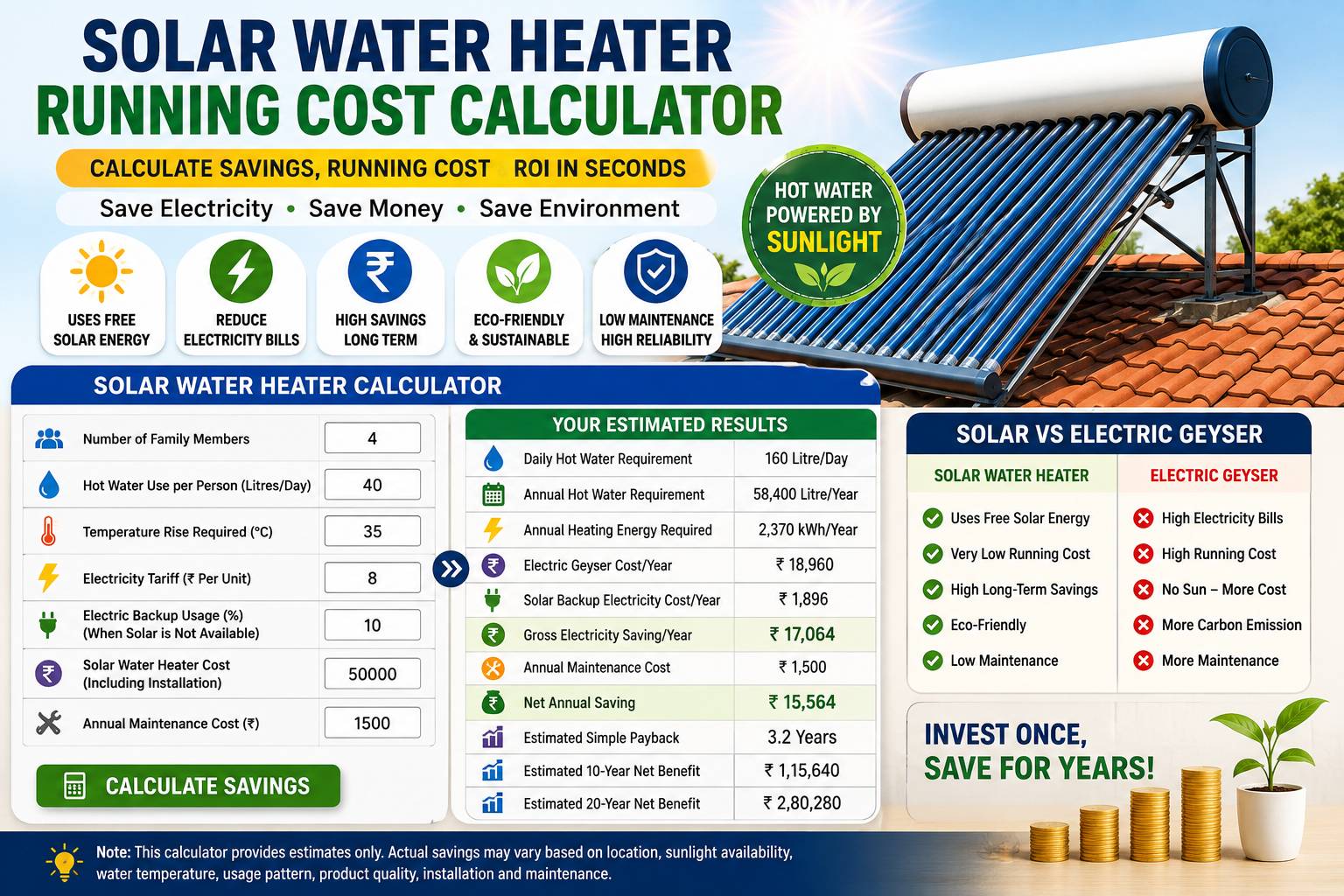
How much does a solar water heater actually cost to run in India?
Is it really “free hot water,” or are there hidden expenses such as electric backup, maintenance, hard-water scaling and replacement parts?
The answer is more nuanced than simply saying “solar water heaters have zero running cost.”
A solar water heater uses sunlight as its primary energy source, so its day-to-day heating energy cost can be extremely low. However, a household may still spend money on maintenance, plumbing, cleaning, circulation pumps in some systems, and electricity when an electric backup is used during cloudy or rainy periods.
The Ministry of New and Renewable Energy (MNRE) describes solar water heaters as a mature solar-thermal technology that uses the sun’s free energy to provide hot water and can produce significant electricity-bill savings. MNRE says 100–500 LPD systems are suitable for domestic use.
This guide gives you a practical Solar Water Heater Running Cost Calculator that lets you estimate:
- Monthly electricity cost
- Annual running cost
- Electricity saved
- Annual savings
- Solar water heater payback period
- 10-year savings
- 20-year savings
- Effect of electric backup
- Comparison with an electric geyser
🔥 Solar Water Heater Running Cost Calculator
Use the calculator below to estimate the economics of your own home.
Enter:
1. Family size: Number of people
2. Daily hot-water use: Litres per person
3. Electricity tariff: ₹/unit
4. Electric backup usage: % of hot-water heating supplied by electricity
5. Solar water heater price: ₹
6. Annual maintenance: ₹
☀️ Solar Water Heater Running Cost Calculator
Calculate electricity savings, running cost and payback period
Energy required to heat water is estimated using Q = m × Cp × ΔT. The calculator assumes water has a specific heat capacity of approximately 4.186 kJ/kg°C and 1 litre of water ≈ 1 kg. It then estimates the electricity cost if the same water were heated electrically and compares it with the specified electric-backup percentage of the solar system.
⚠️ Important
The calculator is an estimate, not a guarantee. It uses the physics-based heat requirement for water and assumes a temperature rise of approximately 35°C. Real-world solar water heater performance varies with location, season, collector type, tank insulation, water temperature, shading and user behaviour.
For a published calculator, it is better to allow readers to enter their own electricity tariff rather than hard-code a single national electricity price.
What Is the Running Cost of a Solar Water Heater?
The answer depends on what you mean by "running cost."
A solar water heater doesn't normally consume electricity to collect solar heat.
Its costs can include:
☀️ Solar energy
₹0
The sunlight used to heat water is free.
⚡ Electric backup
Variable
If the system has an electric backup and the backup is used during cloudy weather, additional electricity is consumed.
🔧 Maintenance
Variable
Cleaning, plumbing inspection, replacement components and servicing may create annual expenses.
💧 Water treatment
Variable
Hard-water conditions can increase maintenance requirements.
🚿 Plumbing
Occasional repair or replacement may be required.
Therefore:
A solar water heater is not necessarily zero-cost to operate, but its primary heating energy is free.
How Does a Solar Water Heater Save Electricity?
The basic principle is simple.
Electric geyser
Electricity → heating element → heat → hot water
Solar water heater
Sunlight → solar collector → heat → hot water
This is why solar water heating can dramatically reduce electricity used for hot-water production.
MNRE specifically identifies solar water heating as an application of solar thermal technology that uses the sun's free energy and can produce significant electricity-bill savings.
How Much Electricity Does an Electric Geyser Use?
The easiest way to understand the potential saving is to calculate how much energy is required to heat your water.
The basic relationship is:
Energy = Mass × Specific Heat × Temperature Rise
For water, the specific heat is approximately:
4.186 kJ/kg°C
Because approximately 1 litre of water has a mass close to 1 kg, heating:
100 litres
by:
35°C
requires approximately:
4.07 kWh
before accounting for system losses.
This means a household using large quantities of hot water can consume a substantial amount of electricity if all that water is heated by a resistance geyser.
Example: Family of Four
Suppose:
- 4 people
- 40 litres/person/day
- Total = 160 litres/day
- Temperature rise = 35°C
Approximate theoretical energy requirement:
160 × 4.186 × 35 ÷ 3600 ≈ 6.5 kWh/day
Annual theoretical requirement:
≈ 2,370 kWh/year
At an illustrative electricity tariff of ₹8/unit:
2,370 × ₹8 = approximately ₹18,960/year
This is an energy requirement estimate, not a prediction of your actual electricity bill. Actual geyser consumption will differ because of storage losses, heating efficiency, incoming water temperature, thermostat settings and usage patterns.
What Happens After Installing Solar?
Suppose the solar water heater provides most of the required heat.
The electric backup might only be required during:
- prolonged rain
- cloudy periods
- unusually high hot-water demand
- early morning use after insufficient solar heating
- system maintenance
If backup electricity supplies only 10% of the annual heat requirement in our example:
2,370 × 10% ≈ 237 units
At ₹8/unit:
≈ ₹1,896/year
The theoretical electricity saving compared with heating all the water electrically would therefore be roughly:
₹18,960 − ₹1,896 = ₹17,064/year
Then subtract annual maintenance to estimate net savings.
Again, this is an illustrative calculation rather than a guaranteed saving.
What Is the Running Cost of a 100 LPD Solar Water Heater?
LPD means Litres Per Day.
A 100 LPD system is designed around approximately 100 litres/day of hot-water production under specified conditions.
MNRE identifies 100–500 LPD solar water heaters as suitable for domestic applications.
For a small household, 100 LPD may be sufficient depending on actual hot-water consumption.
Typical running-cost structure
| Expense | Approximate nature |
|---|---|
| Solar heating energy | ₹0 |
| Electric backup | Variable |
| Cleaning | Periodic |
| Plumbing | Occasional |
| Maintenance | Variable |
| Replacement parts | Occasional |
The exact cost cannot be determined from capacity alone.
What Is the Running Cost of a 200 LPD Solar Water Heater?
A 200 LPD system is commonly considered for a medium-sized family, although actual sizing should be based on usage rather than family size alone.
A 200 LPD system does not automatically consume twice the electricity of a 100 LPD system.
Why?
Because the solar collector supplies the majority of the heating energy.
The relevant question is:
How much of the annual hot-water requirement must be supplied by the electric backup?
If solar provides almost all the required heat, electricity consumption can remain very low.
What Is the Running Cost of a 300 LPD Solar Water Heater?
A 300 LPD system is appropriate for higher hot-water demand.
It can be useful for:
- larger families
- villas
- multiple bathrooms
- guest houses
- small commercial properties
But installing a larger system than necessary can increase upfront cost without delivering proportional financial benefits.
Family Size Selector
Here's a practical starting point:
| Household | Starting Capacity to Evaluate |
|---|---|
| 1–2 people | 100 LPD |
| 3–4 people | 150–200 LPD |
| 5–6 people | 200–300 LPD |
| 7+ people | 300–500 LPD |
These are guidelines, not fixed rules.
Actual sizing should consider:
- litres used per person
- number of showers
- bucket bathing
- simultaneous usage
- bathrooms
- climate
- incoming water temperature
- desired hot-water temperature
MNRE's domestic category of 100–500 LPD provides a useful range for household systems.
Solar Water Heater vs Electric Geyser: Running Cost
| Factor | Electric Geyser | Solar Water Heater |
|---|---|---|
| Primary heating energy | Electricity | Sunlight |
| Electricity consumption | High | Low |
| Initial investment | Lower | Higher |
| Backup electricity | Not applicable | Sometimes required |
| Maintenance | Required | Required |
| Roof space | Not required | Required |
| Long-term energy cost | Higher | Lower |
| Monsoon performance | Unaffected by sunlight | Solar output may decrease |
| Backup required | Grid electricity | Optional electric backup |
| Long-term savings potential | Lower | Higher |
Is Solar Water Heater Running Cost Really Zero?
No—not literally.
This is one of the most important points for an AEO article.
A solar water heater can have near-zero solar heating energy cost, but the overall system can still incur:
- maintenance costs
- plumbing costs
- cleaning
- electric backup costs
- pump electricity in some installations
- component replacement
Therefore, the more accurate statement is:
Solar water heaters have very low operating energy costs because their primary heat source is free sunlight.
What About Electric Backup?
A hybrid solar water heater can be extremely practical in India.
During sunny weather:
Solar → hot water
During extended cloudy weather:
Electric backup → hot water
This avoids the major disadvantage of solar-only systems.
However, every unit of heat supplied by the electric backup adds to the electricity bill.
How Much Does Monsoon Increase Running Cost?
There is no fixed percentage.
It depends on:
- location
- rainfall
- number of cloudy days
- collector technology
- tank size
- insulation
- hot-water consumption
- backup settings
A household in Bengaluru may have a different annual backup requirement from one in coastal Karnataka or northern India.
This is why annual calculations are more meaningful than judging the system from one rainy month.
ETC vs FPC: Does It Affect Running Cost?
Yes.
Solar water heaters commonly use:
ETC — Evacuated Tube Collector
Advantages:
- Generally lower initial cost
- Good solar-heat collection
- Widely used in residential applications
FPC — Flat Plate Collector
Advantages:
- Robust construction
- Different durability characteristics
- Often considered for demanding applications
The choice should consider:
- local climate
- water quality
- installation conditions
- maintenance
- budget
- manufacturer specifications
India has standards covering both evacuated-tube and flat-plate solar water-heating systems. MNRE lists relevant BIS standards including IS 16544 for all-glass evacuated-tube systems and IS 12933 for flat-plate collectors.
Does Hard Water Increase Solar Water Heater Running Cost?
Potentially, yes.
Hard water can cause mineral deposits in:
- pipes
- tanks
- valves
- heat-transfer surfaces
The actual impact depends on system design and water chemistry.
If you live in a hard-water area, ask the installer:
- What maintenance is required?
- Is the tank suitable for the local water?
- What protection is provided?
- How often should the system be serviced?
- What parts are covered under warranty?
What Is the Annual Maintenance Cost?
There is no single India-wide fixed maintenance cost.
It depends on:
- system type
- location
- water quality
- plumbing
- collector design
- installation quality
- service provider
For a calculator, you should allow the user to enter their own annual maintenance estimate instead of claiming that every household will spend a specific amount.
That's exactly why the calculator above includes an "Annual Maintenance Cost" field.
Solar Water Heater ROI Calculator
The simplest payback calculation is:
Payback Period = Initial Investment ÷ Annual Net Savings
Where:
Annual Net Savings = Electricity Savings − Annual Operating/Maintenance Cost
Example
Suppose:
System + installation = ₹50,000
Annual electricity saving:
₹18,000
Annual maintenance:
₹1,500
Net annual saving:
₹16,500
Estimated simple payback:
₹50,000 ÷ ₹16,500 ≈ 3.0 years
After that, the system can continue generating savings, although actual long-term economics will depend on maintenance, component replacement, tariff changes and system performance.
What Happens After Payback?
This is where solar water heating becomes interesting.
Imagine:
Initial investment
₹50,000
Payback
Approximately 3–4 years
If the system continues operating for many more years, subsequent electricity savings represent the economic benefit after recovering the initial investment.
But don't assume all years are pure profit.
You may eventually need:
- replacement tubes
- plumbing repairs
- valves
- insulation
- other components
A proper ROI model should include these expenses.
10-Year Solar Water Heater Calculation
Let's use an illustrative example.
Initial investment:
₹50,000
Annual net saving:
₹16,500
10-year cumulative saving:
₹1,65,000
Subtract initial investment:
₹1,15,000 net benefit
This is a simplified calculation and does not account for inflation, tariff changes, financing costs, major component replacements or declining system performance.
20-Year Calculation
Using the same simplified assumptions:
₹16,500 × 20 = ₹3,30,000
Minus:
₹50,000 initial investment
Potential cumulative net benefit:
₹2,80,000
Again, this is an illustrative scenario, not a guaranteed return.
Why Your Actual Savings Could Be Higher or Lower
Your results can change dramatically depending on:
1. Electricity tariff
₹6/unit and ₹10/unit produce very different savings.
2. Hot-water consumption
A family using 250 litres/day has a different economic case from a household using 60 litres/day.
3. Incoming water temperature
Colder water requires more energy to reach the desired temperature.
4. Solar radiation
More useful solar radiation generally means greater solar contribution.
5. Collector efficiency
Different products perform differently.
6. Backup usage
More electric backup means higher electricity cost.
7. Installation quality
Poor orientation, shading or plumbing can reduce performance.
How to Make Your Solar Water Heater More Economical
☀️ 1. Avoid Shading
The collector should receive good sunlight.
Nearby:
- buildings
- trees
- water tanks
- walls
can reduce solar exposure.
🧭 2. Get the Orientation Right
Your installer should design the system appropriately for the location and roof.
🔧 3. Don't Oversize the System
A huge system isn't automatically better.
Size it according to actual demand.
💧 4. Manage Hard Water
Follow the manufacturer's maintenance recommendations.
⚡ 5. Use Electric Backup Strategically
Don't use electric backup when sufficient solar-heated water is available.
🧼 6. Maintain the Collectors
Dust and deposits can reduce performance.
Is Solar Water Heating Better Than Installing More Solar PV?
This is an interesting question.
Suppose you have a home with:
Option A
Solar PV panels generate electricity.
Then:
Electricity → geyser → heat
Option B
Solar thermal water heater:
Sunlight → collector → heat
For water heating specifically, solar thermal can be highly efficient because it directly converts solar radiation into heat instead of first converting sunlight into electricity and then electricity into heat.
However, solar PV has the advantage of being versatile: the electricity can power many household appliances.
Therefore, the best choice depends on the home's overall energy needs.
Solar Water Heater vs Heat Pump
Another increasingly important comparison is:
Solar Water Heater vs Heat Pump Water Heater
Solar water heater
Uses:
Sunlight → thermal energy
Heat pump
Uses:
Electricity → heat movement from ambient air → hot water
Heat pumps can be highly efficient, especially where consistent hot-water demand exists but rooftop solar thermal isn't practical.
A hybrid approach can also be considered in some homes.
Is a Solar Water Heater Worth It in Karnataka?
For many independent homes in Karnataka, it is worth evaluating because the state receives substantial solar resource and many households have suitable rooftops.
But the economics still depend on:
- electricity tariff
- family size
- hot-water demand
- roof orientation
- shading
- water quality
- installation cost
For a household that uses hot water every day, the potential electricity savings can be significant over several years.
Who Should Buy a Solar Water Heater?
Best suited for:
✅ Independent house owners
✅ Villas
✅ Families using hot water daily
✅ Homes with sunny rooftops
✅ High electricity-consuming households
✅ Long-term homeowners
Less suitable for:
❌ Renters
❌ Homes without suitable roof space
❌ Heavily shaded roofs
❌ Very low hot-water consumption
❌ People planning to move shortly
What Should You Check Before Buying?
Don't choose a solar water heater purely on price.
Check:
- Capacity in LPD
- Collector type
- Tank material
- Insulation
- Water-pressure compatibility
- Hard-water suitability
- Warranty
- Spare-parts availability
- Installer reputation
- Service network
- Electric backup option
- BIS/required standards compliance
MNRE publishes standards for solar water-heating systems and also provides access to information on BIS-approved manufacturers.
Frequently Asked Questions
What is the running cost of a solar water heater?
The primary solar heating energy has no fuel or electricity cost, because the system uses sunlight. However, total running expenses can include maintenance, plumbing, cleaning, pumps in some systems and electricity used by an electric backup.
Does a solar water heater consume electricity?
A basic thermosiphon solar water heater may require little or no electricity for the solar heating process. A system with an electric backup, circulation pump or other powered components can consume electricity.
How much electricity can a solar water heater save?
The saving depends on how much hot water your household uses and how much of that heat the solar system supplies. A household with high daily hot-water demand can potentially save substantially more than a household with low demand.
Is 100 LPD enough for a family of four?
It may be insufficient for some families of four. A 150–200 LPD system may be more appropriate depending on actual hot-water consumption. Capacity should be based on usage rather than family size alone.
Is 200 LPD enough for a family of four?
In many cases, 200 LPD can be a reasonable starting point for a four-person household, but actual requirements depend on bathing habits and daily hot-water consumption.
Does a solar water heater work during monsoon?
Yes, but solar heat production can decrease during extended cloudy or rainy periods. A system with electric backup can provide greater reliability.
What is cheaper: an electric geyser or solar water heater?
An electric geyser generally costs less initially. A solar water heater generally has much lower heating-energy costs and can become cheaper over the long term for households with regular hot-water consumption.
How long does a solar water heater take to pay for itself?
There is no universal payback period. It depends primarily on installation cost, electricity tariff, hot-water consumption, solar contribution and maintenance. Use the calculator above with your own numbers rather than relying on a generic payback claim.
Does a solar water heater work at night?
The collector doesn't generate heat at night, but the insulated storage tank can retain hot water for later use. Actual overnight temperature retention depends on tank insulation, ambient temperature and system design.
🚨 Don't Make This Solar Water Heater Buying Mistake
Many buyers ask:
"How much does a 200 LPD solar water heater cost?"
That's useful—but incomplete.
Ask these five questions instead:
- How much hot water does my family actually use?
- How much electricity am I currently spending to heat it?
- How much of that energy can solar realistically supply?
- How much will electric backup cost during low-sun periods?
- What is my 10-year total cost?
That calculation is much more useful than comparing product prices alone.
🧮 The Most Important Formula
For your own analysis:
Annual Electricity Cost Without Solar
= Annual electricity required for water heating × Electricity tariff
Annual Solar Backup Cost
= Annual electricity requirement × Backup percentage × Electricity tariff
Annual Electricity Saving
= Electricity cost without solar − Solar backup cost
Annual Net Saving
= Annual electricity saving − Maintenance cost
Simple Payback
= Solar system cost ÷ Annual net saving
This is the basic framework behind the calculator.
🏆 Final Verdict
Is a Solar Water Heater Really Cheap to Run?
Yes—when properly installed and correctly sized, a solar water heater can have a very low running cost because sunlight supplies the primary energy for heating water.
But don't call it completely free.
You may still have:
- maintenance
- plumbing
- cleaning
- component replacement
- electric backup during low-sun periods
The real financial advantage comes from replacing a recurring electricity expense with free solar thermal energy.
For a household that uses hot water every day, the long-term savings can be substantial.
And the best way to find out whether it makes financial sense for your home is not to trust a salesperson's generic savings claim.
Enter your own:
family size + hot-water consumption + electricity tariff + backup usage + system cost
into the calculator above.
That gives you a much more realistic estimate of your solar water heater running cost, annual electricity savings and payback period.
⚡ AEO Quick Answer
What is the running cost of a solar water heater in India?
A solar water heater has very low primary energy costs because it uses sunlight to heat water. However, the total running cost can include maintenance, cleaning, plumbing, pumps in some systems and electricity used for backup heating. MNRE states that solar water heaters use the sun's free energy and can provide significant electricity-bill savings; domestic systems of 100–500 LPD are suitable for household applications.
How much can a solar water heater save on electricity?
There is no fixed amount. Savings depend on daily hot-water consumption, electricity tariff, incoming water temperature, solar radiation, system efficiency and the amount of electric backup used. The most accurate approach is to calculate your household's annual hot-water energy requirement and compare it with your actual electricity tariff.
Is solar water heating better than an electric geyser?
For a homeowner with suitable roof space and regular hot-water demand, a solar water heater can be substantially cheaper to operate over the long term. An electric geyser generally has a lower upfront cost and provides more predictable heating regardless of sunlight, making it more practical for some apartments and rented homes.
What size solar water heater does a family need?
Domestic solar water heaters commonly range from 100 to 500 LPD, according to MNRE. The correct size depends on actual daily hot-water consumption rather than simply the number of family members.
Is a solar water heater completely maintenance-free?
No. Solar water heaters still require periodic inspection and maintenance. The frequency and cost depend on the system design, water quality, installation and local conditions.
Recommended internal links for SolarKarnataka.com
- 7 Hidden Costs of Electric Geysers Nobody Talks About
- Nuetech vs EMMVEE vs Racold vs V-Guard
- Solar Water Heater vs Heat Pump Water Heater
- Solar Water Heater During Monsoon in Karnataka