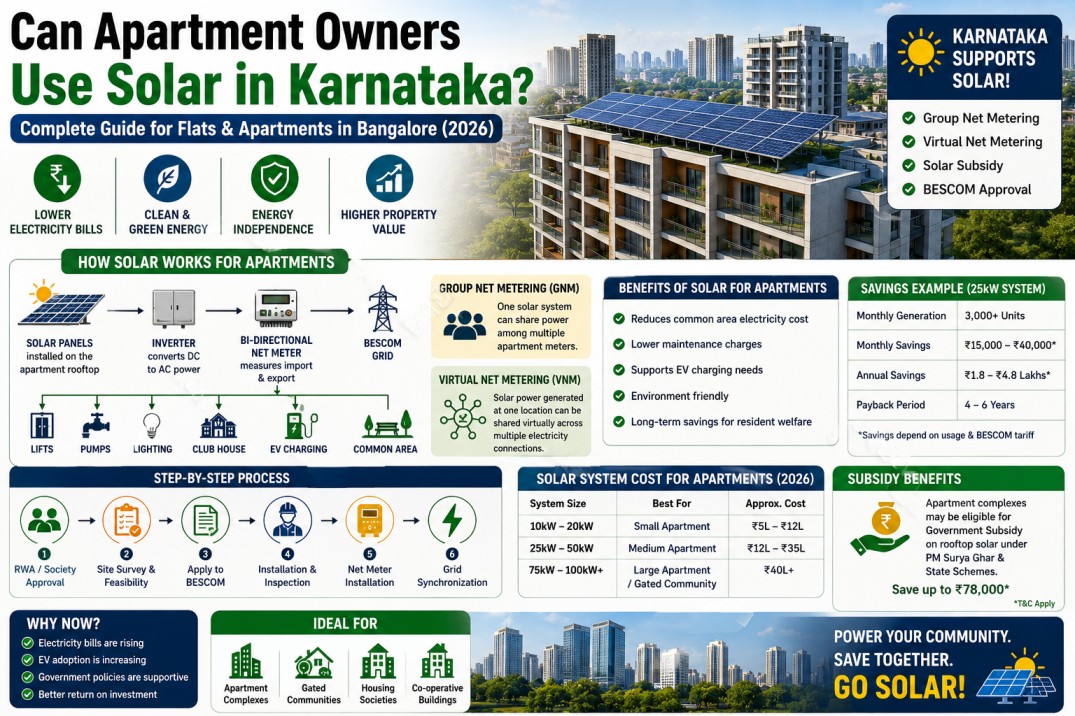
☀️ Can Apartment Owners Install Solar in Karnataka?
Yes — apartment owners and flat residents in Karnataka can now benefit from solar power, and recent policy changes have made it easier than ever.
For years, rooftop solar in India mainly focused on:
- independent houses
- villas
- factories
- commercial buildings
But now, with:
✅ Group Net Metering (GNM)
✅ Virtual Net Metering (VNM)
✅ Apartment solar subsidies
✅ BESCOM rooftop solar approvals
even apartment complexes in Bangalore and Karnataka can adopt solar systems more efficiently.
This is becoming a major trend because:
- BESCOM electricity bills are increasing
- apartment maintenance costs are rising
- EV charging demand is growing
- residents want long-term savings
🏢 Why Apartment Solar Was Difficult Earlier
Traditional rooftop solar systems work best when:
- one roof
- one owner
- one electricity meter
But apartment complexes usually have:
- multiple flats
- shared rooftops
- separate BESCOM meters
- limited roof area per resident
This created major billing and ownership complications.
⚡ What Changed in Karnataka?
Karnataka has now become one of India’s most progressive solar states.
The Karnataka Electricity Regulatory Commission (KERC) introduced:
👉 Virtual Net Metering (VNM)
👉 Group Net Metering (GNM)
under the new Distributed Solar PV (DSPV) reforms.
This is a BIG development for:
- apartments
- housing societies
- gated communities
- residential associations
🔋 What Is Group Net Metering (GNM)?
Group Net Metering allows:
👉 one solar system
to distribute electricity credits across:
👉 multiple electricity connections.
Example:
An apartment complex installs:
- 50kW rooftop solar system
The generated electricity can help offset:
- common area electricity bills
- lift usage
- corridor lighting
- water pumps
- even multiple apartment meters
🌞 What Is Virtual Net Metering (VNM)?
Virtual Net Metering is even more powerful.
It allows:
👉 solar power generated at one location
to be shared virtually across different electricity accounts.
This is extremely useful for:
- apartment residents
- people without enough rooftop space
- housing societies
Karnataka officially introduced VNM in 2025 reforms.
🏙 Why Solar for Apartments Is Growing Fast in Bangalore
Bangalore is seeing rapid apartment solar adoption because of:
⚡ 1. Rising BESCOM Electricity Bills
Electricity tariffs are increasing regularly.
Common apartment expenses now include:
- lifts
- water pumps
- basement lighting
- EV charging
- clubhouses
- security systems
Solar can reduce these recurring expenses significantly.
🚗 2. EV Charging Demand
More apartment residents now own:
- Tata Nexon EV
- MG ZS EV
- Ather
- Ola Electric scooters
This increases:
👉 electricity consumption inside apartment complexes.
🌞 3. Better Solar Policies
Karnataka now supports:
- Group Net Metering
- Virtual Net Metering
- flexible DSPV installation models.
💰 4. Long-Term Maintenance Savings
Apartment associations can reduce:
- maintenance costs
- diesel generator dependency
- common area electricity bills
🏠 Can Individual Flat Owners Install Solar?
This depends on:
- rooftop access rights
- apartment bylaws
- RWA approval
- roof availability
In most apartments:
👉 solar is installed collectively through the apartment association.
⚡ Best Solar Model for Apartments
✅ OPTION 1 — Common Area Solar (Most Popular)
Solar powers:
- lifts
- corridors
- water pumps
- parking lights
- clubhouses
Benefits:
✅ Lower maintenance charges
✅ Easier approval
✅ Faster ROI
✅ OPTION 2 — Group Net Metering
Solar credits shared across:
- multiple flat owners
Useful for:
- larger apartment complexes
✅ OPTION 3 — Virtual Net Metering
Best for:
- societies with limited roof space
- multiple connected accounts
💸 How Much Solar Can Apartments Install?
Approximate guideline:
| Apartment Size | Solar Capacity |
|---|---|
| Small apartment | 10kW–20kW |
| Medium society | 25kW–75kW |
| Large gated community | 100kW+ |
💰 Apartment Solar Cost in Bangalore (2026)
Approximate costs:
| System Size | Approx Cost |
|---|---|
| 10kW | ₹5L–₹7L |
| 25kW | ₹12L–₹16L |
| 50kW | ₹22L–₹35L |
| 100kW | ₹45L+ |
Costs depend on:
- panel quality
- rooftop structure
- inverter type
- battery usage
- installation complexity
🏦 Is Subsidy Available for Apartments?
Yes.
Apartment complexes and housing societies can apply for rooftop solar subsidy support for common-area installations.
Under PM Surya Ghar-related schemes:
- subsidy eligibility depends on system type
- RWA structure
- DISCOM approval
Residential subsidy for smaller systems can reach:
👉 up to ₹78,000.
⚡ How Much Can Apartments Save?
Savings depend on:
- electricity tariff
- system size
- common area consumption
Example Scenario
Medium Apartment Complex
| Parameter | Example |
|---|---|
| Solar System | 25kW |
| Monthly Generation | 3,000+ units |
| BESCOM Offset | Significant |
| Maintenance Savings | ₹15K–₹40K/month possible |
📈 Return on Investment (ROI)
Typical apartment solar payback:
| System | Payback Period |
|---|---|
| Common-area solar | 4–6 years |
| Larger apartment systems | 5–7 years |
Panels generally last:
👉 25+ years.
⚡ Step-by-Step Apartment Solar Process
✅ STEP 1 — Apartment Association Approval
RWA/apartment committee approval is usually required.
✅ STEP 2 — Site Feasibility Study
Vendor checks:
- roof area
- sunlight
- transformer capacity
- electricity usage
✅ STEP 3 — Choose Solar Vendor
Select experienced EPC companies familiar with:
- BESCOM
- apartment projects
- Karnataka solar policy
✅ STEP 4 — Apply for BESCOM Approval
Application submitted through:
👉 BESCOM rooftop solar process.
✅ STEP 5 — Net Meter Installation
Bi-directional net meter installed for:
- import/export tracking
✅ STEP 6 — Commissioning
System activated and synchronized with grid.
⚠️ Challenges Apartment Owners Should Know
❌ Limited Roof Space
Large apartments may not have enough roof area for all flats.
❌ Resident Disagreements
Some residents may:
- oppose investment
- question ROI
- disagree on billing
❌ Structural Approval
Older buildings may require:
- rooftop strength assessment
❌ BESCOM Delays
Sometimes:
- approval timelines
- transformer issues
- documentation delays occur
🚀 Future of Apartment Solar in Bangalore
Most experts believe:
👉 apartment solar adoption will increase massively over the next 5 years.
Reasons include:
- rising electricity tariffs
- EV charging demand
- smart home growth
- improved net metering
- AI energy management systems
🤖 Future Trend — Smart Solar Apartments
Future Bangalore apartments may include:
✅ Rooftop solar
✅ Shared battery storage
✅ AI energy optimization
✅ EV charging stations
✅ Smart energy dashboards
This creates:
- lower maintenance costs
- better energy independence
- reduced grid dependency
⚡ Check Your Apartment Solar Savings
Thinking about apartment solar?
👉 Use the calculator below to estimate:
- Solar system size
- Installation cost
- Subsidy amount
- Savings & ROI
🔢 Solar Subsidy & Savings Calculator
👉 ADD YOUR CALCULATOR HERE
(Paste your Solar Calculator code)
🔗 Related Articles
👉 Also read:
- Solar Panel Price in Bangalore
- Karnataka Solar Net Metering Explained
- Can Solar Panels Charge EV Cars in India?
- AI is Changing Solar in India
- Solar for ₹3000 Electricity Bill
- Solar for ₹5000 Electricity Bill
❓ FAQs
Can apartment residents install rooftop solar?
Yes, through apartment associations or group net metering systems.
Is subsidy available for apartment solar?
Yes, common-area apartment solar systems may qualify for subsidy support.
Can solar reduce apartment maintenance charges?
Yes, especially by reducing common-area electricity expenses.
Does BESCOM allow apartment solar?
Yes. Karnataka now supports VNM and GNM models for apartments.
🔥 Final Verdict
Apartment owners in Karnataka can absolutely benefit from solar power in 2026.
Thanks to:
- Group Net Metering
- Virtual Net Metering
- BESCOM rooftop solar policies
- improved subsidy support
solar is no longer limited to villas and independent houses.
As electricity prices rise and EV charging becomes common, apartment solar is likely to become one of the fastest-growing renewable energy segments in Bangalore and Karnataka.