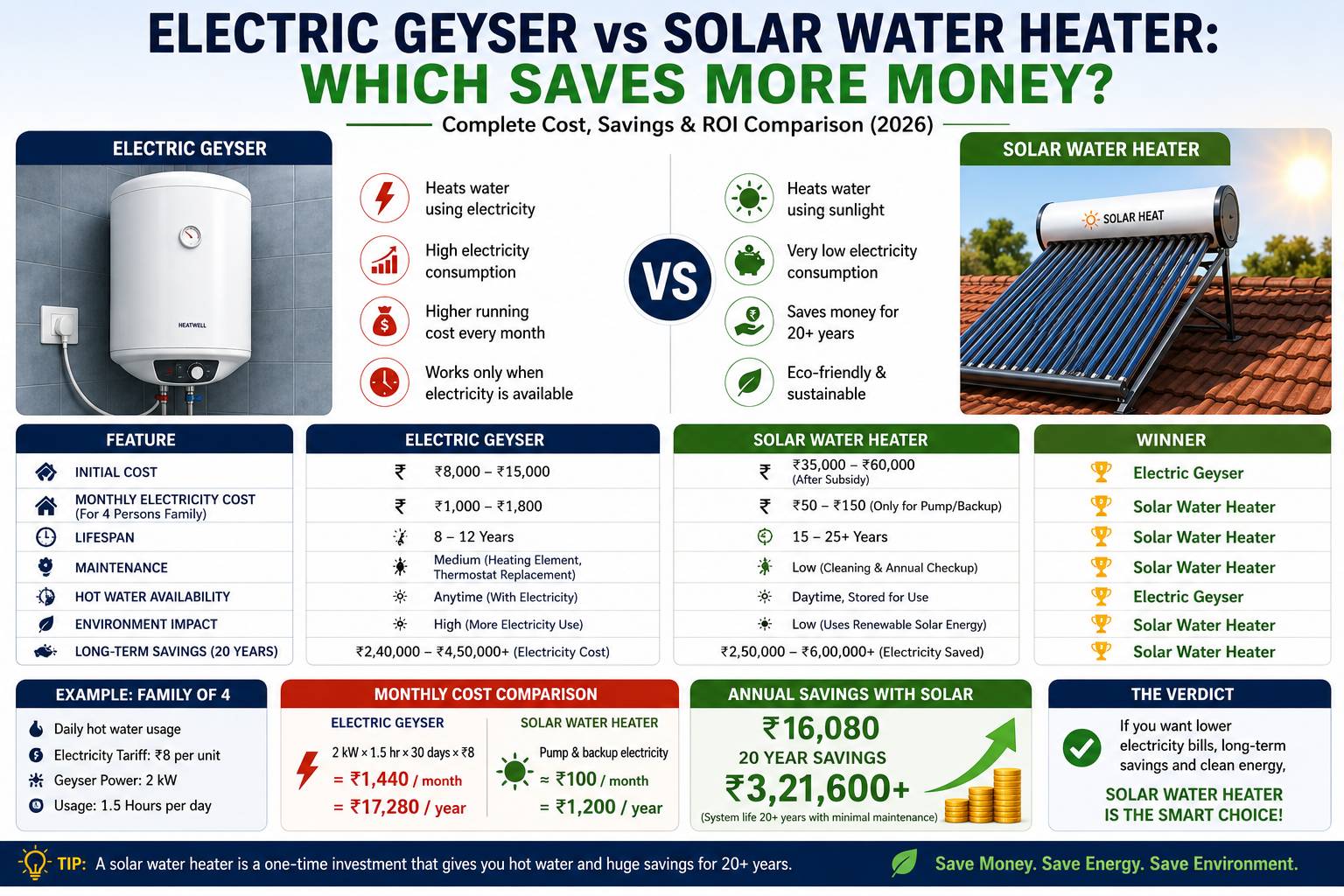
Can a solar water heater really save more money than an electric geyser?
If you’re planning to buy a water heating system for your home, this is probably your biggest question.
The short answer is:
Yes—for most Indian homeowners, a solar water heater can save significantly more money over its lifetime than an electric geyser, especially if you use hot water daily and have access to a sunny rooftop.
However, the right choice depends on your family’s hot water usage, location, roof availability, budget, and long-term plans.
This guide compares electric geysers vs solar water heaters in terms of cost, electricity consumption, maintenance, lifespan, return on investment (ROI), and long-term savings to help you make the best decision.
Quick Comparison
| Feature | Electric Geyser | Solar Water Heater |
|---|---|---|
| Initial Cost | Lower | Higher |
| Monthly Electricity Cost | High | Very Low |
| Hot Water Availability | Anytime with electricity | Daytime, stored for later use |
| Lifespan | 8–12 years | 15–25 years (or more with maintenance) |
| Maintenance | Moderate | Low |
| Running Cost | High | Minimal |
| Environmental Impact | Higher | Low |
| Best For | Apartments, renters | Independent homes |
Winner:
Solar Water Heater for long-term savings.
How Does an Electric Geyser Work?
An electric geyser heats water using an electric heating element.
Whenever you need hot water:
- Switch on the geyser
- Wait 10–20 minutes
- Electricity is consumed throughout the heating process
The more people in your home, the more electricity you typically use.
How Does a Solar Water Heater Work?
A solar water heater uses sunlight to heat water through solar collectors.
During the day:
- Sunlight heats the water.
- Hot water is stored in an insulated tank.
- The stored water remains warm for hours, depending on the system design and usage.
Because sunlight provides the primary energy, electricity consumption is much lower than with a conventional electric geyser.
Which Costs More to Buy?
Electric Geyser
Typical purchase cost:
- Lower upfront investment
- Installation is generally simple
Solar Water Heater
Upfront costs are higher because the system includes:
- Solar collectors
- Storage tank
- Mounting structure
- Plumbing
- Installation
Although the initial investment is larger, operating costs are much lower over the system’s lifetime.
Monthly Electricity Cost Comparison
Imagine a family of four using hot water every day.
Electric Geyser
Monthly electricity costs can become a noticeable part of the power bill, particularly during winter or in households with frequent hot water use.
Solar Water Heater
Electricity usage is minimal because sunlight provides most of the heating energy.
Many homeowners notice a meaningful reduction in electricity consumption after installing a properly sized solar water heater.
Which Saves More Money Over Time?
This is where the difference becomes significant.
Electric Geyser
Every year you continue paying for:
- Electricity
- Repairs
- Replacement after several years
The operating cost continues throughout the product’s life.
Solar Water Heater
Most of the expense occurs at the time of purchase.
After installation:
- Running costs remain low.
- Electricity savings accumulate year after year.
- The system continues providing value for many years.
Example: Family of Four
Assume:
- Daily hot water use
- Consistent usage throughout the year
- Properly sized solar water heater
Instead of paying for water heating every day with electricity, much of the required heat comes from sunlight.
Over the long term, the cumulative savings can exceed the higher initial purchase cost.
Electricity Bill Impact
Electric Geyser
Your monthly electricity bill includes the energy required to heat water.
Higher usage generally means higher costs.
Solar Water Heater
Water heating contributes much less to your electricity consumption because solar energy performs most of the work.
Which Is Better During Power Cuts?
Electric Geyser
No electricity usually means no hot water.
Solar Water Heater
Many thermosiphon systems can still provide stored hot water even during power outages, provided the water was heated earlier by sunlight.
Performance During Monsoon
Many buyers ask:
“Will a solar water heater work during cloudy weather?”
Yes.
Solar water heaters continue to produce hot water during cloudy conditions, although performance may be lower than on bright sunny days.
Many systems also include an optional electric backup for periods of extended rain.
Maintenance Comparison
Electric Geyser
Maintenance may include:
- Heating element replacement
- Thermostat replacement
- Scale removal
- Tank servicing
Solar Water Heater
Typical maintenance includes:
- Cleaning collectors
- Periodic inspection
- Checking insulation
- Addressing scale in hard-water areas where applicable
Overall maintenance requirements are generally low.
Lifespan Comparison
| Product | Typical Lifespan |
|---|---|
| Electric Geyser | 8–12 years |
| Solar Water Heater | 15–25+ years |
A quality solar water heater can continue operating long after several electric geysers might have been replaced.
Which Is Better for Different Homes?
Choose an Electric Geyser If:
- You live in a rented home.
- You have limited roof access.
- Hot water usage is low.
- You need a lower upfront cost.
Choose a Solar Water Heater If:
- You own an independent house.
- You use hot water every day.
- You have a sunny rooftop.
- You want to reduce long-term electricity expenses.
- You plan to stay in the home for many years.
Environmental Benefits
Electric Geyser
- Uses grid electricity
- Higher carbon footprint
Solar Water Heater
- Uses renewable solar energy
- Reduces electricity demand
- Lowers greenhouse gas emissions
Is the Higher Initial Cost Worth It?
For households with regular hot water usage, many homeowners find that the lower operating costs over the system’s lifetime justify the higher initial investment.
The value increases further when the system is well maintained and correctly sized.
Electric Geyser vs Solar Water Heater: Final Comparison
| Category | Winner |
|---|---|
| Initial Cost | Electric Geyser |
| Monthly Running Cost | Solar Water Heater |
| Electricity Savings | Solar Water Heater |
| Lifespan | Solar Water Heater |
| Long-Term Value | Solar Water Heater |
| Eco-Friendly | Solar Water Heater |
| ROI | Solar Water Heater |
| Convenience for Apartments | Electric Geyser |
| Best for Independent Homes | Solar Water Heater |
Frequently Asked Questions
Which is cheaper to operate: an electric geyser or a solar water heater?
A solar water heater is generally much cheaper to operate because it uses sunlight rather than electricity as the primary heat source.
Can a solar water heater completely replace an electric geyser?
In many independent homes with adequate sunlight, a solar water heater can provide most daily hot water needs. Some systems also include an electric backup for extended cloudy periods.
Is a solar water heater worth the higher initial cost?
For households with regular hot water usage and suitable roof space, the long-term electricity savings often make it a worthwhile investment.
Which lasts longer?
A quality solar water heater typically has a longer service life than a conventional electric geyser when properly maintained.
Does a solar water heater work in winter?
Yes. Solar water heaters continue to operate in winter, although performance depends on sunlight availability, weather conditions, and system design.
Conclusion
If your priority is the lowest purchase price, an electric geyser is the simpler choice.
If your priority is saving money over the next 15–25 years, reducing electricity bills, and using clean energy, a solar water heater is generally the better long-term investment for homeowners with suitable roof space.
Instead of asking:
“Which water heater is cheaper to buy?”
Ask:
“Which water heater will cost me less over the next two decades?”
For many Indian families, the answer is a solar water heater.
🔗 Suggested Internal Links (SolarKarnataka.com)
- Best Solar Water Heater Brands in India (2026)
- Nuetech vs EMMVEE vs Racold vs V-Guard Comparison
- ETC vs FPC Solar Water Heater: Which Is Better?
- Solar Battery vs Generator: Which Saves More Money?
- Solar Powered Home + EV: No Petrol Bill, No Electricity Bill?
- Solar During Monsoon Karnataka
- Solar Panel Reality Check
- Solar ROI Calculator India