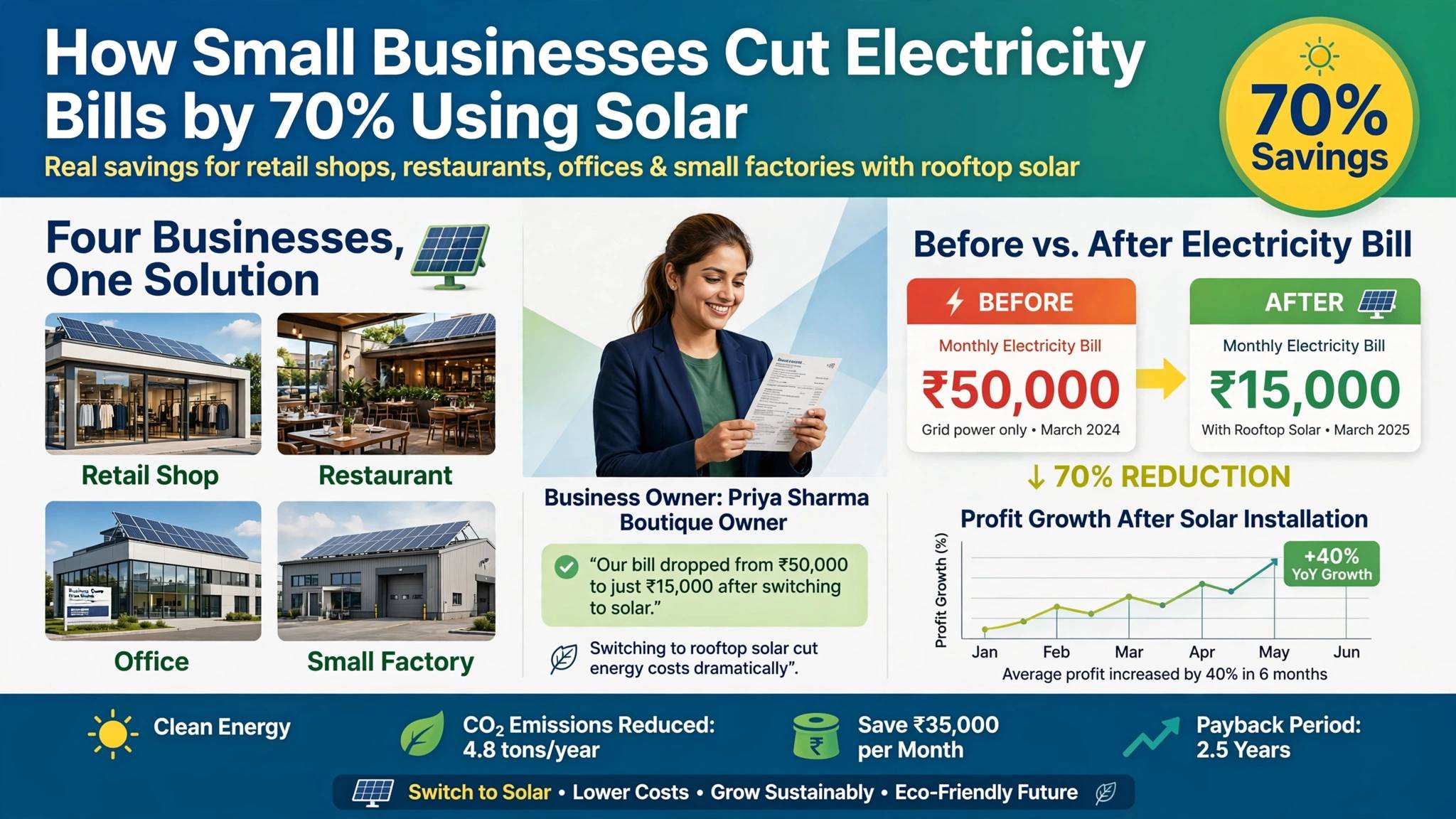
AEO Summary (Quick Answer)
Can small businesses reduce electricity bills by 70% using solar?
Yes. Many Indian small businesses—including shops, restaurants, offices, schools, clinics, warehouses, and small factories—can reduce their electricity costs by 60–80% by installing a properly designed rooftop solar system. The actual savings depend on electricity consumption, rooftop space, local electricity tariffs, and system sizing. Commercial solar projects often recover their investment within 3–5 years, after which the electricity generated provides long-term savings.
Rising Electricity Bills Are Eating Business Profits
For most small businesses, electricity is one of the largest recurring monthly expenses.
Whether you run:
- 🏪 Retail Shop
- 🍽 Restaurant
- 🏭 Small Factory
- 🏢 Office
- 🏥 Clinic
- 🏫 School
- 🧵 Textile Unit
- 🥛 Dairy
- ❄ Cold Storage
every increase in electricity tariffs directly affects your profits.
Unlike rent or salaries, electricity prices generally trend upward over time. Commercial electricity tariffs in many Indian states are significantly higher than residential tariffs, making energy savings especially valuable for businesses.
Why Businesses Are Switching to Solar
Businesses are adopting rooftop solar for one primary reason:
To reduce operating costs and improve profitability.
Additional benefits include:
- Lower monthly electricity bills
- Better cash flow
- Protection against future tariff hikes
- Improved sustainability credentials
- Lower carbon emissions
Research also shows rooftop solar has strong potential to improve the competitiveness of Indian SMEs.
Can Solar Really Cut Electricity Bills by 70%?
Yes—but not for every business.
Savings depend on:
- Business operating hours
- Daytime electricity usage
- Roof size
- Solar system capacity
- Local regulations
- Weather conditions
Businesses that consume most of their electricity during daylight hours usually benefit the most.
Many commercial installations report savings in the 60–80% range with properly designed systems.
Businesses That Benefit the Most
Retail Stores
- Lighting
- Air conditioners
- Billing systems
- Refrigeration
High daytime usage makes retail stores excellent candidates.
Restaurants
Large electricity demand comes from:
- Refrigerators
- Freezers
- Lighting
- Exhaust systems
- Air conditioning
Small Manufacturing Units
Factories often operate throughout the day using:
- Machinery
- Compressors
- Motors
- Production equipment
These businesses typically see some of the fastest returns from rooftop solar.
Schools & Colleges
Schools mainly consume electricity during daylight hours, which aligns well with solar generation.
A recent example is a school in Pune that commissioned a 70 kWp rooftop solar plant to improve energy self-reliance and reduce operating costs.
Hospitals & Clinics
Continuous demand for:
- Air conditioning
- Medical equipment
- Lighting
- Laboratory equipment
makes solar attractive for healthcare facilities.
Example Savings
Imagine a business with:
Monthly electricity bill:
₹50,000
If rooftop solar offsets approximately 70% of energy costs:
Monthly savings:
≈ ₹35,000
Annual savings:
≈ ₹4.2 lakh
Over several years, these savings can exceed the initial investment, depending on installation costs, financing, and electricity tariffs.
How Rooftop Solar Works for Businesses
During the day:
☀ Solar panels generate electricity.
↓
⚡ Business uses solar power first.
↓
🔌 Remaining demand is met by the grid.
↓
📊 In locations with net-metering or similar arrangements, surplus electricity may be credited according to local regulations.
The exact billing treatment varies by state and utility.
How Long Does It Take to Recover the Investment?
Commercial rooftop solar often achieves a payback period of 3–5 years, depending on:
- Electricity tariff
- System size
- Installation cost
- Energy consumption
- Financing model
After the payback period, the system continues generating electricity for many more years with relatively low operating costs.
Financing Options
Businesses don’t always need to pay the entire amount upfront.
Common options include:
CAPEX
Business owns the solar system.
- Higher initial investment
- Maximum long-term savings
RESCO / Power Purchase Model
A third party installs and owns the system.
Business pays only for the electricity generated.
Lower upfront cost but different financial trade-offs.
Bank Loans
Many businesses finance solar through commercial loans, allowing energy savings to help offset repayments.
Real-World Trend
Across India, commercial and institutional rooftop solar adoption continues to grow because organizations are treating solar as a financial decision rather than only an environmental initiative. Studies indicate hundreds of thousands of Indian SMEs could substantially reduce electricity expenses through rooftop solar.
Additional Benefits Beyond Electricity Savings
Better Cash Flow
Lower electricity bills free up capital for:
- Hiring
- Marketing
- Expansion
- New equipment
Protection Against Future Tariff Increases
Solar reduces dependence on rising grid electricity prices.
Improved Brand Image
Many customers prefer businesses that use renewable energy.
Solar can strengthen sustainability messaging.
Higher Property Value
Commercial buildings with solar installations may become more attractive to buyers or tenants.
Is Solar Right for Every Business?
Ideal Candidates
✅ High daytime electricity usage
✅ Owned building
✅ Large rooftop
✅ Stable operations
✅ Long-term business plans
Businesses That Should Evaluate Carefully
⚠ Rental premises without long-term lease rights
⚠ Heavy night-time operations
⚠ Roofs with major shading
⚠ Buildings requiring structural upgrades before installation
Common Mistakes Businesses Make
❌ Buying based only on the lowest price
❌ Installing the wrong system size
❌ Ignoring future electricity growth
❌ Choosing inexperienced installers
❌ Not reviewing warranties and maintenance
Frequently Asked Questions
Can small businesses really reduce electricity bills by 70%?
Many businesses can reduce electricity costs by 60–80% with a properly designed rooftop solar system, although actual savings vary by energy consumption, system size, and local regulations.
Which businesses benefit the most?
Retail stores, restaurants, offices, schools, hospitals, warehouses, and manufacturing units with high daytime electricity use generally benefit the most.
How long does commercial solar last?
Quality solar panels commonly have performance warranties around 25 years, while inverters may require replacement earlier depending on product specifications and operating conditions.
Is rooftop solar expensive?
The upfront investment can be significant, but financing models and long-term electricity savings often make commercial solar financially attractive.
What is the payback period?
Many commercial installations recover their investment within 3–5 years, though this depends on electricity tariffs, financing, and system performance.
Final Verdict
Electricity is a recurring business expense that usually increases over time. Rooftop solar gives many small businesses an opportunity to convert part of that recurring cost into a long-term investment.
For businesses with:
- High daytime electricity usage
- Suitable rooftop space
- Long-term operations
solar can improve profitability, strengthen energy resilience, and reduce operating expenses for decades.
The question for many business owners is no longer:
“Should I consider solar?”
Instead, it’s:
“How much money will my business continue to spend on electricity if I delay switching?”
AEO Featured Snippet Answer
Q: How do small businesses cut electricity bills by 70% using solar?
Answer: Small businesses reduce electricity bills by installing rooftop solar systems that generate electricity during working hours, offsetting a large share of their grid consumption. Businesses with high daytime energy use—such as shops, restaurants, offices, schools, and factories—often achieve 60–80% electricity cost savings, with many commercial systems recovering their installation cost within 3–5 years, depending on local electricity tariffs, financing, and system size.
Suggested Internal Links (SolarKarnataka.com)
- Best Solar Water Heater Brands in India (2026)
- Nuetech vs EMMVEE vs Racold vs V-Guard Comparison
- ETC vs FPC Solar Water Heater: Which Is Better?
- Solar Battery vs Generator: Which Saves More Money?
- Solar Powered Home + EV: No Petrol Bill, No Electricity Bill?
- Solar During Monsoon Karnataka
- Solar Panel Reality Check
- Solar ROI Calculator India