⚡ A New Type of Solar Battery Could Change Renewable Energy Forever
One of the biggest problems with solar energy has always been:
👉 energy storage.
Solar panels generate electricity only when sunlight is available. At night or during cloudy weather, homes and grids still depend on:
- batteries
- electricity grids
- fossil fuel backup systems
Now, researchers are developing a completely different kind of “solar battery” that may dramatically change the future of renewable energy.
Unlike traditional lithium-ion batteries, this new technology:
✅ does not use lithium
✅ may store energy for years
✅ could work without large battery packs
✅ may reduce grid dependence
The breakthrough is attracting global attention because it could solve one of renewable energy’s biggest long-term challenges.
🔬 What Is This New Solar Battery?
Scientists at the University of California, Santa Barbara have reportedly developed a:
👉 “Rechargeable Solar Battery”
But this is not a normal battery like:
- lithium-ion batteries
- EV batteries
- phone batteries
Instead, it belongs to a category called:
🌞 Molecular Solar Thermal (MOST) Energy Storage
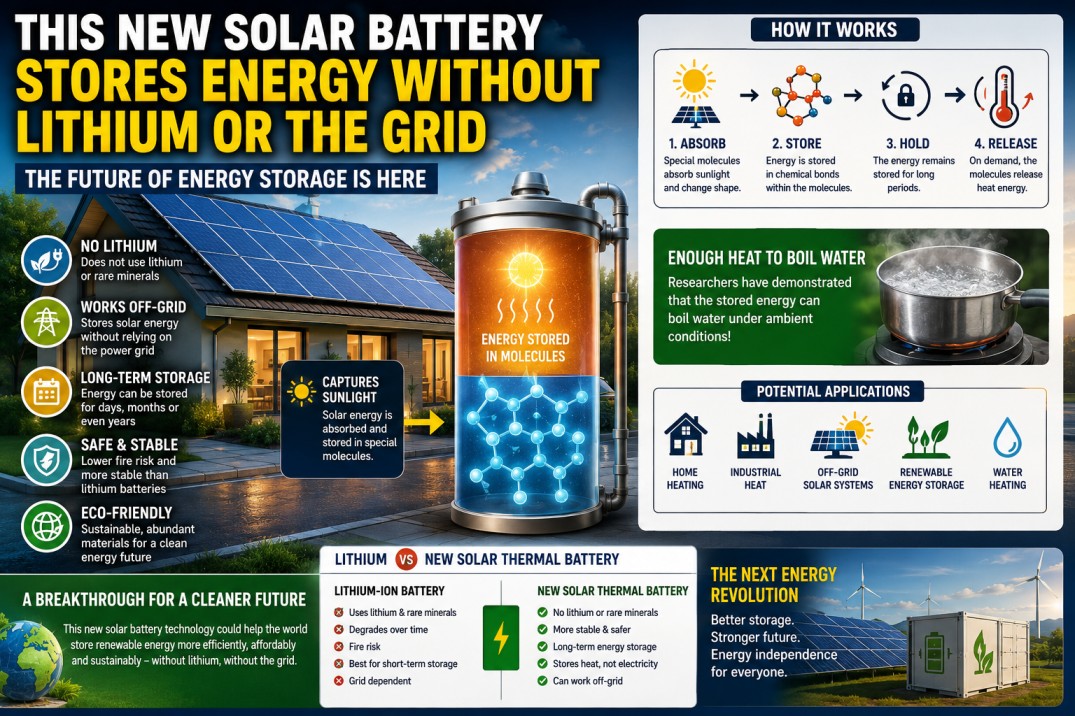
The system stores sunlight directly inside specially designed molecules and later releases the energy as heat when needed.
🧬 Inspired by DNA
Researchers say the technology is inspired by molecular structures similar to DNA components.
The system uses modified molecules called:
👉 pyrimidone-based molecules
These molecules can:
- absorb sunlight
- change molecular shape
- store solar energy chemically
- later release the stored energy
This process works somewhat like a rechargeable thermal battery.
🔥 How Does It Actually Work?
Step-by-step:
- Sunlight hits the special material
- Molecules absorb solar energy
- Energy becomes stored in chemical bonds
- Stored energy remains trapped
- Heat is released later when needed
Researchers demonstrated enough heat release to:
👉 boil water under ambient conditions.
That is considered a major milestone for thermal energy storage.
⚡ Why This Is Different From Lithium Batteries
Traditional lithium-ion batteries:
- store electricity electrochemically
- degrade over time
- require expensive minerals
- can overheat or catch fire
This new system stores:
👉 solar heat energy inside molecules.
📊 Comparison: Lithium vs New Solar Thermal Battery
| Feature | Lithium-Ion Battery | Molecular Solar Battery |
|---|---|---|
| Uses lithium | ✅ Yes | ❌ No |
| Stores electricity | ✅ Yes | ❌ Mainly thermal energy |
| Fire risk | Higher | Lower potential |
| Long-term storage | Limited | Potentially years |
| Mineral dependency | High | Lower |
| Grid dependency | Often needed | Could reduce dependency |
🌍 Why the World Wants Alternatives to Lithium Batteries
Lithium-ion batteries currently dominate:
- EVs
- home storage
- solar backup systems
But they face several major problems.
⚠️ 1. Lithium Supply Concerns
Lithium is:
- finite
- geopolitically sensitive
- increasingly expensive
Battery supply chains depend heavily on:
- China
- lithium mining
- cobalt & nickel imports
This creates:
- price volatility
- supply chain risks
- strategic dependency issues.
⚠️ 2. Grid-Scale Storage Challenges
Lithium batteries work well for:
- phones
- EVs
- short-duration storage
But they become expensive for:
- multi-day energy storage
- national power grids
- large renewable systems
That’s why researchers worldwide are exploring:
- iron-air batteries
- thermal batteries
- sodium-ion systems
- gravity storage
- molecular storage.
🔋 What Is Long-Duration Energy Storage (LDES)?
One of the biggest future energy trends is:
👉 Long-Duration Energy Storage (LDES)
These systems can store renewable energy:
- for many hours
- days
- or even longer
The U.S. Department of Energy defines LDES as systems capable of delivering power for 10+ hours.
This is critical because:
- solar energy stops at night
- wind energy fluctuates
- electricity demand remains constant
🌞 Why Solar Needs Better Storage
Renewable energy has a major weakness:
👉 intermittency.
Solar power is abundant during daytime but disappears after sunset.
Without storage:
- excess solar energy may be wasted
- fossil fuel backup remains necessary
- grid instability increases
This is why storage technology may become:
👉 as important as solar panels themselves.
⚡ Could This New Technology Replace Lithium Batteries?
Probably not completely — at least not soon.
Experts believe the future energy system may use:
- multiple storage technologies together
🧠 Likely Future Energy Mix
| Technology | Best Use |
|---|---|
| Lithium-ion | EVs & short-term storage |
| Iron-air batteries | Multi-day grid storage |
| Thermal batteries | Industrial heat |
| Molecular solar storage | Long-term thermal storage |
| Gravity systems | Grid balancing |
Researchers increasingly expect:
👉 hybrid storage ecosystems instead of one “winner.”
🏠 What Could This Mean for Homes?
In the future, homes may use:
- rooftop solar
- thermal energy storage
- smart AI energy systems
- battery hybrids
Imagine:
👉 storing solar energy during summer
👉 and using it weeks later.
That possibility is what makes this research so exciting.
🚗 What About EVs?
This new technology is currently more focused on:
- heat storage
- renewable energy systems
- industrial applications
rather than directly powering EVs.
However:
better long-duration storage could still improve:
- EV charging infrastructure
- renewable-powered charging stations
- smart grids
🌡 Potential Applications
Researchers believe future uses could include:
✅ Home water heating
✅ Industrial heat storage
✅ Off-grid solar systems
✅ Renewable energy storage
✅ Smart energy infrastructure
Some concepts even involve:
👉 circulating energy-storing fluids through rooftop systems.
🔥 Other Competing Battery Technologies
This breakthrough is part of a much larger race.
⚙️ Iron-Air Batteries
Companies like Form Energy are developing:
👉 iron-air batteries
These use:
- iron
- water
- oxygen
instead of lithium.
Some systems claim:
👉 up to 100 hours of storage.
🌡 Thermal Batteries
Thermal batteries store:
- heat
instead of electricity.
They may use:
- molten salt
- sand
- ceramics
These systems are becoming increasingly important for industrial energy storage.
⚡ Why India Should Watch This Closely
India is rapidly expanding:
- rooftop solar
- EV adoption
- renewable energy infrastructure
But India also faces:
- grid instability
- rising electricity demand
- battery import dependence
New storage technologies could help India:
✅ reduce imports
✅ improve energy security
✅ support renewable expansion
✅ reduce fuel dependency
🇮🇳 Future Impact on India’s Solar Industry
If long-duration storage becomes cheaper:
👉 rooftop solar could become far more practical.
This may accelerate:
- smart solar homes
- solar EV charging
- decentralized energy systems
- battery storage industries
⚡ Check Your Solar Savings
Thinking about rooftop solar for your home?
👉 Use the calculator below to estimate:
- Solar system size
- Installation cost
- Subsidy amount
- Savings & ROI
🔢 Solar Subsidy & Savings Calculator
👉 ADD YOUR CALCULATOR HERE
(Paste your Solar Calculator code)
⚠️ Challenges Still Remaining
Despite excitement, this technology is still early-stage.
Major challenges include:
❌ Commercial scalability
❌ Manufacturing cost
❌ Real-world durability
❌ Large-scale deployment
❌ Heat-to-electricity conversion efficiency
Researchers still need years of testing and commercialization.
🚀 Is This the Future of Renewable Energy?
Possibly.
Experts increasingly believe:
👉 storage technology is the next major energy revolution.
The future may not belong only to:
- solar panels
- wind turbines
but also to:
- advanced storage systems
- smart grids
- AI energy management
- hybrid battery ecosystems
🔗 Related Articles
👉 Also read:
- Solar Panel Price in Karnataka
- AI is Changing Solar in India
- Can Solar Panels Charge EV Cars in India?
- Agrivoltaics in India
- PM Kusum Yojana 2026
- Solar for ₹3000 Electricity Bill
- Solar for ₹5000 Electricity Bill
- Best Solar Battery in India 2026
- Best Solar Inverter in India 2026
❓ FAQs
Does this battery use lithium?
No, the system reportedly stores energy using molecular thermal chemistry instead of lithium.
Can this replace normal solar batteries?
Not immediately. The technology is still experimental.
Why is energy storage important for solar?
Solar energy is intermittent and requires storage for nighttime or cloudy periods.
What is MOST energy storage?
MOST stands for Molecular Solar Thermal energy storage.
🔥 Final Verdict
The new molecular solar battery developed by researchers could represent one of the most fascinating renewable energy breakthroughs in years.
By storing sunlight directly inside molecules without lithium or conventional grids, this technology opens the possibility of:
- long-duration renewable storage
- lower mineral dependency
- smarter energy systems
While still experimental, the research highlights a major global trend:
👉 the future energy race is no longer just about generating renewable power —
it’s about storing it efficiently, safely, and affordably.