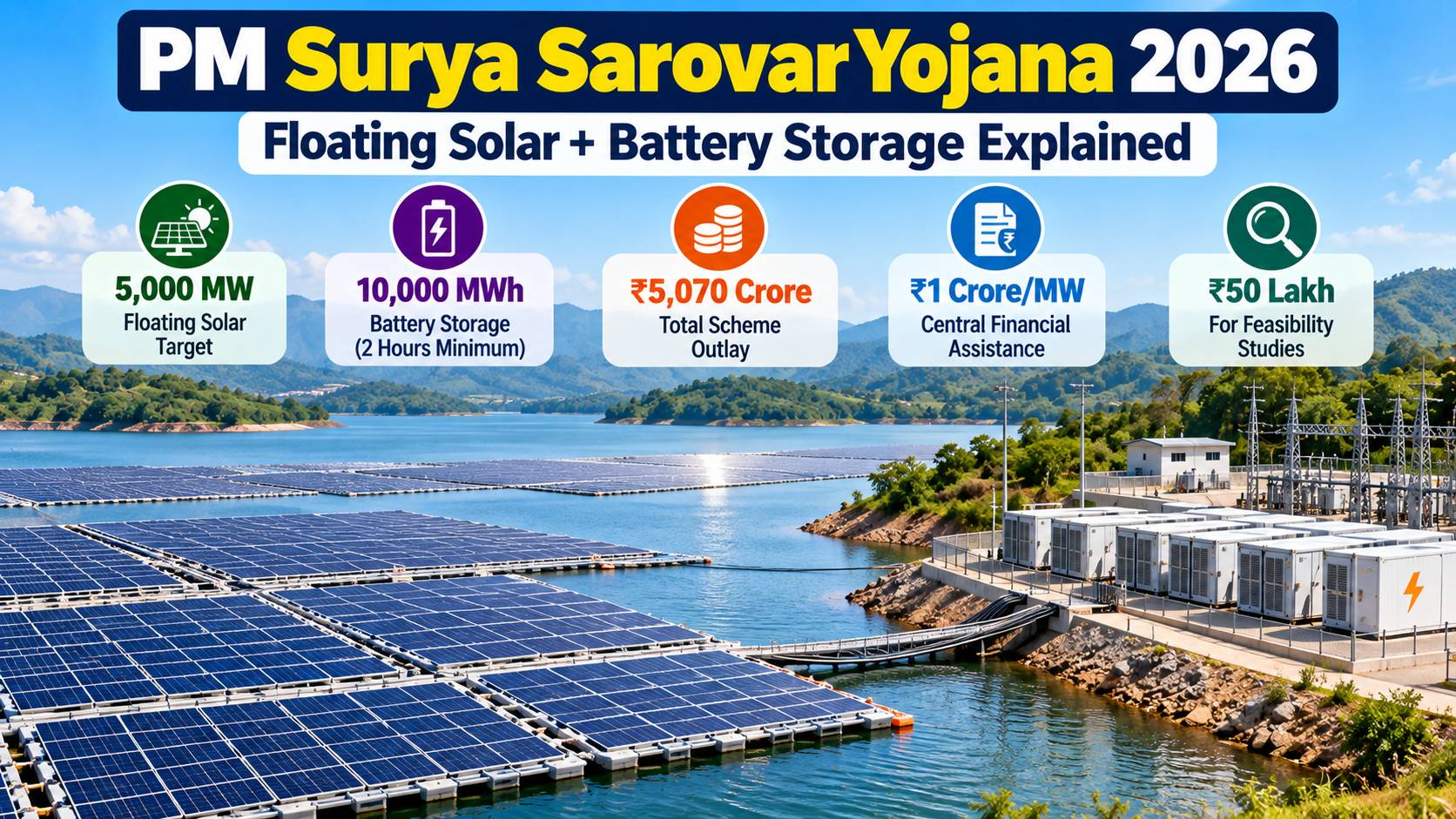
The Pradhan Mantri Surya Sarovar Yojana (PM-SSY) 2026 is a Government of India scheme approved with an outlay of ₹5,070 crore to develop 5,000 MW of floating solar power projects integrated with energy storage systems. The programme aims to generate renewable electricity using suitable reservoirs and other inland water bodies while storing energy for later use. The projects are scheduled for sanction during FY 2026–27 to FY 2030–31, with financial support continuing until FY 2032–33.
Unlike PM Surya Ghar Muft Bijli Yojana, which supports eligible residential rooftop solar installations, PM Surya Sarovar focuses on large-scale floating solar infrastructure and battery storage.
PM Surya Sarovar Yojana 2026: Key Details at a Glance
| Scheme detail | Officially announced information |
|---|---|
| Full name | Pradhan Mantri Surya Sarovar Yojana (PM-SSY) |
| Approval date | 31 July 2026 |
| Total scheme outlay | ₹5,070 crore |
| Floating solar target | 5,000 MW (5 GW) |
| Minimum associated energy storage | 10,000 MWh (10 GWh) |
| Minimum storage duration | 2 hours |
| Project sanction period | FY 2026–27 to FY 2030–31 |
| Financial support period | Through FY 2032–33 |
| Central financial assistance for eligible floating solar projects | ₹1 crore per MW after successful commissioning |
| Feasibility-study assistance | Up to ₹50 lakh per project |
| Geographic coverage | States and Union Territories across India |
Source: Government of India Cabinet announcement and Ministry of New and Renewable Energy release. See the official PM India announcement.
1. What Is PM Surya Sarovar Yojana?
PM Surya Sarovar Yojana is a national renewable energy programme designed to accelerate the development of floating solar photovoltaic (FSPV) projects combined with energy storage systems (ESS).
Instead of installing every solar panel on land, floating solar projects place photovoltaic modules on specially engineered floating structures over suitable water bodies. The generated electricity is transferred to electrical infrastructure on land and then supplied to the grid.
The scheme has two connected objectives:
- Expand floating solar generation: Add 5 GW of floating solar capacity using suitable existing water bodies.
- Improve electricity availability: Pair these projects with energy storage so electricity generated during sunny hours can be used later, including during periods of higher demand.
The Cabinet approval follows an assessment by the National Institute of Solar Energy (NISE), which estimated India’s floating solar potential at approximately 102.18 GWp across reservoirs and suitable inland water bodies.
The programme is intended to help India expand renewable energy while reducing competition for land and improving grid reliability.
2. How Does Floating Solar Power Work?
Floating solar uses the same basic photovoltaic principle as conventional solar panels. The difference is where the modules are installed.
A floating solar project generally contains five main components:
- Solar modules: Convert sunlight into direct-current electricity.
- Floating platforms: Support the panels above the water surface.
- Anchoring and mooring systems: Keep the installation in position despite wind, waves and changing water levels.
- Electrical equipment: Inverters, cables, transformers and protection systems convert and deliver electricity.
- Grid connection: Transfers the electricity to the relevant power network.
The floating structure must be designed for the specific water body. Reservoir depth, changes in water level, wind loads, wave conditions, water quality and access for maintenance all influence project design.
Floating solar is therefore not simply a matter of placing ordinary rooftop panels on a pond. It requires specialist engineering, environmental assessment and coordination with the authorities responsible for the water body.
3. Why Is Battery Storage Included in the Scheme?
Solar panels produce electricity when sunlight is available, with output varying throughout the day. Electricity demand, however, continues after sunset and can peak in the evening.
A battery energy storage system helps address this timing mismatch.
For example, a floating solar project may generate more electricity around midday than the grid needs at that moment. A suitably configured battery can store some of that energy and discharge it later.
How solar and battery storage work together
- Morning: Solar generation begins increasing.
- Midday: Solar output rises and some available energy can charge the battery.
- Evening: Stored energy can be discharged to support electricity demand.
- Grid support: Storage can help balance fluctuations and improve the usefulness of renewable generation.
The scheme specifies at least two hours of storage duration, with a cumulative storage target of 10,000 MWh.
This does not mean every Indian household will receive a two-hour battery or free electricity storage. The storage is associated with eligible large-scale projects.
What does 10,000 MWh of storage mean?
Megawatts (MW) measure power capacity, while megawatt-hours (MWh) measure energy.
For example, a battery system capable of delivering 1,000 MW for two hours would provide 2,000 MWh of energy, assuming the stated output can be sustained over that period.
Across the PM-SSY programme, the announced target is 10,000 MWh of storage associated with 5,000 MW of floating solar capacity.
Actual usable energy depends on the battery design, operating limits, efficiency and discharge conditions.
4. How Much Government Funding Is Available?
The scheme has a total announced outlay of ₹5,070 crore. Its Cabinet-approved financial support includes two important elements.
A. Central financial assistance for eligible floating solar projects
Eligible floating solar photovoltaic projects can receive central financial assistance of ₹1 crore per MW after successful commissioning.
Illustrative calculations using this announced rate:
| Eligible project capacity | Illustrative CFA at ₹1 crore/MW |
|---|---|
| 10 MW | ₹10 crore |
| 50 MW | ₹50 crore |
| 100 MW | ₹100 crore |
These calculations show the arithmetic of the announced rate; they are not approval guarantees. Actual assistance depends on the final scheme guidelines, eligibility conditions, sanctioned project capacity and compliance requirements.
B. Assistance for feasibility studies
The scheme also provides for central financial assistance of up to ₹50 lakh per project for feasibility studies and preparatory work.
This can cover activities such as:
- Bathymetric surveys to map water-body depth and underwater contours.
- Hydrographic assessments of water-body characteristics.
- Environmental studies.
- Other preparatory activities needed to assess project feasibility.
These studies help determine whether a proposed location is technically, environmentally and commercially suitable for floating solar.
Important: Is ₹5,070 crore a direct subsidy for households?
No. The announced funding supports the floating solar and storage programme. The ₹1 crore-per-MW assistance is for eligible projects, not a fixed payment to individual homeowners or farmers.
For residential rooftop solar assistance, see the separate PM Surya Ghar Muft Bijli Yojana official portal.
5. Who Can Benefit from PM Surya Sarovar Yojana?
The scheme is designed around utility-scale infrastructure rather than small individual solar installations.
Potential beneficiaries and participants include:
- Government agencies and public-sector entities involved in renewable energy.
- Eligible project developers and infrastructure companies.
- Electricity utilities and other participating power-sector organisations.
- Manufacturers of floating structures, solar modules, electrical equipment and energy storage systems.
- Engineering, procurement and construction (EPC) contractors.
- Companies providing surveys, project design, installation, operations and maintenance.
- States and Union Territories seeking additional renewable electricity capacity.
The scheme’s wider economic impact may extend to local contractors, skilled technicians, logistics providers and equipment suppliers.
However, participation depends on the final implementation framework, procurement arrangements and project-specific requirements.
6. Can Ordinary Homeowners Apply for PM Surya Sarovar Yojana?
PM Surya Sarovar Yojana is not an individual rooftop solar subsidy programme. Its announced purpose is to support floating solar projects with associated energy storage.
Homeowners looking to install panels on their roofs should investigate PM Surya Ghar Muft Bijli Yojana instead, subject to its current eligibility rules and application process.
Do not pay an agent who claims that PM-SSY automatically entitles every household to a free solar panel system or free home battery.
7. Can Farmers Apply for This Scheme?
Farmers may potentially benefit indirectly when suitable water bodies, agricultural infrastructure or nearby renewable energy projects become part of an approved development. They may also find opportunities in construction, logistics, equipment supply or project services.
However, the scheme announcement does not establish a universal individual farmer subsidy or a direct payment for installing floating panels on a private farm pond.
Before making an investment, a farmer should establish:
- Who legally controls the water body.
- Whether floating solar is permitted at that location.
- Which agency or developer is responsible for the project.
- Whether the proposed project is covered by the scheme.
- What approvals, environmental assessments and grid arrangements are required.
Farmers interested in solar irrigation should separately check the current status of PM-KUSUM through the Ministry of New and Renewable Energy. The eligibility and application rules for that programme are different.
8. How to Apply for PM Surya Sarovar Yojana 2026
The Cabinet approval establishes the programme’s objectives, funding and implementation period. However, prospective participants must distinguish the Cabinet announcement from the detailed procedures used to invite, evaluate and sanction individual projects.
As of 9 October 2026, consult official scheme notifications and procurement announcements before assuming that a particular application window is open.
Practical steps for interested project developers
Step 1: Identify a suitable water body
Assess whether a reservoir, industrial pond or other eligible inland water body can accommodate a floating solar installation.
Step 2: Establish site rights and permissions
Confirm ownership or operating control, water-use permissions and coordination requirements with the relevant state agencies, water-resource authorities and other stakeholders.
Step 3: Commission a feasibility assessment
Evaluate water depth, water-level variation, wind and wave conditions, grid connectivity, environmental constraints and project economics.
Step 4: Review official scheme and procurement documents
Check the Ministry of New and Renewable Energy (MNRE), Solar Energy Corporation of India (SECI) and relevant state agencies for applicable guidelines, tenders, eligibility criteria and project-selection procedures.
Step 5: Prepare a technically and financially sound proposal
A project proposal will need to address generation capacity, storage configuration, capital costs, grid connection, environmental compliance, financing and the intended route for selling electricity.
Step 6: Follow the official sanction and commissioning process
Assistance should be assumed only after the relevant authority confirms the project’s eligibility and the applicable requirements have been met.
Official websites to monitor
- Ministry of New and Renewable Energy (MNRE)
- Solar Energy Corporation of India (SECI)
- Press Information Bureau (PIB)
- Prime Minister of India – official announcements
Do not treat a general news article, an unofficial registration form or an agent’s promise as proof that a project has been approved.
9. What Are the Advantages of Floating Solar with Battery Storage?
Better use of existing water bodies
Floating solar can use suitable reservoirs and industrial ponds without occupying the same amount of additional land as a comparable ground-mounted project.
Potential reduction in water evaporation
Panels can shade portions of a water surface, potentially reducing evaporation. The actual benefit depends on the area covered, weather, reservoir characteristics and operating conditions.
Potential performance benefits
Water can influence the local temperature around floating panels, and cooler module operating conditions may improve output in some circumstances. Actual performance depends on system design, ventilation, humidity and site conditions.
More flexible renewable electricity
Battery storage can shift some solar energy from periods of high generation to later periods. This can improve the usefulness of solar electricity when demand and sunlight do not coincide.
Manufacturing and employment opportunities
The scheme is expected to support activity across floating structures, solar modules, energy storage, engineering, construction and maintenance. The government has estimated approximately 16,000–17,000 full-time-equivalent employment opportunities across the project value chain.
These are expected programme-level outcomes, not guaranteed job numbers for any individual state or project.
10. What Are the Main Challenges?
Floating solar with storage offers benefits, but it is more technically demanding than a standard rooftop installation.
Higher project complexity
Floating platforms, anchoring systems, specialised cables and water-resistant electrical equipment can increase costs and engineering requirements.
Water-level changes and extreme weather
Reservoirs may experience changing water levels, strong winds, waves and other demanding conditions. Anchoring and floating structures must be designed for the site’s actual conditions.
Environmental safeguards
Projects must consider aquatic life, water quality, fisheries, biodiversity, recreation and existing water uses. Suitable environmental assessment and permissions are essential.
Grid connectivity
A technically successful solar installation still needs a workable route to connect to the electricity grid and deliver power where it is needed.
Battery costs and lifecycle management
Storage adds capital costs and requires suitable operating controls, safety systems and maintenance. Battery degradation, efficiency losses and eventual replacement also affect project economics.
Coordination between agencies
Large projects may require coordination between electricity utilities, water-resource departments, environmental authorities, state agencies and project developers.
The scheme’s success will therefore depend on more than financial support. Suitable site selection, reliable engineering, sound project economics and effective implementation will all matter.
11. What Does PM Surya Sarovar Yojana Mean for Karnataka?
Karnataka has reservoirs, irrigation infrastructure and industrial water bodies that may warrant assessment for floating solar. However, the existence of a suitable-looking water body does not automatically make it eligible for a project.
Potential developments would need to consider:
- Technical suitability and available water surface.
- Water supply, irrigation and other existing uses.
- Environmental and ecological constraints.
- Proximity to suitable grid infrastructure.
- Project financing and electricity offtake arrangements.
- Permissions from the authorities responsible for the site.
For Karnataka residents, businesses and farmers, the immediate practical step is to follow official MNRE, SECI and state-agency announcements rather than assume that a local application scheme is already available.
The programme may create opportunities for EPC contractors, equipment suppliers, engineering consultants and energy-storage businesses as eligible projects move from planning to procurement and construction.
12. PM Surya Sarovar Yojana vs PM Surya Ghar Yojana
These two schemes have different purposes.
| Feature | PM Surya Sarovar Yojana | PM Surya Ghar Muft Bijli Yojana |
|---|---|---|
| Main objective | Floating solar projects with energy storage | Residential rooftop solar |
| Scale | Utility-scale projects | Individual households |
| Announced financial support | ₹5,070 crore total scheme outlay | Separate residential rooftop programme |
| Primary infrastructure | Floating solar and associated storage | Rooftop photovoltaic systems |
| Is it an automatic household subsidy? | No | No; households must meet scheme requirements and follow the official process |
| Where to check | MNRE and SECI | Official PM Surya Ghar portal |
The name similarity can cause confusion. Check the full scheme name before applying, paying an installer or relying on a subsidy claim.
Frequently Asked Questions
1. What is the PM Surya Sarovar Yojana 2026?
PM Surya Sarovar Yojana is a Government of India programme approved on 31 July 2026 with a total outlay of ₹5,070 crore. It aims to develop 5,000 MW of floating solar projects integrated with energy storage systems.
2. What is the total budget of PM Surya Sarovar Yojana?
The announced total scheme outlay is ₹5,070 crore.
3. How much floating solar capacity will the scheme create?
The scheme targets 5,000 MW, equivalent to 5 GW, of floating solar photovoltaic capacity.
4. How much battery storage is included?
The programme envisages a minimum storage duration of two hours and a cumulative storage capacity of 10,000 MWh, equivalent to 10 GWh.
5. How much subsidy is available under PM Surya Sarovar Yojana?
The Cabinet announcement provides for central financial assistance of ₹1 crore per MW for eligible floating solar projects after successful commissioning, plus up to ₹50 lakh per project for eligible feasibility studies and preparatory activities. These are project-level assistance provisions, not universal household subsidies.
6. Can I apply for PM Surya Sarovar Yojana for my home?
No. The scheme is designed for floating solar projects with energy storage, not individual residential rooftop systems. Homeowners should check PM Surya Ghar Muft Bijli Yojana for eligible rooftop solar support.
7. Can individual farmers receive free solar panels under this scheme?
The Cabinet announcement does not establish a universal free-panel benefit for individual farmers. Farmers should verify project-specific opportunities and check separate agricultural solar programmes for applicable assistance.
8. When will PM Surya Sarovar Yojana projects be implemented?
Projects are scheduled for sanction during FY 2026–27 to FY 2030–31, with financial support continuing through FY 2032–33. Actual project timelines depend on sanction, feasibility, permissions, procurement, construction and commissioning.
9. Where can I check PM Surya Sarovar Yojana application details?
Check official MNRE and SECI announcements, relevant tenders and notifications from the responsible authorities. Confirm the current application or procurement process before submitting documents or paying anyone.
10. Will floating solar reduce water evaporation?
It can reduce evaporation from the portions of water bodies covered by panels, but the result varies with the local climate, water-body characteristics and percentage of surface covered. Water savings are not guaranteed at a fixed rate.
11. Why does the scheme include battery storage?
Storage can capture some solar electricity generated during sunny hours and release it later. This can help manage the difference between solar generation and electricity demand, while supporting grid reliability.
12. Is PM Surya Sarovar Yojana available in Karnataka?
The announced scheme is intended to benefit all States and Union Territories. A specific Karnataka site or project must still meet the applicable technical, environmental, regulatory and scheme requirements. Check official notifications for actual project opportunities.
Conclusion
PM Surya Sarovar Yojana 2026 is a significant policy initiative aimed at scaling floating solar power and battery storage in India. Its ₹5,070 crore outlay, 5 GW floating solar target and 10 GWh storage target reflect a broader effort to expand renewable electricity while making better use of suitable water bodies.
For project developers, equipment suppliers and energy-sector businesses, the programme may create opportunities as implementation advances. For homeowners and farmers, the most important point is to understand the scheme correctly: PM-SSY is not a universal household rooftop solar subsidy.
Follow official government notifications for project eligibility, procurement details and implementation updates before making financial decisions.
Official Sources
- Prime Minister of India — Cabinet approval of PM Surya Sarovar Yojana
- Press Information Bureau — Ministry of New and Renewable Energy announcement
- Ministry of New and Renewable Energy
- Solar Energy Corporation of India
- PM Surya Ghar Muft Bijli Yojana
Last reviewed: 9 October 2026. Scheme details, tender conditions and application procedures may be updated by the responsible authorities. Confirm the latest official documents before acting.