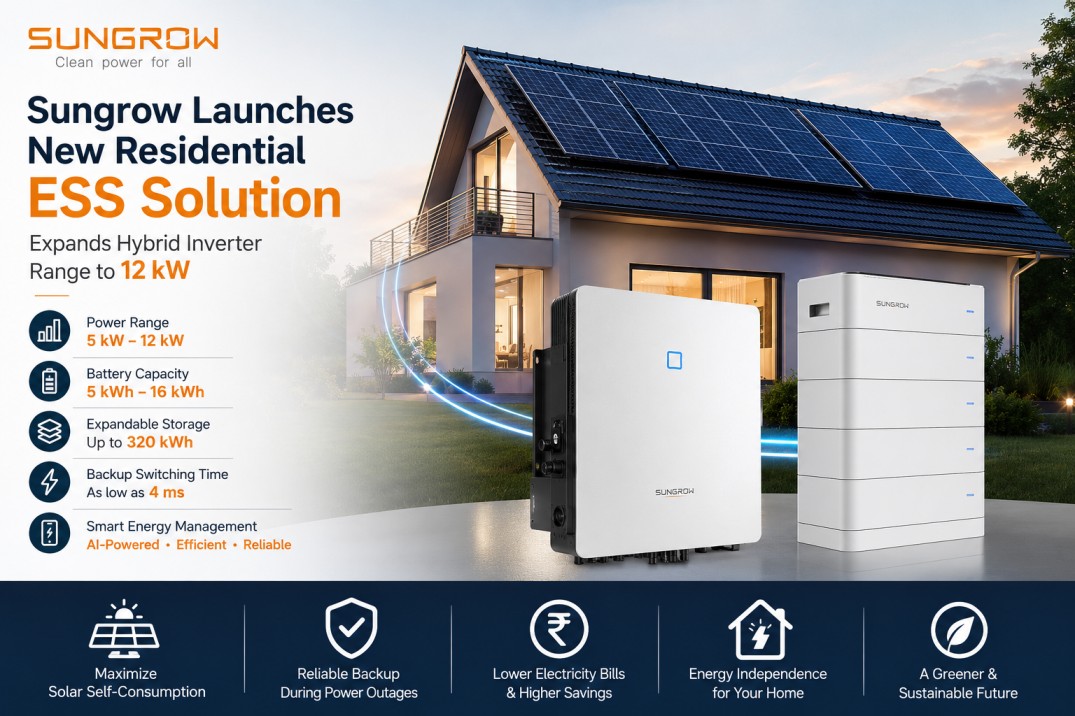
Sungrow Expands Home Energy Storage Portfolio with New 12 kW Hybrid Inverter
As homeowners increasingly seek energy independence, backup power, and greater solar self-consumption, global solar inverter and energy storage giant Sungrow has launched its next-generation residential Energy Storage System (ESS) solution. The company has expanded its hybrid inverter lineup from 5 kW to 12 kW with the introduction of the new MG12RL hybrid inverter, offering greater flexibility for modern households with higher electricity demands. The launch is aimed at supporting residential solar users who want reliable backup power, improved energy management, and scalable battery storage solutions.
Quick Summary
| Feature | Details |
|---|---|
| Company | Sungrow |
| New Product | MG12RL Hybrid Inverter |
| Power Range | 5 kW to 12 kW |
| Application | Residential Solar + Energy Storage |
| Battery Capacity | 5 kWh to 16 kWh |
| Expandable Storage | Up to 320 kWh |
| Backup Switching Time | As low as 4 milliseconds |
| Target Market | Residential homeowners |
| Key Benefit | Energy independence and reliable backup power |
Why This Launch Matters
Residential solar adoption is growing rapidly worldwide. However, many homeowners face challenges such as:
- Frequent grid outages
- Rising electricity costs
- Limited energy storage options
- Increasing electricity consumption from EVs and smart appliances
Traditional solar systems generate power only during daylight hours. Energy Storage Systems (ESS) solve this problem by storing excess solar energy for later use.
With its latest residential ESS platform, Sungrow aims to help homeowners maximize solar self-consumption while ensuring uninterrupted power during grid failures. The new MG12RL hybrid inverter extends the company’s residential portfolio and allows larger homes to support higher electrical loads.
What is the New Sungrow Residential ESS Solution?
The new residential ESS solution combines:
- Hybrid inverter technology
- Battery energy storage
- Intelligent energy management
- Backup power functionality
The system is designed for both:
- Solar self-consumption
- Emergency backup power
Homeowners can customize their energy setup based on household consumption patterns and future expansion plans. The solution supports various battery configurations ranging from 5 kWh to 16 kWh and can scale significantly for larger energy requirements.
Key Features of the New MG12RL Hybrid Inverter
1. Expanded Power Range up to 12 kW
The biggest upgrade is the introduction of the MG12RL inverter, increasing Sungrow’s residential hybrid inverter range from 5 kW to 12 kW.
This allows:
- Support for larger homes
- Better handling of high-power appliances
- Future-ready EV charging integration
- Enhanced backup capabilities
The expanded range addresses growing residential electricity demands worldwide.
2. Flexible System Scalability
The inverter platform can scale significantly through parallel operation.
This flexibility allows homeowners to:
- Start with smaller installations
- Expand storage later
- Increase solar capacity over time
- Adapt to changing energy needs
Scalable architecture is becoming increasingly important as households adopt electric vehicles and smart home technologies.
3. Reliable Backup Power
One of the most valuable features is seamless backup power functionality.
Previous-generation Sungrow residential systems demonstrated backup transition times of approximately 4 milliseconds, helping maintain power continuity during outages. Such rapid switching minimizes disruption to household appliances and electronics.
4. Battery Storage Options
The system supports multiple battery configurations, including:
| Storage Option | Capacity |
|---|---|
| Entry Level | 5 kWh |
| Mid-Range | 10 kWh |
| Premium | 16 kWh |
| Expanded System | Up to 320 kWh |
This enables homeowners to choose storage capacity based on:
- Daily electricity consumption
- Backup requirements
- Budget
- Future energy goals
5. Smart Energy Management
The ESS solution supports intelligent energy management designed to optimize:
- Solar energy utilization
- Battery charging cycles
- Grid imports
- Electricity cost savings
Sungrow’s energy management ecosystem is increasingly incorporating AI-driven optimization features for improved efficiency and user control.
Benefits for Residential Solar Users
Lower Electricity Bills
Stored solar energy can be used during evening peak hours, reducing grid dependency and electricity costs.
Improved Energy Independence
Homeowners gain greater control over energy consumption and storage.
Protection During Power Outages
Battery backup ensures critical appliances remain operational during grid failures.
Better Solar Utilization
Instead of exporting excess solar power to the grid, homeowners can store and use it later.
Future EV Readiness
Larger inverter capacities make the system more suitable for households planning electric vehicle adoption.
What Does This Mean for India and Karnataka?
The launch has significant relevance for India’s rapidly growing residential solar market.
Government initiatives such as the PM Surya Ghar scheme are encouraging rooftop solar adoption across the country. As more homeowners install rooftop systems, demand for battery storage and hybrid inverters is expected to rise.
In Karnataka, where solar adoption is among the highest in India, hybrid ESS solutions can provide additional benefits:
- Reduced dependence on grid electricity
- Better utilization of rooftop solar generation
- Backup power during outages
- Enhanced savings under net-metering arrangements
For homeowners in Bengaluru, Mysuru, Hubballi, Mangaluru, and other urban centers, hybrid solar-plus-storage systems could become increasingly attractive as electricity consumption grows.
Expert Analysis
The residential solar market is shifting from simple grid-connected systems toward integrated solar-plus-storage solutions.
Several factors are driving this trend:
- Falling battery costs
- Rising electricity tariffs
- Increased EV adoption
- Growing awareness of energy security
Sungrow’s decision to extend its residential hybrid inverter range to 12 kW reflects changing homeowner requirements. Larger inverter capacities provide greater flexibility for high-consumption households and future-proof solar investments.
The launch also highlights a broader industry movement toward intelligent energy ecosystems that combine solar generation, battery storage, EV charging, and AI-driven energy management.
Competitive Position
Sungrow is one of the world’s leading inverter manufacturers and has deployed hundreds of gigawatts of power electronics globally. The company’s focus on scalable residential ESS solutions positions it strongly within the growing home energy storage market.
Frequently Asked Questions
What is a residential ESS?
A Residential Energy Storage System (ESS) stores electricity generated by solar panels for later use, improving energy independence and backup power capability.
What is the MG12RL inverter?
The MG12RL is Sungrow’s newly introduced hybrid inverter that expands the company’s residential power range up to 12 kW.
Can the system work during power outages?
Yes. The system is designed to provide backup power functionality and rapid switching during grid interruptions.
Is this suitable for Indian homes?
Yes. Hybrid inverter and battery systems are increasingly relevant for Indian households seeking lower electricity bills, backup power, and improved solar utilization.
Why are hybrid inverters becoming popular?
Hybrid inverters combine solar generation, battery storage management, and grid interaction in a single solution, making them more efficient and future-ready.
Conclusion
Sungrow’s latest residential ESS solution marks another step toward smarter and more resilient home energy systems. By introducing the MG12RL hybrid inverter and expanding its residential range to 12 kW, the company is addressing the growing need for energy independence, battery storage, and reliable backup power.
As rooftop solar adoption accelerates across India and Karnataka, hybrid solar-plus-storage solutions like these are expected to play a critical role in helping households reduce electricity costs, improve energy security, and maximize the value of their solar investments.
🔗 Related Articles
👉 Also read: