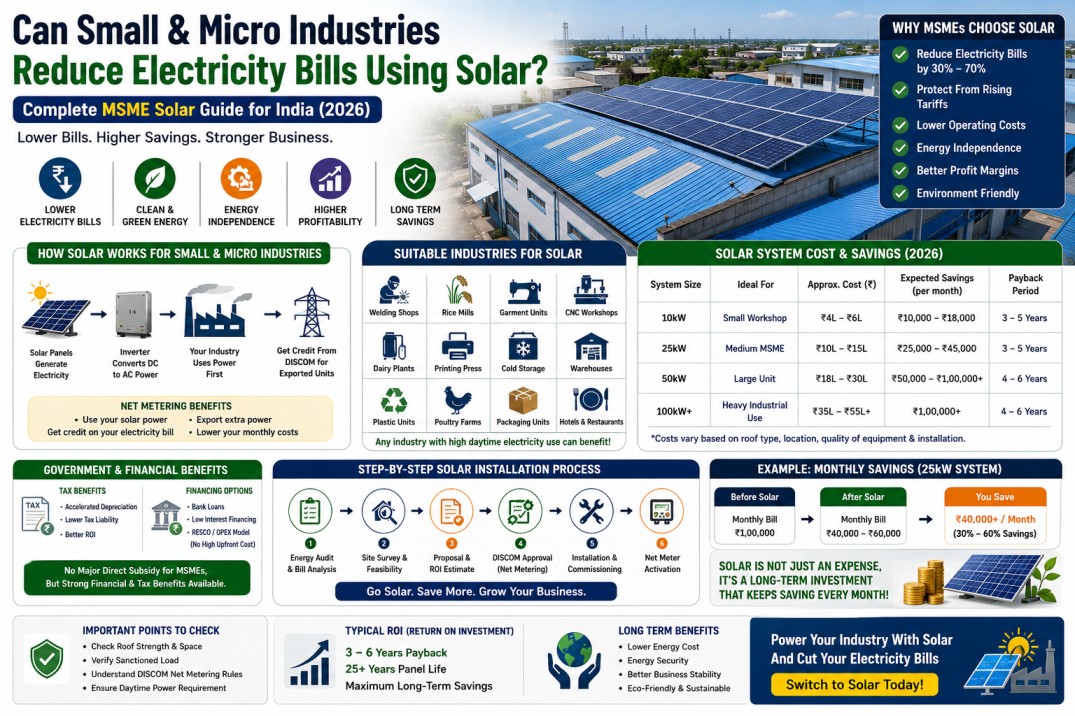
⚡ Rising Electricity Bills Are Becoming a Huge Problem for MSMEs
Across India, small and micro industries are struggling with rapidly increasing electricity costs.
For many MSMEs:
- electricity is one of the biggest monthly expenses
- commercial tariffs are much higher than residential rates
- fuel adjustment charges keep increasing
- power cuts and voltage fluctuations affect productivity
This is why thousands of:
- workshops
- rice mills
- garment units
- fabrication shops
- dairy plants
- printing presses
- warehouses
- commercial buildings
are now turning toward:
☀️ Rooftop Solar for MSMEs
In many cases, solar can reduce industrial electricity expenses by:
👉 30%–70%
while also improving long-term business profitability.
🌞 Can Small Industries Really Use Solar?
✅ YES — absolutely.
Small and micro industries can use:
- rooftop solar
- captive solar
- net metering
- group net metering
- solar + battery systems
to dramatically reduce electricity costs.
Industrial solar is now one of the fastest-growing renewable energy sectors in India because:
👉 MSMEs consume large amounts of daytime electricity.
That is PERFECT for solar generation.
⚡ Why Solar Works So Well for MSMEs
Factories and workshops usually operate:
👉 during daytime.
Solar panels also generate maximum electricity during daytime.
This creates:
✅ Direct Self-Consumption Advantage
Meaning:
- solar power is instantly consumed by machines
- dependence on grid electricity reduces
- electricity bills fall sharply
This makes MSME solar:
👉 more profitable than residential solar in many situations.
🏭 Which Small Industries Benefit Most From Solar?
Very suitable for:
✅ Welding shops
✅ Rice mills
✅ Garment factories
✅ CNC workshops
✅ Packaging units
✅ Plastic molding units
✅ Printing presses
✅ Dairy processing
✅ Poultry farms
✅ Cold storage
✅ Hotels & restaurants
✅ Warehouses
💸 Why MSME Electricity Bills Are So High
Industrial and commercial tariffs are much higher than residential tariffs.
Typical MSME electricity rates:
👉 ₹8–₹12 per unit
or sometimes even higher depending on:
- state
- sanctioned load
- peak demand
- fuel adjustment charges.
That means:
electricity becomes a major operating burden.
☀️ Best Solar Option for MSMEs
✅ Rooftop Solar + Net Metering (BEST OPTION)
This is the most practical and popular setup.
⚡ How It Works
☀️ Solar panels generate electricity
→ factory uses electricity directly
→ extra power exported to grid
→ DISCOM provides credits
This system is called:
👉 Net Metering
A bi-directional meter tracks:
- imported electricity
- exported electricity.
📊 Example MSME Solar Savings
| Business Type | Monthly Electricity Bill | Possible Savings |
|---|---|---|
| Small workshop | ₹25K | ₹10K–₹18K |
| Medium MSME | ₹1L | ₹40K–₹70K |
| Heavy daytime factory | ₹3L | Very high savings |
🏗 How Much Rooftop Space Is Needed?
Approximate requirement:
| Solar Capacity | Roof Space Needed |
|---|---|
| 10kW | 800–1000 sq ft |
| 25kW | 2000+ sq ft |
| 50kW | 4000+ sq ft |
| 100kW | 8000+ sq ft |
Industrial sheds are ideal because:
✅ large roof area
✅ daytime operation
✅ strong sunlight exposure
💰 MSME Solar System Cost in India (2026)
Approximate pricing:
| Solar System | Approx Cost |
|---|---|
| 10kW | ₹4L–₹6L |
| 25kW | ₹10L–₹15L |
| 50kW | ₹18L–₹30L |
| 100kW | ₹35L–₹55L |
Costs depend on:
- panel brand
- inverter quality
- roof structure
- installation complexity
- DISCOM approvals
🏦 Is Subsidy Available for MSMEs?
This is important.
⚠️ Reality Check
Unlike residential solar:
👉 MSMEs usually DO NOT get major central subsidies.
Industry experts note there is currently no major direct central rooftop subsidy specifically for MSME solar systems in 2026.
However, MSMEs still benefit through:
✅ Tax benefits
✅ Accelerated depreciation
✅ Lower electricity bills
✅ Financing options
✅ Solar loans
✅ Net metering benefits
📈 Accelerated Depreciation Benefit
Businesses can often claim:
👉 accelerated depreciation on solar assets
This improves:
- tax savings
- project ROI
- payback speed
💳 Solar Financing for MSMEs
Many MSMEs now install solar using:
- bank loans
- NBFC financing
- RESCO/OPEX models
instead of paying full upfront cost.
Solar financing companies now offer:
- EMI-based solar systems
- low upfront investment
- pay-as-you-save models.
⚡ What Is RESCO / OPEX Solar?
In RESCO model:
👉 third-party company installs solar plant
MSME:
- buys electricity at cheaper rate
- avoids huge upfront investment
This is becoming increasingly popular for:
- factories
- warehouses
- commercial buildings
⏳ MSME Solar Payback Period
Industrial solar usually has:
👉 very fast ROI
because electricity tariffs are high.
Typical payback:
| System | Payback Period |
|---|---|
| 10–25kW | 3–5 years |
| 50kW+ | 4–6 years |
Panels generally last:
👉 25+ years.
That means:
after ROI period,
electricity becomes extremely cheap for many years.
🔋 Should MSMEs Use Battery Storage?
Usually:
❌ NOT initially.
Reason:
- batteries are still expensive
- net metering already provides strong savings
Battery systems make sense if:
✅ frequent power cuts
✅ night operation
✅ backup requirement
✅ sensitive machinery
🇮🇳 Karnataka Is One of the Best States for MSME Solar
Karnataka strongly supports:
- rooftop solar
- industrial solar
- distributed solar systems
- net metering reforms
The state has introduced:
✅ flexible distributed solar policies
✅ virtual net metering
✅ group net metering support.
This makes Karnataka especially attractive for MSME solar adoption.
⚠️ Important Challenges MSMEs Should Know
❌ Grid Charges in Some States
Some states like Maharashtra recently introduced:
- grid support charges
- banking restrictions
- extra fees for larger solar systems.
This affected MSME solar savings significantly.
Karnataka policies are currently considered:
👉 more solar-friendly.
❌ Roof Strength Issues
Older industrial sheds may require:
- structural reinforcement
❌ Transformer Limitations
Some industrial areas have:
- transformer export restrictions
- grid limitations
❌ Approval Delays
Sometimes DISCOM approvals can take:
- weeks
- or months
depending on:
- sanctioned load
- transformer capacity
- documentation
⚡ How MSMEs Can Apply for Rooftop Solar
✅ STEP 1 — Electricity Bill Analysis
Solar vendor studies:
- monthly usage
- sanctioned load
- daytime consumption
✅ STEP 2 — Site Survey
Checks:
- roof strength
- shadow analysis
- solar feasibility
✅ STEP 3 — Proposal & ROI Estimate
Vendor provides:
- system size
- expected savings
- ROI projection
✅ STEP 4 — DISCOM Net Metering Application
Application submitted for:
👉 net metering approval.
✅ STEP 5 — Installation
Panels + inverter + safety systems installed.
✅ STEP 6 — Net Meter Activation
DISCOM installs:
👉 bi-directional meter.
Now excess electricity can be exported.
🚗 Future of MSME Solar
The future is moving toward:
☀️ Solar + 🔋 Battery + 🚗 EV + 🤖 AI
Future MSMEs may use:
✅ Rooftop solar
✅ Smart AI energy management
✅ EV fleets
✅ Battery backup systems
✅ Energy analytics dashboards
This creates:
- lower operating cost
- energy independence
- higher profitability
📈 Why Solar Is Becoming a Competitive Advantage
MSMEs using solar often gain:
✅ lower operational expenses
✅ stable energy cost
✅ better long-term planning
✅ improved sustainability branding
In competitive industries:
👉 lower electricity cost can directly improve profit margins.
⚡ Check Your MSME Solar Savings
Thinking about solar for your workshop or factory?
👉 Use the calculator below to estimate:
- Solar system size
- Installation cost
- Monthly savings
- ROI & payback
🔢 Solar Subsidy & Savings Calculator
👉 ADD YOUR CALCULATOR HERE
(Paste your Solar Calculator code)
🔗 Related Articles
👉 Also read:
- Solar Panel Price in Karnataka
- Solar + EV Setup Cost Explained
- Can Apartment Owners Use Solar in Karnataka?
- AI is Changing Solar in India
- Solar for ₹3000 Electricity Bill
- Solar for ₹5000 Electricity Bill
- Is Solar Worth It in Karnataka
- Solar Saving Calculator
- Best Solar Battery in India 2026
- Best Solar Inverter in India 2026
❓ FAQs
Can MSMEs use rooftop solar?
Yes. Rooftop solar is one of the best ways for MSMEs to reduce electricity costs.
Is subsidy available for MSME solar?
Direct residential-style subsidies are limited, but tax and financing benefits are available.
How much can MSMEs save?
Many businesses reduce electricity bills by 30%–70%.
Is solar profitable for small factories?
Yes, especially for daytime-operating industries with high electricity bills.
🔥 Final Verdict
For small and micro industries in India, rooftop solar is no longer just an environmental decision —
it is increasingly becoming:
👉 a financial survival strategy.
As:
- electricity tariffs rise
- fuel costs increase
- industrial competition grows
MSMEs that reduce electricity dependency through solar may gain a major long-term cost advantage.
Especially in Karnataka, rooftop solar for MSMEs is becoming one of the smartest investments for factories, workshops, warehouses, and commercial businesses looking to improve profitability and energy stability.