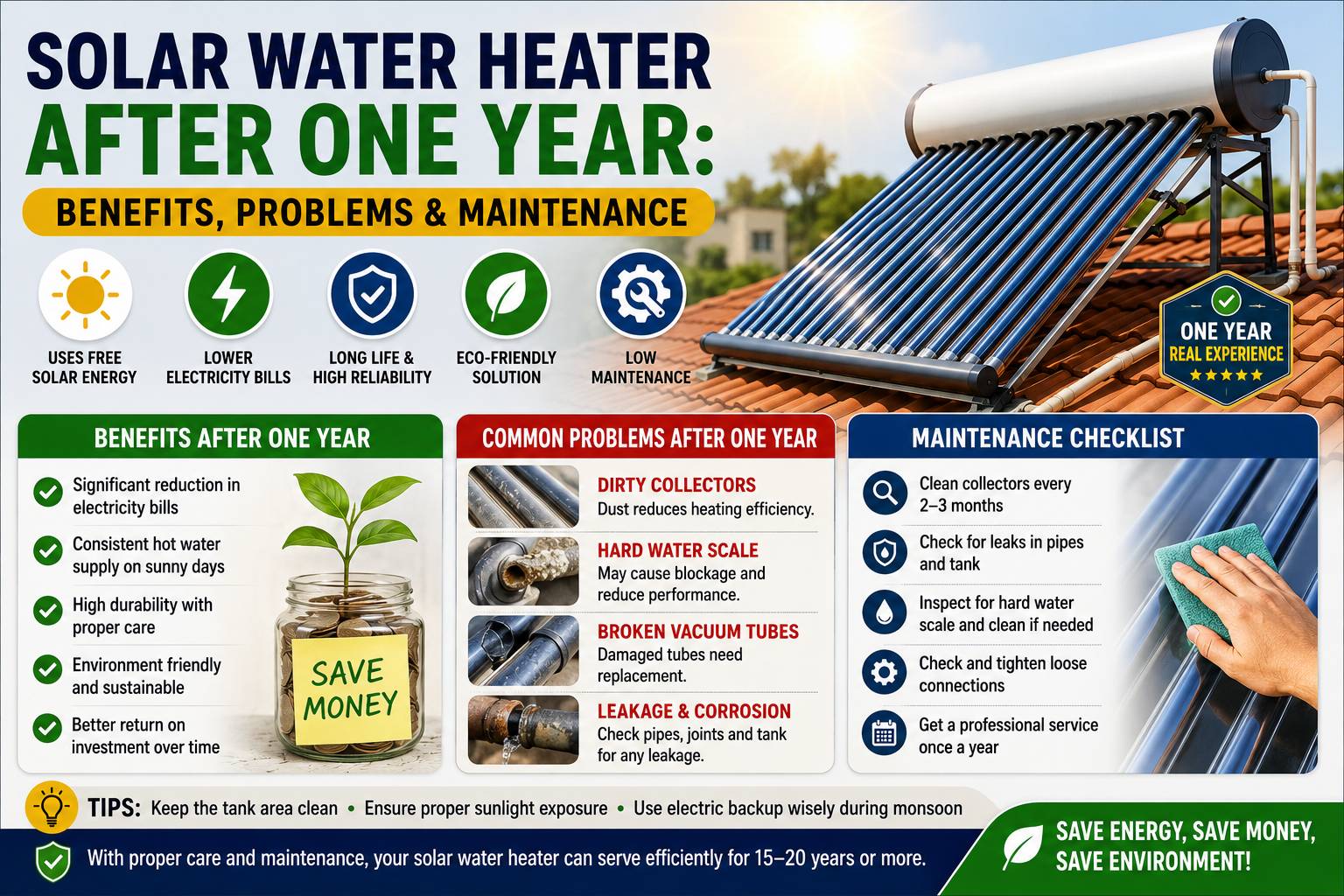
A solar water heater can dramatically reduce the electricity used for hot water—but what happens after you have actually used it for one full year?
The first few months are usually exciting. The system is installed, the sun heats the water, and the electric geyser gets used much less.
But after 12 months, homeowners start noticing the things that sales brochures don’t always explain:
- How much electricity did you really save?
- Does the system still heat water as well as it did initially?
- What happens during monsoon?
- Do solar tubes need cleaning?
- What happens if a tube breaks?
- Does hard water cause problems?
- How often should the tank and plumbing be checked?
- Is electric backup necessary?
- Was the investment actually worth it?
This one-year reality check answers those questions and gives you a practical maintenance checklist for Indian homes.
India’s Ministry of New and Renewable Energy (MNRE) describes solar water heating as a mature solar-thermal technology that uses the sun’s free energy and can provide significant electricity-bill savings. MNRE says 100–500 litres-per-day (LPD) systems are suitable for domestic use.
☀️ Quick Answer: Is a Solar Water Heater Still Worth It After One Year?
Yes, in most suitable homes.
If your solar water heater has:
- adequate sunlight,
- correct capacity,
- good-quality components,
- proper installation,
- minimal shading,
- and regular maintenance,
it should continue providing hot water after one year while substantially reducing the electricity required for water heating.
However, performance after one year depends more on installation, water quality, sunlight and maintenance than simply on the brand name.
The first-year experience also reveals whether the system was correctly sized for your family’s actual hot-water consumption.
What Changes After One Year?
A solar water heater doesn’t suddenly become less effective after 12 months.
Instead, gradual changes can occur because of:
- dust and dirt on collectors,
- mineral deposits,
- water-quality issues,
- plumbing deterioration,
- insulation damage,
- shading caused by growing vegetation,
- leaks,
- damaged evacuated tubes,
- incorrect system pressure,
- poor installation.
The good news is that many of these issues can be identified during a routine inspection.
1. ⚡ The Biggest Benefit: Lower Electricity Consumption
The biggest financial benefit remains the same:
Sunlight replaces electricity as the primary energy source for heating water.
MNRE states that solar water heating uses free solar energy and can result in significant electricity-bill savings.
For a household that previously relied heavily on an electric geyser, the difference can become visible over a full year.
For example, if a family previously spent an average of:
₹1,500/month
on electricity attributable to water heating, that’s:
₹18,000/year
A solar water heater may substantially reduce that expense.
But don’t assume the entire ₹18,000 automatically disappears.
You may still use electricity for:
- electric backup,
- pumps in some systems,
- occasional heating,
- other appliances that were previously confused with geyser consumption.
How to Calculate Your Real First-Year Saving
The best method is to compare electricity consumption rather than simply comparing total electricity bills.
Before solar
Record:
Annual electricity consumption before installation
After solar
Record:
Annual electricity consumption after installation
Then compare the difference while accounting for changes in:
- family size,
- air-conditioner usage,
- appliances,
- electricity tariff,
- working-from-home patterns,
- EV charging,
- seasonal consumption.
This is much more accurate than saying:
“My electricity bill fell by ₹2,000, so solar saved ₹2,000.”
Your entire electricity bill contains many variables.
2. 🚿 Hot Water Availability After One Year
A properly sized system should continue providing hot water after one year.
But homeowners sometimes report:
“The water isn’t as hot as it was when the system was new.”
That doesn’t automatically mean the solar heater has failed.
Check these factors first:
☀️ Sunlight
Is the collector receiving the same sunlight?
🌳 New shade
Has a tree grown or has another structure started blocking the collector?
🧼 Collector cleanliness
Dust and dirt can reduce the amount of solar radiation reaching the collector.
💧 Water circulation
A plumbing or circulation problem can affect performance.
🌡️ Seasonal conditions
Winter and prolonged cloudy weather naturally reduce solar heat availability.
3. 🌧️ What Happens During Monsoon?
This is one of the biggest real-world tests.
During sunny days:
Solar collector → heat → storage tank
During extended cloudy or rainy periods:
Solar energy available ↓ → water temperature may decrease
This doesn’t necessarily mean the system is defective.
Solar water heaters depend on available solar radiation.
In Karnataka, for example, monsoon conditions can produce several consecutive days of lower solar availability.
Should You Keep an Electric Backup?
For many homes, yes.
A hybrid arrangement can be very practical:
☀️ Solar heating
⚡ Electric backup
The solar system supplies most of the hot water during favourable conditions.
The electric backup provides additional heating when solar energy isn’t sufficient.
This is particularly useful for:
- families with fixed bathing schedules,
- homes requiring hot water early in the morning,
- extended rainy periods,
- elderly residents,
- larger families.
4. 🧼 Do Solar Water Heater Tubes Need Cleaning?
Yes, collector surfaces can accumulate:
- dust,
- bird droppings,
- leaves,
- pollution,
- other deposits.
The required cleaning frequency depends on the local environment.
A house near:
- a busy road,
- construction,
- agricultural fields,
- dusty terrain
may require more frequent cleaning than a house in a relatively clean environment.
Practical rule
Inspect the collectors periodically.
If significant dirt or deposits are visible, clean them using a method recommended by the manufacturer.
Don’t use abrasive materials or aggressive chemicals unless specifically approved.
5. 🧪 Hard Water: The Hidden Problem
Hard water is one of the biggest concerns for water-heating systems in many Indian locations.
Water containing high levels of dissolved minerals can contribute to deposits in:
- pipes,
- valves,
- tanks,
- heating components,
- heat-transfer surfaces.
The consequences can include:
- reduced water flow,
- slower heating,
- more frequent servicing,
- component deterioration.
After one year, check:
✔ Water flow
✔ Hot-water temperature
✔ Visible leakage
✔ Pipe condition
✔ Valves
✔ Unusual noise
If your home has particularly hard water, ask the manufacturer or qualified technician about the appropriate maintenance procedure for your specific system.
6. 🔧 Inspect the Plumbing
The solar collector isn’t the only part of the system.
A typical solar water-heating system includes:
- storage tank,
- solar collectors,
- hot-water pipes,
- cold-water supply,
- valves,
- insulation,
- mounting structure.
MNRE describes these as the main elements of solar water-heating systems.
After one year, inspect the plumbing for:
Leaks
Even a small leak can waste water and reduce system performance.
Insulation damage
Damaged insulation allows heat to escape.
Corrosion
Check exposed metal components and connections.
Loose connections
Wind, thermal expansion and normal use can affect fittings.
7. 🔍 Check the Storage Tank
The storage tank is one of the most important components.
Look for:
- external corrosion,
- leakage,
- damaged insulation,
- unusual pressure behaviour,
- temperature problems.
Don’t open or modify pressure-related components yourself.
If you notice:
water leaking from the tank,
or
unusual pressure,
have a qualified technician inspect it.
8. 🪟 What About Broken ETC Tubes?
If your system uses Evacuated Tube Collectors (ETC), individual tubes can potentially be damaged.
Possible causes include:
- accidental impact,
- hail,
- improper handling,
- installation problems,
- thermal/mechanical stress.
A broken tube should not simply be ignored.
Ask the installer whether the affected tube needs replacement and whether the system can continue operating safely with the damaged component.
ETC vs FPC After One Year
Two major collector technologies used in solar water heating are:
ETC — Evacuated Tube Collector
Common characteristics:
- cylindrical glass tubes,
- good heat collection,
- widely used in residential systems.
FPC — Flat Plate Collector
Common characteristics:
- rigid collector panel,
- different construction,
- often selected for durability and particular site requirements.
MNRE lists Indian standards for both evacuated-tube and flat-plate solar water-heating systems, including IS 16544 for all-glass evacuated-tube systems and IS 12933 for flat-plate collectors.
After one year, the most important question isn’t simply ETC vs FPC.
It’s:
Is the system performing properly for your location and water quality?
9. 💰 What About ROI After One Year?
This is where expectations need to be realistic.
Suppose your system cost:
₹50,000
and your first-year electricity saving was:
₹15,000
Then your simple first-year recovery is:
₹15,000 / ₹50,000 = 30%
You haven’t recovered the entire investment yet.
But the system continues operating.
If the annual saving remains around ₹15,000:
| Year | Cumulative Saving |
|---|---|
| 1 | ₹15,000 |
| 2 | ₹30,000 |
| 3 | ₹45,000 |
| 4 | ₹60,000 |
| 5 | ₹75,000 |
This is only an illustration.
Actual savings can change because of:
- electricity tariffs,
- weather,
- hot-water consumption,
- maintenance,
- system performance,
- backup usage.
10. 📉 Don’t Expect the Same Saving Every Month
A solar water heater doesn’t produce identical savings throughout the year.
For example:
Summer
☀️ High solar availability
🔥 High hot-water temperature
⚡ Very little backup
Monsoon
🌧️ Lower solar availability
🔥 Lower average heating contribution
⚡ More backup may be required
Winter
☀️ Depends on location and sunlight
🌡️ Greater temperature rise may be required
⚡ Backup usage can increase
Therefore, calculate ROI using annual performance, not a single month.
11. 🔥 Why Your Water May Be Too Hot
Another problem homeowners sometimes notice is:
“The water becomes extremely hot.”
Solar collectors can heat water significantly under strong sunlight.
This is why systems need appropriate safety and temperature management.
If water becomes excessively hot or you notice abnormal pressure or other safety concerns, don’t attempt to modify valves or pressure devices yourself.
Have the system inspected by a qualified technician.
12. 🏠 Is Your Family Using the Right Capacity?
After one year, you can finally determine whether you bought the correct capacity.
For example:
100 LPD
May be suitable for a small household with moderate hot-water use.
200 LPD
Can be suitable for a medium-sized family.
300 LPD
May be useful for larger families or higher consumption.
MNRE states that 100–500 LPD systems are suitable for domestic applications.
But capacity should be selected based on actual hot-water demand—not just family size.
🚨 Signs Your Solar Water Heater Needs Attention
Watch for these warning signs:
❌ Water isn’t getting hot even on sunny days
Possible causes include:
- shading,
- collector problems,
- circulation issues,
- plumbing problems,
- damaged components.
❌ Water temperature suddenly drops
Investigate:
- leaks,
- shading,
- collector condition,
- water mixing,
- system circulation.
❌ Water leakage
Don’t ignore it.
❌ Reduced water pressure
Possible plumbing or valve issue.
❌ Broken glass tube
Arrange inspection/replacement.
❌ Excessive corrosion
Have the system evaluated.
❌ Unusual noises
Especially if accompanied by poor heating or leakage.
❌ Electric backup running much more frequently
This can be an important signal that solar contribution has decreased.
🛠️ One-Year Solar Water Heater Maintenance Checklist
Here’s a practical checklist for homeowners.
☀️ Collector
- Check for dust
- Check for bird droppings
- Check for broken tubes
- Check for shading
- Check mounting condition
🚿 Plumbing
- Check for leaks
- Check insulation
- Inspect joints
- Check water flow
🛢️ Tank
- Check for leakage
- Inspect external condition
- Check insulation
- Check temperature performance
🔧 System
- Check valves
- Check backup heating
- Check unusual noises
- Review water quality issues
📄 Documentation
- Keep purchase invoice
- Keep warranty documents
- Record installation date
- Record service history
- Save model/serial number
📅 How Often Should You Service a Solar Water Heater?
There isn’t one universal service interval that applies to every solar water heater.
The appropriate schedule depends on:
- collector technology,
- water quality,
- manufacturer instructions,
- climate,
- system configuration,
- usage.
A sensible approach is to:
Inspect regularly
Look for visible problems.
Conduct periodic professional inspection
Follow the manufacturer’s recommended service schedule.
Perform additional servicing
If you notice:
- reduced heating,
- leakage,
- scaling,
- unusual pressure,
- damaged components.
MNRE’s current solar-water-heater page also points to IS 12976:2023, Solar Water Heating Systems – Code of Practice, as an applicable Indian standard.
💧 What Happens If You Ignore Maintenance?
A solar water heater may continue operating even when maintenance is overdue.
But small problems can become expensive.
For example:
Small leak
↓
Water loss
↓
Reduced performance
↓
Damage to insulation/components
↓
Larger repair
Similarly:
Dirty collector
↓
Reduced solar absorption
↓
More electric backup
↓
Higher electricity bill
The owner may think:
“Solar isn’t saving me money anymore.”
when the actual problem is simply maintenance.
🧮 One-Year Performance Test
Here’s a simple test every homeowner should perform.
Step 1
Check how much hot water your family uses each day.
Step 2
Check whether the water becomes sufficiently hot on a clear sunny day.
Step 3
Observe electric backup usage.
Step 4
Compare electricity consumption with the period before installation.
Step 5
Inspect the collector and plumbing.
Step 6
Check for leaks and damaged components.
Step 7
Calculate your annual saving.
Solar Water Heater One-Year ROI Formula
Use:
Annual Electricity Saving = Electricity Cost Before Solar − Electricity Cost for Backup
Then:
Net Annual Saving = Annual Electricity Saving − Maintenance Cost
And:
Simple Payback = Installation Cost ÷ Net Annual Saving
Example
System cost:
₹50,000
Annual electricity saving:
₹17,000
Maintenance:
₹1,500
Net annual saving:
₹15,500
Simple payback:
₹50,000 ÷ ₹15,500 ≈ 3.2 years
Again, this is an example—not a guaranteed payback period.
What If Your Savings Are Much Lower Than Expected?
Suppose you expected:
₹20,000/year
but actually saved:
₹8,000/year.
Don’t immediately conclude that the solar water heater was a bad investment.
Investigate:
1. Is the system oversized?
You may be paying for capacity you don’t use.
2. Is the roof shaded?
Even partial shading can affect solar collection.
3. Is the collector dirty?
Inspect it.
4. Is the family using more hot water?
Consumption may have increased.
5. Is electric backup being used unnecessarily?
Check the backup settings and operating pattern.
6. Is the water temperature lower?
Compare performance on clear sunny days.
7. Is there a plumbing problem?
Leaks and poor circulation can reduce performance.
🔥 One-Year Reality: What Salespeople May Not Tell You
A solar water heater isn’t a magic box that produces unlimited hot water.
Its performance depends on:
Sunlight + collector + tank + plumbing + installation + water quality + usage
If any part of that equation is poor, the overall result can suffer.
This is why installation quality is just as important as product selection.
Is a Solar Water Heater Maintenance-Free?
No.
This is one of the biggest myths.
It generally requires less ongoing energy expenditure than an electric geyser, but that doesn’t mean:
“Install it and forget it for 20 years.”
Periodic inspection and maintenance remain important.
Can You Maintain It Yourself?
You can perform basic visual checks such as:
- checking for leaks,
- looking for broken tubes,
- checking visible dirt,
- checking shading,
- observing hot-water performance.
But don’t attempt to:
- open pressurized tanks,
- modify safety valves,
- dismantle plumbing,
- repair electrical backup wiring,
- work on rooftop equipment without appropriate safety precautions.
For technical repairs, use a qualified installer/service professional.
🏆 Solar Water Heater After One Year: Pros and Cons
| Factor | After 1 Year |
|---|---|
| Electricity savings | 🟢 Major potential benefit |
| Solar heating | 🟢 Continues normally with good sunlight |
| Maintenance | 🟡 Required periodically |
| Monsoon performance | 🟡 Lower solar contribution |
| Electric backup | 🟡 Useful during low sunlight |
| Hard water | 🟠 Requires attention |
| Roof space | 🟡 Permanently occupied |
| ROI | 🟢 Usually still in progress |
| Lifespan | 🟢 Long-term asset |
| Environmental benefit | 🟢 Significant |
Solar Water Heater vs Electric Geyser After One Year
This is where the difference becomes obvious.
Electric geyser
After one year:
Purchase cost + electricity consumption + maintenance
Solar water heater
After one year:
Purchase cost + maintenance + occasional backup electricity
The solar system generally has the advantage in operating cost, while the electric geyser has the advantage in lower initial cost and easier installation.
Should You Buy a Solar Water Heater in 2026?
For an independent house owner, it is worth considering if:
✅ Your family uses hot water every day
✅ You have suitable rooftop space
✅ The collector receives adequate sunlight
✅ You plan to remain in the property for several years
✅ Your electricity tariff makes electric heating expensive
It may be less attractive if:
❌ You’re renting
❌ Your roof is heavily shaded
❌ Hot-water consumption is very low
❌ You have no suitable installation location
Quality Matters More Than the Cheapest Price
MNRE lists multiple Indian standards covering solar water-heating systems, including standards for evacuated tubes, tanks, flat-plate collectors, performance testing, durability/reliability and code of practice.
MNRE also publishes information on BIS-approved solar water-heater manufacturers, which is useful when evaluating products and suppliers.
Don’t choose a system solely because:
“This dealer is ₹10,000 cheaper.”
Compare:
- product quality,
- applicable standards,
- warranty,
- installation,
- service network,
- spare parts,
- tank construction,
- collector technology,
- local water conditions.
⭐ 12-Month Solar Water Heater Maintenance Calendar
Every month
👀 Quick visual inspection
Check:
- leaks,
- obvious damage,
- broken tubes,
- unusual water temperature.
Every few months
🧼 Check collector cleanliness and surrounding shading.
Before/after monsoon
🌧️ Inspect:
- plumbing,
- mounting,
- insulation,
- collector condition.
Around the one-year mark
🔧 Consider a proper system inspection, particularly if:
- performance has fallen,
- backup usage has increased,
- water quality is poor,
- leaks are present,
- the manufacturer recommends annual service.
Always follow the product manufacturer’s maintenance instructions where they differ.
Frequently Asked Questions
Is a solar water heater still effective after one year?
Yes. A properly installed and maintained solar water heater should continue operating after one year. Performance depends on sunlight, collector condition, water quality, installation and system design.
Does solar water heater efficiency decrease after one year?
There is no universal one-year performance drop. A reduction in output may instead indicate dirt, shading, scaling, plumbing problems, component damage or other maintenance issues.
How often should a solar water heater be cleaned?
There is no single interval for every system. Collector cleaning frequency depends on local dust, pollution and environmental conditions. Inspect the collectors regularly and follow the manufacturer’s recommendations.
Does hard water damage a solar water heater?
Hard water can contribute to mineral scaling and maintenance problems in water-heating systems. The severity depends on water chemistry and system design.
Can a solar water heater work during monsoon?
Yes, but prolonged cloudy or rainy weather can reduce solar heat production. An electric backup can provide hot water when solar energy is insufficient.
Should I keep an electric geyser after installing solar?
Keeping an electric backup can be useful, particularly during monsoon, winter or periods of unusually high hot-water demand.
What should I do if one ETC tube breaks?
Have the damaged tube inspected and replaced according to the manufacturer’s instructions. Don’t ignore damaged glass components on a rooftop system.
Is a solar water heater maintenance-free?
No. It generally has low operating-energy costs, but periodic inspection, cleaning, plumbing checks and occasional component maintenance may still be required.
How long can a solar water heater last?
Service life varies significantly by technology, product quality, water quality, installation and maintenance. Rather than relying on a single lifespan number, evaluate the manufacturer’s warranty, applicable standards and expected service conditions.
AEO Quick Answers
What happens to a solar water heater after one year?
After one year, a properly installed solar water heater should continue providing hot water and reducing the electricity required for water heating. Performance can be affected by dust, shading, hard-water deposits, leaks, damaged collectors, plumbing problems and seasonal changes in sunlight.
Does a solar water heater need maintenance after one year?
Yes. A one-year inspection is sensible, particularly for checking collectors, plumbing, tank condition, insulation, leaks, valves and overall hot-water performance. The exact service schedule should follow the manufacturer’s recommendations and applicable maintenance guidance.
Why is my solar water heater not heating water after one year?
Possible causes include reduced sunlight, new shading, dirty collectors, broken evacuated tubes, plumbing or circulation problems, water-quality issues, leaks or incorrect system sizing. If the system performs poorly even on clear sunny days, have it professionally inspected.
Is a solar water heater worth it after one year?
For homes with suitable sunlight and regular hot-water demand, it can remain a strong long-term energy-saving investment. The first-year ROI depends on the installation cost, electricity displaced, backup usage and maintenance expenses.
🔥 Final Verdict: Solar Water Heater After One Year
The one-year mark is actually the perfect time to judge your solar water heater.
Don’t judge it simply by asking:
“Is the water hot?”
Instead ask:
☀️ Is it producing enough hot water?
⚡ How much electricity did I save?
💰 What was my actual first-year ROI?
🔧 Does it need maintenance?
🌧️ How much backup did I use during monsoon?
💧 Is hard water affecting performance?
🏠 Is the system correctly sized for my family?
If the answers are positive, your solar water heater is doing exactly what it was designed to do: using free solar energy to reduce the electricity needed for hot water.
MNRE classifies solar water heating as a mature technology and notes its potential for significant electricity-bill savings. It also maintains technical standards and information on approved manufacturers, giving homeowners useful reference points when buying or maintaining a system.
The real lesson after one year:
A solar water heater isn’t a “fit and forget” appliance. It is a long-term energy asset. Treat it like one—monitor its performance, maintain it properly and calculate your actual savings every year.
That is how you turn a solar water heater from a one-time purchase into a 20-year electricity-saving investment.