Farmers in Karnataka looking to reduce irrigation costs often ask three important questions: What is the price of a 3HP, 5HP or 7.5HP solar pump? How much subsidy can they receive? How can they apply for a solar pump through the government?
The PM-KUSUM scheme was designed to support solar-powered agricultural irrigation through standalone solar pumps and solarisation of existing grid-connected agricultural pumps. However, the original scheme period was scheduled to end on 31 March 2026, and farmers must verify the latest Karnataka government notification before assuming that fresh applications or subsidies are available in October 2026. Official MNRE PM-KUSUM guidelines.
This guide explains indicative 3HP, 5HP and 7.5HP pump costs, the historical subsidy structure, eligibility, documents and the official portal for checking application status.
Quick Answer: Solar Pump Price and Subsidy in Karnataka
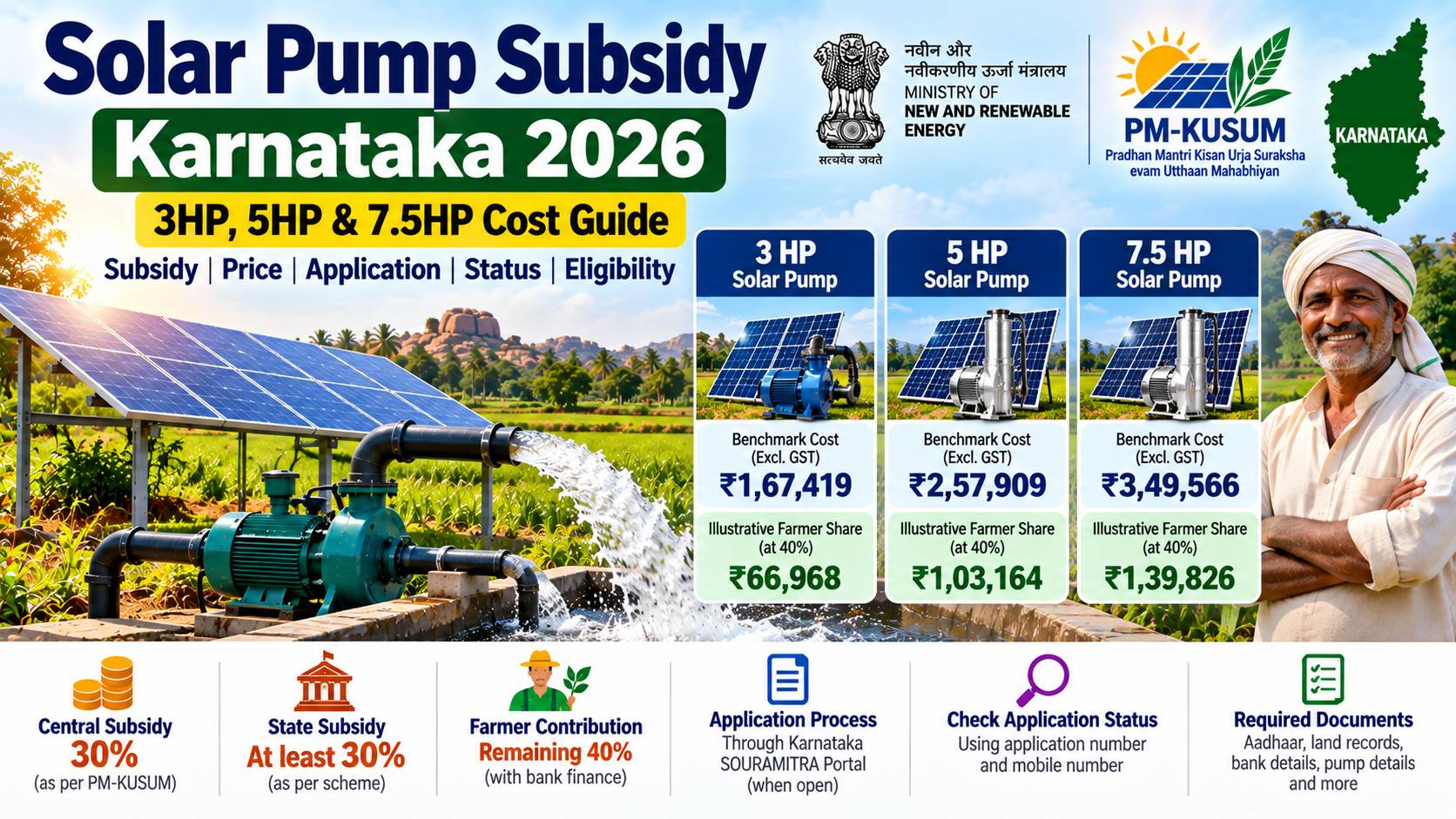
Under the MNRE benchmark-cost order dated 4 September 2023, the benchmark costs for standalone solar agricultural pumps in general states were as follows. These are historical benchmark costs excluding GST, not guaranteed current market prices or Karnataka tender prices. MNRE benchmark-cost order.
| Solar pump capacity | MNRE benchmark cost (excluding GST) | Illustrative farmer share at 40% |
|---|---|---|
| 3HP | ₹1,67,419 | ₹66,968 |
| 5HP | ₹2,57,909 | ₹1,03,164 |
| 7.5HP | ₹3,49,566 | ₹1,39,826 |
Important: The farmer-share figures are arithmetic illustrations based on a hypothetical 60% combined subsidy. They are not confirmed Karnataka prices or approved beneficiary contributions for 2026. Actual costs and assistance depend on the applicable tender, taxes, state contribution, scheme sanction and beneficiary category.
1. What Is the Solar Pump Subsidy Scheme in Karnataka?
The main central programme historically used to support solar agricultural pumps is the Pradhan Mantri Kisan Urja Suraksha evam Utthaan Mahabhiyan (PM-KUSUM), administered by the Ministry of New and Renewable Energy (MNRE).
Its relevant components include:
- Component B: Standalone solar agricultural pumps, generally intended for eligible off-grid locations.
- Component C — Individual Pump Solarisation: Solarisation of eligible existing grid-connected agricultural pumps.
- Component C — Feeder-Level Solarisation: Solar power projects supplying agricultural electricity feeders.
Under the original scheme framework, Components B and C for individual pump solarisation generally provided central financial assistance of 30% of the applicable benchmark cost or tender cost, whichever was lower. The state was expected to contribute at least 30%, with the remaining cost payable by the beneficiary. The guidelines also contain provisions for implementation without the state’s 30% share, in which case the farmer’s share can increase. MNRE official scheme details.
These historical provisions should not be treated as a guarantee of fresh subsidy approval in Karnataka during 2026.
2. 3HP Solar Pump Price in Karnataka
A 3HP solar pump may suit smaller irrigation requirements, depending on the water source, pumping depth, delivery distance and crop water demand.
The historical MNRE benchmark cost for a 3HP standalone solar pump in a general state was ₹1,67,419 excluding GST.
The actual price of a complete installation can depend on:
- Surface pump versus submersible pump.
- Borewell depth and water level.
- Required discharge and total dynamic head.
- Solar panel capacity and mounting structure.
- Motor, controller and protection equipment.
- Pipework, installation, transport and applicable taxes.
- The tender specification and approved vendor.
A 3HP pump is not automatically suitable for every small farm. A deep borewell or high irrigation demand may require a different pump configuration even when the farm’s acreage is limited.
Before buying: Ask for a written quotation that specifies the pump model, solar array capacity, head and discharge, installation scope, warranty and after-sales service.
3. 5HP Solar Pump Price in Karnataka
A 5HP solar pump may be appropriate for farms with greater irrigation requirements, but the correct capacity depends on the hydraulic conditions and crop demand.
The historical MNRE benchmark cost for a 5HP standalone solar pump was ₹2,57,909 excluding GST.
When comparing 5HP solar pump quotations, check:
- The actual pump’s rated capacity and operating range.
- Borewell depth and seasonal water-level variation.
- Required water discharge per hour.
- Solar module make and rated wattage.
- Controller protections and dry-run protection.
- Installation, commissioning and maintenance terms.
- Whether the quote is for an unsubsidised purchase or an approved government tender installation.
Do not compare two quotations using HP alone. A pump designed for a deep borewell can have different performance characteristics from a pump designed to lift water from a shallow source.
4. 7.5HP Solar Pump Price in Karnataka
A 7.5HP solar pump may be considered for higher irrigation demand, deeper water sources or larger delivery requirements, subject to a proper technical assessment.
The historical MNRE benchmark cost for a 7.5HP standalone solar pump in a general state was ₹3,49,566 excluding GST.
Under the original PM-KUSUM framework, standalone pumps under Component B were supported up to 7.5HP. Component C individual pump solarisation also had specific capacity-related limits for calculating central assistance. Check the current applicable guidelines before selecting a system.
Before purchasing a 7.5HP pump, confirm that the water source can sustain the required discharge. A higher-capacity pump cannot compensate for inadequate groundwater availability and may not be economical if the water yield is low.
5. How Much Subsidy Can Farmers Receive?
Under the original PM-KUSUM structure for eligible Components B and C individual pump solarisation, the central share was generally 30% of the applicable benchmark or tender cost, whichever was lower. The state share was expected to be at least 30% where that arrangement applied. The beneficiary paid the balance.
The following table shows a hypothetical calculation using the historical MNRE benchmark costs. It does not confirm that Karnataka currently offers this subsidy.
| Pump | Benchmark cost | Illustrative central share (30%) | Illustrative state share (30%) | Illustrative farmer share (40%) |
|---|---|---|---|---|
| 3HP | ₹1,67,419 | ₹50,226 | ₹50,226 | ₹66,968 |
| 5HP | ₹2,57,909 | ₹77,373 | ₹77,373 | ₹1,03,164 |
| 7.5HP | ₹3,49,566 | ₹1,04,870 | ₹1,04,870 | ₹1,39,826 |
Figures are rounded to the nearest rupee. Calculations use the historical benchmark cost excluding GST; actual tender calculations and payment amounts may differ.
The final farmer contribution can change because of tender pricing, taxes, additional equipment, approved specifications, scheme availability and the state funding arrangement. A vendor should not promise a subsidy amount without providing the relevant official sanction or approved beneficiary cost calculation.
6. Is the PM-KUSUM Solar Pump Subsidy Available in Karnataka in 2026?
The original PM-KUSUM scheme period listed by MNRE ended on 31 March 2026. The published scheme period does not, by itself, confirm whether a subsequent extension, new allocation or Karnataka application window is available.
Farmers should check the following official resources before submitting an application or making a payment:
- Karnataka Souramitra portal: https://souramitra.com/KA/landing.html
The portal provides PM-KUSUM Component B information and application-status tracking. - MNRE PM-KUSUM page: https://mnre.gov.in/en/pradhan-mantri-kisan-urja-suraksha-evam-utthaan-mahabhiyaan-pm-kusum/
Check the latest scheme period, guidelines and implementing-agency information. - Karnataka Renewable Energy Development Limited (KREDL): https://kredl.karnataka.gov.in/
Check official Karnataka notices and contact details.
The Souramitra portal includes an application-tracking facility using an application number and consumer mobile number. The presence of a portal or an old application form does not prove that new applications are open.
Before paying: Confirm the current application window, approved vendor, sanctioned pump capacity, beneficiary contribution and payment procedure through the authorised implementing agency.
7. Who Is Eligible for a Solar Pump Subsidy?
Eligibility depends on the applicable component, Karnataka’s implementation rules and the current allocation.
Under the original framework, the relevant applicant categories included:
- Individual farmers seeking eligible standalone solar pumps.
- Farmers with existing grid-connected agricultural pumps seeking eligible pump solarisation.
- Other eligible entities or groups where permitted under the relevant component.
For a standalone pump under Component B, the original scheme focused on off-grid areas where grid electricity was unavailable. For Component C individual pump solarisation, the applicant generally needed an existing eligible grid-connected agricultural pump.
Ownership or cultivation records alone do not guarantee approval. The implementing agency may verify the location, pump type, irrigation source, land records, electricity connection and other technical requirements.
8. Documents Farmers Should Keep Ready
Prepare the following documents where applicable, then verify the current Karnataka application checklist:
- Aadhaar and registered mobile number.
- Farmer identity and land ownership or cultivation records.
- Survey number and land details.
- Bank account details and supporting documents.
- Existing agricultural electricity connection details for Component C.
- Borewell or water-source information.
- Pump capacity, type and technical details.
- Category certificate, if applicable under the programme.
- Passport-size photograph or other documents requested by the implementing agency.
Do not upload sensitive documents to unofficial websites or send them to an unverified agent.
9. How to Check Solar Pump Application Status in Karnataka
If you have already applied through the Karnataka portal, use the official tracking facility.
- Open the Souramitra Karnataka portal.
- Find the PM-KUSUM application tracking section.
- Enter the application number and consumer mobile number requested by the portal.
- Complete any verification step displayed.
- Review the status and save the acknowledgement or receipt for your records.
If your application is pending, contact the authorised agency using official contact details. Do not assume that a pending application guarantees installation or subsidy payment.
10. Solar Pump Subsidy vs Buying a Pump Without Subsidy
| Factor | Government-supported installation | Private purchase |
|---|---|---|
| Upfront payment | Depends on approved beneficiary contribution | Based on vendor quotation |
| Subsidy | Only when eligible and formally approved | Do not assume a government subsidy |
| Equipment | Must meet applicable scheme specifications | Depends on the selected product and contract |
| Vendor choice | May be restricted to approved or tender-selected vendors | Generally broader choice |
| Timeline | Depends on allocation, approval and installation process | Depends on vendor stock and installation schedule |
| Documentation | Scheme application and verification may be required | Commercial invoice and warranty documentation |
A subsidised pump is not automatically cheaper in every situation if eligibility is unavailable or installation is delayed. Compare the complete written cost and the conditions of each route before deciding.
11. How to Choose Between 3HP, 5HP and 7.5HP
Select pump capacity based on the irrigation system, not solely on acreage.
| Requirement | What to assess |
|---|---|
| Water source | Open well, borewell, pond or other source |
| Water level | Static and seasonal pumping level |
| Delivery requirement | Litres per hour and daily irrigation demand |
| Total head | Vertical lift plus friction losses in pipes |
| Crops | Water demand during different growth stages |
| Solar availability | Expected operating hours and shading |
| Future use | Planned expansion of irrigated area or crop changes |
Ask a qualified pump installer to calculate the required discharge and total dynamic head before selecting the pump. The right capacity should deliver the required water within the available solar operating hours without unnecessary oversizing.
Frequently Asked Questions
What is the price of a 3HP solar pump in Karnataka in 2026?
The historical MNRE benchmark cost was ₹1,67,419 excluding GST for a 3HP standalone solar pump in a general state. This is not a verified 2026 retail price or Karnataka tender rate. Obtain a current written quotation for the exact pump configuration.
What is the price of a 5HP solar pump in Karnataka?
The historical MNRE benchmark cost was ₹2,57,909 excluding GST. The current installed price depends on the approved specification, tender or vendor quotation, taxes and installation requirements.
What is the price of a 7.5HP solar pump in Karnataka?
The historical MNRE benchmark cost was ₹3,49,566 excluding GST for a 7.5HP standalone solar pump in a general state. It should not be treated as a confirmed current selling price.
Can a farmer receive a 60% subsidy on a solar pump?
The original PM-KUSUM framework generally combined 30% central financial assistance with at least 30% state support for eligible Component B and Component C individual pump solarisation projects where the state-share arrangement applied. Actual assistance depends on the approved project, tender cost and current state implementation. Do not assume that the same structure is currently available in Karnataka.
Is PM-KUSUM Karnataka registration open in October 2026?
The official MNRE page lists the original scheme period through 31 March 2026. A current extension or fresh Karnataka application window must be confirmed through official notifications and the authorised implementing agency. Do not rely on old application dates or third-party advertisements.
How can I check my Karnataka solar pump application status?
Use the Souramitra Karnataka portal and follow its application-tracking instructions. Keep your application number and registered consumer mobile number ready.
Is a solar pump suitable for a deep borewell?
It can be, provided the selected pump is designed for the borewell’s total dynamic head and required discharge. A technical assessment of water level, borewell yield, pipework and daily water demand is necessary before buying.
Can I buy a solar pump first and claim the subsidy later?
Do not assume that a privately purchased pump will qualify for reimbursement. Government assistance generally depends on the applicable programme, approval and prescribed procurement or installation process. Obtain written confirmation from the implementing agency before placing an order.
Final Takeaway
For Karnataka farmers, the practical first step is to establish the required pump capacity and obtain a current, itemised installation quotation. Historical MNRE benchmark costs provide a reference for understanding the 3HP, 5HP and 7.5HP categories, but they do not establish today’s retail price or subsidy entitlement.
Before paying a dealer, verify whether a relevant PM-KUSUM application window is open, confirm the approved beneficiary contribution and use the official Karnataka portal or KREDL for scheme-related information.
Related guides on SolarKarnataka.com:
- PM-KUSUM Karnataka: Solar Pump Subsidy, Application and Status
- Solar for Farmers
- 1 Acre Solar Farm Income Reality in India
- Solar Calculators
Editorial note: Government schemes, tender prices and application windows can change. Verify current official notifications before making financial decisions.