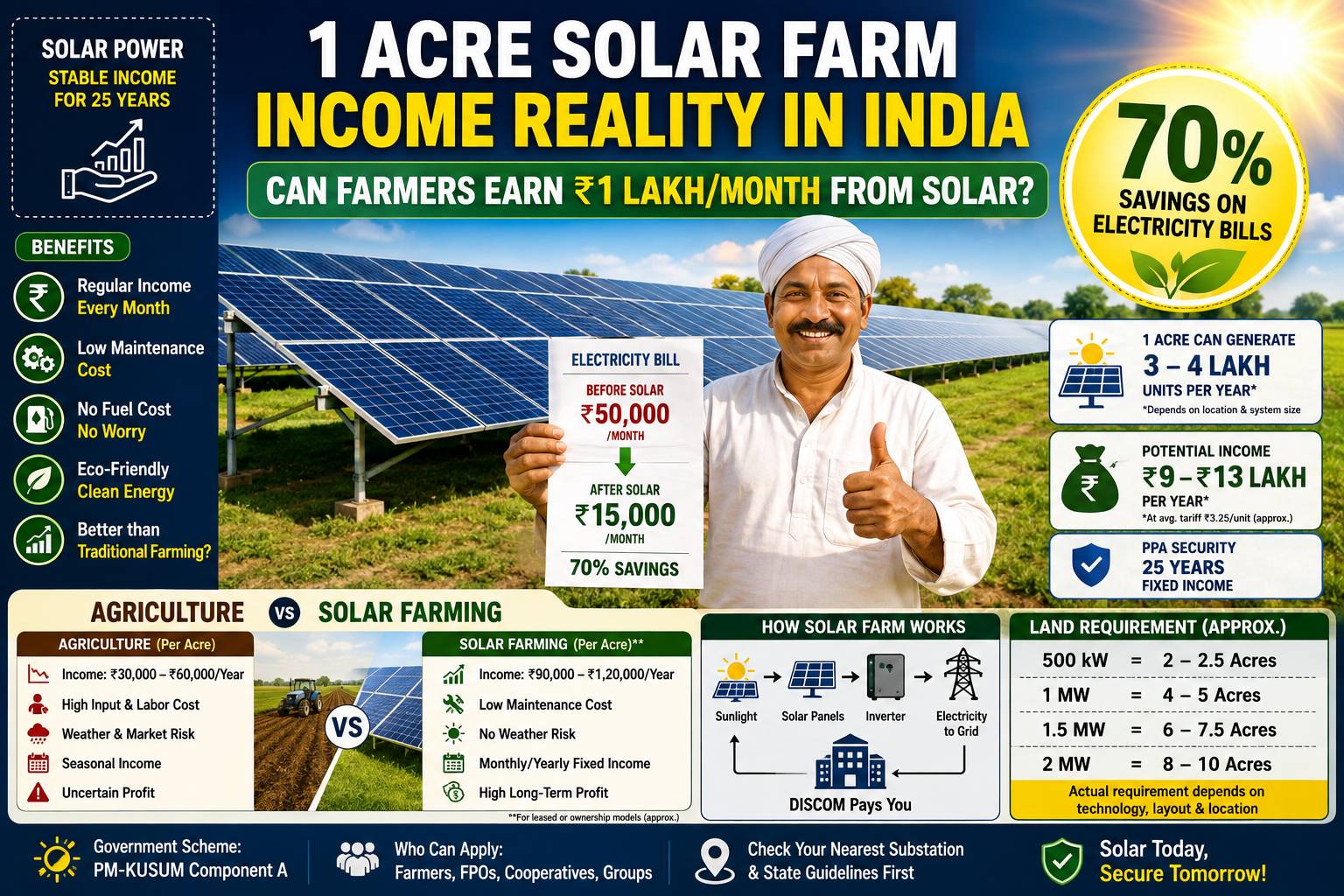
Can a Farmer Really Earn ₹1 Lakh a Month From Solar?
Yes, solar can create substantial long-term income from agricultural land—but the popular claim that “1 acre of solar land can easily generate ₹1 lakh every month” is misleading.
The first thing a farmer needs to understand is the difference between:
- Owning and operating a solar power plant
- Leasing land to a solar developer
- Participating in PM-KUSUM Component A
- Using solar to reduce the cost of agricultural operations
These are completely different business models.
Under PM-KUSUM Component A, grid-connected renewable-energy plants are generally in the 500 kW to 2 MW range. The electricity is purchased by the DISCOM at a tariff determined by the relevant State Electricity Regulatory Commission, under the scheme framework. Farmers who cannot finance the plant themselves can also choose a developer/DISCOM development model and receive mutually agreed land lease income.
That means a farmer with only one acre should not assume that he can simply install a solar plant and start receiving ₹1 lakh every month from the government.
In many project layouts, roughly 4–5 acres are used for 1 MW, although actual land requirements vary by technology and layout.
So the real question is:
Is solar farming more profitable than agriculture, and how much can a farmer realistically earn?
Let’s calculate it.
Quick Answer
Can 1 acre generate ₹1 lakh per month from solar?
Not reliably under the normal PM-KUSUM Component A model.
A 1-acre parcel is generally too small for the standard 500 kW minimum under Component A when typical land requirements are considered.
For example, if a project could physically fit around 200–250 kW on one acre, and the plant generated roughly 1.4–1.6 million units per MW annually, the proportional generation might be around 2.8–4.0 lakh units/year.
At an illustrative tariff of ₹3.25/unit:
₹2.8 lakh × ₹3.25 = ₹9.1 lakh/year
to
₹4.0 lakh × ₹3.25 = ₹13 lakh/year
or approximately ₹76,000–₹1.08 lakh/month gross.
But this is only a mathematical illustration—not a guaranteed tariff, generation level, plant size or government payment.
More importantly, a 1-acre project may not qualify for the applicable government scheme, and actual project economics must account for O&M, financing, evacuation infrastructure, taxes, degradation, downtime and regulatory requirements.
What Is PM-KUSUM Component A?
PM-KUSUM is the Government of India’s major farmer-focused renewable-energy programme.
Its objectives include:
- reducing diesel dependence in agriculture
- increasing renewable-energy generation
- helping farmers earn additional income
- solarising agricultural electricity consumption
The official PM-KUSUM portal says Component A covers decentralized grid-connected renewable-energy plants of 500 kW to 2 MW. The scheme also allows farmers, groups of farmers, cooperatives, FPOs and other eligible entities to participate.
The official portal reported 1,659.83 MW installed under Component A as of 30 June 2026, showing that the model has moved beyond the pilot stage.
However, there is an important 2026 caveat.
The published MNRE scheme period was through 31 March 2026, while the national PM-KUSUM portal continues to show sanctioned projects and implementation activity. Therefore, farmers should verify the current state-level availability, sanctioned capacity and application window before assuming that a fresh application is open.
How Does a Farmer Make Money From Solar?
There are three main models.
Model 1: Farmer Owns the Solar Plant
The farmer invests in:
- Solar panels
- Inverters
- Mounting structures
- Transformer
- Electrical infrastructure
- Metering
- Grid connection
- Land development
- Fencing
- Monitoring system
The plant generates electricity.
The DISCOM purchases eligible electricity under the applicable PPA/tariff arrangement.
Potential advantage
The farmer receives the power-sale revenue, rather than just land rent.
Major disadvantage
The farmer also carries:
- Capital cost
- Loan repayment
- O&M expenses
- Insurance
- Grid-related costs
- Performance risk
- Regulatory risk
This is a power-generation business, not passive farming.
Model 2: Farmer Leases Land to a Solar Developer
This is much simpler.
The farmer provides suitable land.
A developer:
- invests the capital
- installs the plant
- operates the plant
- manages the grid connection
- sells the electricity
The farmer receives lease income.
Under PM-KUSUM guidelines, where farmers choose a developer/DISCOM development route, the landowner’s lease rent is mutually agreed and may be structured as an annual amount per acre or based on energy generated per acre.
Advantage
The farmer does not have to invest several crores in the solar plant.
Disadvantage
The farmer’s income is generally much lower than the gross electricity revenue generated by the plant because the developer is taking the investment and operating risk.
Model 3: Group of Farmers / FPO
This could be particularly important for small farmers.
Suppose:
- Farmer A = 1 acre
- Farmer B = 2 acres
- Farmer C = 2 acres
- Farmer D = 1 acre
Together:
6 acres
A group can potentially develop a larger project subject to the applicable scheme, DISCOM capacity, land requirements and state implementation rules.
The PM-KUSUM framework expressly permits participation by groups of farmers and FPOs.
This can solve one of the biggest problems:
Individual farmers often don’t own enough contiguous land for a commercially attractive solar project.
How Much Land Is Needed for a Solar Farm?
There is no universal single number because land requirements depend on:
- panel wattage
- module efficiency
- row spacing
- mounting structure
- terrain
- access roads
- drainage
- transformer area
- fencing
- internal roads
- substation/evacuation arrangement
Official and government-linked project documents commonly use approximately 4 acres per MW as a planning benchmark, while other official guidance cites roughly 4–5 acres per MW.
A practical planning table is therefore:
| Solar Capacity | Approx. Land Planning Range |
|---|---|
| 500 kW | ~2–2.5 acres |
| 1 MW | ~4–5 acres |
| 1.5 MW | ~6–7.5 acres |
| 2 MW | ~8–10 acres |
Actual requirements must be confirmed through the project design and applicable state/DISCOM rules.
🚨 The 1-Acre Reality Check
This is the most important part of the article.
Suppose you own:
1 acre
You cannot simply assume:
“I’ll install a 500 kW PM-KUSUM plant and earn ₹1 lakh every month.”
The standard Component A capacity starts at 500 kW, and typical land planning for 500 kW is around 2–2.5 acres or more.
Therefore:
1 acre alone may not be sufficient.
Your realistic options could include:
- joining neighbouring farmers
- forming an FPO/cooperative/group
- leasing land to a developer
- finding a project-specific arrangement permitted by the state/DISCOM
- using the land for another solar application
Can Farmers Earn ₹1 Lakh Per Month From Solar?
Yes—but don’t interpret ₹1 lakh as guaranteed “profit.”
Let’s create a simplified example.
Assume:
Solar capacity: 500 kW
Annual generation: 7.5 lakh units
This assumes approximately 1.5 million units/MW/year, a commonly used benchmark; actual output varies significantly by location and plant design.
Assume illustrative tariff:
₹3.25/unit
Annual gross electricity revenue:
7,50,000 × ₹3.25 = ₹24,37,500
Average monthly gross revenue:
₹2.03 lakh/month
That looks extremely attractive.
But this is gross revenue—not profit.
What Comes Out of That Revenue?
A solar plant has expenses.
1. O&M
Includes:
- panel cleaning
- preventive maintenance
- inverter maintenance
- electrical inspection
- vegetation management
- security
2. Loan Repayment
If the plant is financed, EMI can be a major expense.
A farmer who borrows most of the project cost may receive much less cash during the early years.
3. Grid Evacuation
The project may require:
- transmission line
- transformer
- switchgear
- metering
- protection equipment
The distance from the appropriate substation matters.
PM-KUSUM guidelines prefer projects within roughly 5 km of the substation to reduce sub-transmission costs and losses.
4. Insurance
Large solar projects should be protected against risks such as:
- fire
- natural disasters
- equipment damage
- theft
5. Taxes and Other Costs
Business structure, financing and applicable tax treatment can materially change the final return.
Therefore:
Never calculate solar profit using electricity revenue alone.
What About a 1 MW Solar Farm?
A 1 MW plant is a much more meaningful scale for a solar-generation business.
Using a simplified benchmark of:
1.5 million units/year
and an illustrative tariff of:
₹3.25/unit
Annual gross revenue:
₹48.75 lakh
Average monthly gross revenue:
₹4.06 lakh
Again:
This is NOT ₹4.06 lakh profit.
It is gross electricity revenue before:
- O&M
- financing
- insurance
- taxes
- land cost
- evacuation costs
- degradation
- other project expenses.
And a 1 MW plant generally requires around 4–5 acres in common planning assumptions.
What If the Farmer Has 5 Acres?
Now the economics become more interesting.
A 5-acre contiguous parcel can potentially accommodate approximately a 1 MW-scale project depending on the design and site.
The farmer could consider:
Option A
Build and own the plant.
Option B
Lease the land to a developer.
Option C
Partner with a developer.
Option D
Create a farmer group/FPO and develop the project collectively.
The best option depends on the farmer’s capital, borrowing capacity, risk tolerance and local DISCOM programme.
Agriculture vs Solar Farming: Which Is More Profitable?
This question has no universal answer.
Agricultural profit varies enormously depending on:
- crop
- irrigation
- soil
- rainfall
- market price
- input costs
- labour
- yield
- crop failures
- storage
- transportation
For example, one acre of irrigated horticulture can generate a very different return from one acre of rain-fed cereal cultivation.
Therefore, instead of claiming:
“Solar is always more profitable than farming”
we should compare the economics properly.
Agriculture Income Model
Suppose a farmer earns:
₹50,000 net profit per acre/year
from a crop.
Over 10 years:
₹5 lakh
before considering changes in crop prices, input costs and inflation.
Another farmer may earn:
₹1 lakh+ per acre/year
from a high-value crop.
Someone else may earn much less.
This is why crop-specific analysis is essential.
Solar Lease Model
Suppose a developer offers:
₹X per acre/year
for a long-term lease.
The farmer:
- retains land ownership
- receives lease income
- avoids plant investment
- avoids operating the plant
But the farmer must examine:
- lease escalation
- contract period
- restoration clause
- land-use permissions
- payment security
- taxes
- termination conditions
The actual lease amount is not fixed nationally under PM-KUSUM; the framework allows mutually agreed rent in developer arrangements.
Solar Ownership Model
If the farmer owns the plant, the potential revenue is much larger.
But so is the investment.
This creates an important distinction:
Solar lease
Lower risk + lower income
Solar ownership
Higher risk + potentially higher income
Agriculture vs Solar: Simple Comparison
| Factor | Agriculture | Solar Plant |
|---|---|---|
| Initial investment | Low–High | Very high for ownership |
| Income frequency | Seasonal | Monthly/periodic under PPA |
| Weather risk | High | Moderate |
| Market-price risk | High | Lower under fixed/approved PPA structure |
| Labour requirement | High | Low–Moderate |
| Water requirement | Often high | Very low after installation |
| Equipment maintenance | Moderate | Moderate |
| Land ownership | Retained | Retained |
| Long-term contract | Usually none | PPA may run 25 years under scheme framework |
| Income predictability | Variable | Potentially more predictable |
| Capital requirement | Lower | Very high for ownership |
| Best for | Active farming | Long-term energy investment |
The PM-KUSUM Component A model provides for a 25-year PPA from COD in the scheme guidelines.
The Hidden Advantage of Solar: Predictability
Agriculture has several uncertainties:
🌧 Rainfall
🌡 Temperature
🐛 Pests
🌾 Crop disease
📉 Market prices
🚜 Labour costs
Solar has a different risk profile.
Once the plant is operating:
☀️ Sunlight → electricity → meter → PPA revenue
The generation still varies with weather and equipment performance, but there is no crop market price to worry about for every harvest.
But Solar Has Its Own Risks
Don’t assume solar is risk-free.
Important risks include:
Grid availability
If evacuation infrastructure is delayed, the plant cannot sell power as planned.
Substation capacity
A project needs an appropriate grid connection and available capacity.
Financing
High interest costs can significantly reduce early cash flow.
Equipment failure
Inverters and other components can fail.
Policy changes
Government programmes and tariffs can change.
Land restrictions
State-level land and revenue rules must be checked.
Contract risk
A poorly drafted lease or PPA arrangement can create major problems.
The Most Important Factor: Distance From Substation
A farmer may have perfect land.
But if the nearest suitable substation is far away, the project economics can deteriorate.
PM-KUSUM guidance says projects are preferably located within a 5 km radius of the relevant substation to reduce sub-transmission cost and losses.
Therefore:
Before buying or leasing additional land for a solar project, check the DISCOM’s available substation capacity.
Do this before spending money on a detailed project report.
How Does a Farmer Apply for PM-KUSUM Component A?
The exact procedure is state-specific.
Broadly, the process involves:
Step 1: Identify the implementing agency
The state government/DISCOM/designated agency implements the scheme.
Step 2: Check notified substations
DISCOMs identify substations and available renewable-energy injection capacity.
Step 3: Check land eligibility
Documents may include:
- land ownership records
- survey details
- identity documents
- location details
- land-use information
Step 4: Submit application / participate in EOI
The state implementing agency/DISCOM may invite applications or expressions of interest.
Step 5: Technical feasibility
The project must be technically feasible for grid connection.
Step 6: Select ownership/developer model
The farmer may potentially:
- build the project
- partner with a developer
- lease land to a developer
subject to the applicable state programme.
Step 7: PPA
An eligible project enters into the applicable power purchase agreement with the DISCOM.
Step 8: Financial closure
The project must arrange:
- equity
- debt
- guarantees/security requirements where applicable
Step 9: Construction
The EPC/developer installs:
- modules
- inverters
- mounting structures
- transformer
- protection system
- cables
- metering
- grid interconnection
Step 10: Commissioning
After testing and approvals, commercial operation begins.
⚠️ Don’t Pay Fake PM-KUSUM Websites
This is extremely important.
The official PM-KUSUM portal specifically warns farmers about fraudulent websites and apps that claim to process PM-KUSUM applications or collect registration/pump payments.
Do not send money to an unofficial PM-KUSUM website simply because it uses “KUSUM” or “PM KUSUM” in its domain name.
Use the official MNRE/PM-KUSUM portal and the designated state implementing agency.
Is There a 30% Solar Subsidy for a Solar Farm?
This is another major misconception.
The PM-KUSUM financial assistance figures commonly discussed online primarily relate to solar agricultural pumps and pump solarisation, not a simple 30% cash subsidy paid to an individual farmer to build any 1 MW solar farm.
Component A works primarily through:
- project selection
- DISCOM procurement
- tariff/PPA arrangements
- developer models
- land leasing
rather than a simple “farmer gets 30% subsidy for a solar power plant” formula.
The official PM-KUSUM portal describes central financial support of 30% or 50% in the context of solar pumps/pump solarisation, while Component A is described separately as grid-connected renewable-energy generation.
Can Agricultural Land Be Used for Solar?
Under PM-KUSUM guidance, solar projects can be developed on barren, uncultivable, pasture or marshy land, while agricultural land can also be permitted in specified circumstances where solar installations use raised/stilt structures and adequate spacing so farming activity is not affected.
However, land-use and revenue rules are state-specific.
A farmer should therefore obtain written confirmation from the relevant state authority before changing land use or signing a long-term lease.
What Is Better: Solar Farming or Agriculture?
Choose Agriculture If:
- Your land is highly productive.
- You have reliable irrigation.
- Your crop generates strong net margins.
- You have a profitable local market.
- You want to remain actively involved in farming.
Consider Solar If:
- Land is barren or low-productivity.
- Irrigation is expensive.
- Crop income is highly volatile.
- The land is near a suitable substation.
- A credible developer offers a good long-term lease.
- You can participate in an eligible grid-connected project.
The Best Strategy May Be “Agriculture + Solar”
Farmers don’t necessarily have to choose between:
100% agriculture
and
100% solar.
Agrivoltaic/stilt-mounted models can potentially combine:
☀️ Solar electricity
🌾 Agricultural production
The PM-KUSUM FAQ specifically recognizes agricultural land for solar projects when the installation is appropriately raised and spaced so agricultural activity is not affected.
This could become increasingly important as land pressure increases.
₹1 Lakh Per Month: What Would It Really Take?
Let’s reverse the calculation.
Suppose the target is:
₹1,00,000/month
That’s:
₹12 lakh/year
If the project earns an illustrative:
₹3.25/unit
the required annual generation is approximately:
3.69 lakh units/year
At a benchmark of around 1.5 million units per MW annually, that corresponds to roughly:
0.25 MW / 250 kW
in a simplified model.
But this is where the real-world issue appears:
250 kW ≠ automatically eligible PM-KUSUM Component A project.
The standard Component A capacity is 500 kW–2 MW, subject to the applicable state/DISCOM rules.
Therefore, the mathematical answer and the scheme-eligibility answer are different.
Can a Farmer Earn ₹1 Lakh/Month Without Investing Crores?
Potentially, through land leasing.
A farmer can contribute land rather than capital if a developer wants the site.
But:
₹1 lakh/month lease income is not a government-guaranteed amount.
Lease rent is negotiated and depends on:
- location
- land quality
- proximity to substation
- project size
- developer economics
- local land market
- lease duration
- escalation clause
Never sign a lease based on a verbal promise.
10 Questions Every Farmer Should Ask a Solar Developer
Before signing anything, ask:
- Who will own the solar plant?
- Who will pay for grid connection?
- Who pays land conversion/permissions?
- What is the annual lease rent?
- Is there annual escalation?
- What happens if the project is delayed?
- Who pays property/revenue-related charges?
- What happens to the land after 25 years?
- Who removes the panels and structures?
- What happens if the developer stops paying?
Also have a qualified lawyer review the agreement.
Solar Farm Income Calculator: Basic Formula
You can estimate gross annual solar revenue using:
Annual Revenue = Annual Solar Generation × PPA Tariff
For example:
7,50,000 units × ₹3.25 = ₹24.38 lakh/year
Then:
Net Cash Flow = Revenue − O&M − Financing − Insurance − Other Costs
And:
Payback Period = Total Project Investment ÷ Annual Net Cash Flow
These are simplified calculations. A professional project model should include degradation, financing, taxes, downtime, replacement reserves, evacuation costs and escalation assumptions.
25-Year Perspective
A solar project should not be judged only on its first-year income.
The PM-KUSUM Component A framework provides for long-term PPAs, with the scheme guidelines specifying 25 years from commercial operation.
That makes solar fundamentally different from seasonal farming.
Agriculture:
Year 1 → crop → harvest → restart
Solar:
Year 1 → generation → revenue
Year 2 → generation → revenue
Year 3 → generation → revenue
and so on.
But solar output gradually declines over time, and equipment eventually needs replacement.
The Biggest Mistake Farmers Should Avoid
Don’t start with:
“How much money can one acre of solar generate?”
Start with:
“Is my land eligible, is there grid capacity nearby, what project size is permitted, who will buy the electricity, what tariff applies, and who will finance the project?”
Only after answering those questions should you calculate income.
Final Verdict
Can Farmers Earn ₹1 Lakh Per Month From Solar?
Yes, it is possible in the right project structure—but it is not guaranteed from one acre of land.
A farmer can potentially earn through:
🟢 Solar plant ownership
Highest potential revenue, but requires substantial capital and carries project risk.
🟢 Land leasing
Lower investment and lower risk, but income depends on the negotiated lease.
🟢 Farmer groups/FPOs
Can help small landowners participate in larger projects.
🟢 Agrivoltaics
Potentially combines agriculture and solar generation where permitted and technically suitable.
The 1-Acre Reality
If you have only 1 acre, don’t rush to install solar.
Under the standard PM-KUSUM Component A framework, the minimum plant size is generally 500 kW, while typical planning requirements for 500 kW are around 2–2.5 acres or more.
Your better strategy may be:
1 acre → join neighbouring landowners → form a group/FPO → identify a suitable substation → check the state/DISCOM programme → evaluate developer/lease or ownership models.
For a farmer with 4–5 acres of suitable land near an eligible substation, the solar-farm opportunity becomes considerably more interesting.
Agriculture vs Solar: The Bottom Line
Solar isn’t automatically more profitable than agriculture.
But if land produces:
low agricultural income + high irrigation costs + uncertain crop returns
then a long-term solar lease or properly structured solar project can potentially transform that land into a predictable income-generating asset.
The most attractive solar land is not necessarily the cheapest land.
It is land that has:
good sunlight + suitable terrain + clear title + acceptable land status + nearby grid capacity + feasible evacuation + a bankable PPA/developer arrangement.
That is the real formula for successful solar farming.
Frequently Asked Questions
Can I install a solar farm on 1 acre?
Possibly under some private/project-specific configurations, but 1 acre is generally insufficient for the standard 500 kW PM-KUSUM Component A plant when typical land requirements are considered. State/DISCOM rules and project design determine the actual requirement.
How much does a 1-acre solar farm earn?
There is no fixed answer. Income depends on plant capacity, generation, tariff, operating expenses, financing and whether you own the plant or lease the land.
Can a farmer earn ₹1 lakh per month from solar?
Yes, potentially through plant ownership or a high-value land lease, but ₹1 lakh/month is not a guaranteed PM-KUSUM income figure.
How much land is required for a 1 MW solar plant?
A common planning benchmark is approximately 4–5 acres, although actual requirements vary by technology and layout.
Can farmers sell solar electricity to the government?
Under PM-KUSUM Component A, eligible grid-connected renewable-energy plants can sell generated electricity to the DISCOM under the applicable tariff/PPA arrangement.
Is PM-KUSUM Component A still open for new applications in 2026?
The published central scheme period was through 31 March 2026, but sanctioned projects and implementation activity continue to appear on the national portal in 2026. A farmer considering a fresh application should therefore check the current notification and state/DISCOM availability rather than assuming a new application window is open.
Is solar better than farming?
It depends. High-value, irrigated agriculture can outperform a solar lease, while low-productivity or water-intensive land may be more attractive for solar. The correct comparison is net annual agricultural profit vs. net solar/lease income, not crop revenue vs. solar revenue.
AEO Quick Answer
Q: Can farmers earn ₹1 lakh per month from solar power?
A: Farmers can potentially earn ₹1 lakh or more per month from solar through plant ownership or a suitable land-lease arrangement, but there is no universal guaranteed income. Under PM-KUSUM Component A, standard projects are generally 500 kW to 2 MW, and typical solar-plant land requirements mean that one acre alone is usually insufficient for a standard 500 kW project. Actual income depends on plant capacity, solar generation, the applicable DISCOM tariff, financing, operating costs and the farmer’s ownership or lease model.
Important note for farmers
Do not pay an agent simply because they promise “₹1 lakh/month solar income” or a guaranteed PM-KUSUM approval. Verify the project through the official MNRE/PM-KUSUM portal and the relevant State Implementing Agency/DISCOM before paying money or signing a land agreement.
Suggested Internal Links (SolarKarnataka.com)
- Best Solar Water Heater Brands in India (2026)
- Nuetech vs EMMVEE vs Racold vs V-Guard Comparison
- ETC vs FPC Solar Water Heater: Which Is Better?
- Solar Battery vs Generator: Which Saves More Money?
- Solar Powered Home + EV: No Petrol Bill, No Electricity Bill?
- Solar During Monsoon Karnataka
- Solar Panel Reality Check
- Solar ROI Calculator India