Last Updated: October 2, 2026
PM-KUSUM is a central government scheme designed to help farmers adopt solar-powered irrigation, reduce dependence on diesel and conventional electricity, and generate income from solar power in eligible projects.
For farmers in Karnataka, the scheme covers three broad areas: standalone solar agricultural pumps, solarisation of existing grid-connected agricultural pumps, and decentralised solar power plants.
But there is one important point for 2026: the Ministry of New and Renewable Energy (MNRE) lists the original PM-KUSUM scheme period as ending on March 31, 2026. A new extension or fresh Karnataka application window must be verified through official announcements before farmers assume applications are open.
This guide explains the subsidy structure, eligibility, application process, required documents, application-status tracking and the official portals Karnataka farmers should use.
Quick Answer: What Is PM-KUSUM Karnataka 2026?
PM-KUSUM Karnataka is part of the Pradhan Mantri Kisan Urja Suraksha evam Utthaan Mahabhiyaan, a programme supporting solar energy in agriculture.
Under the original scheme framework:
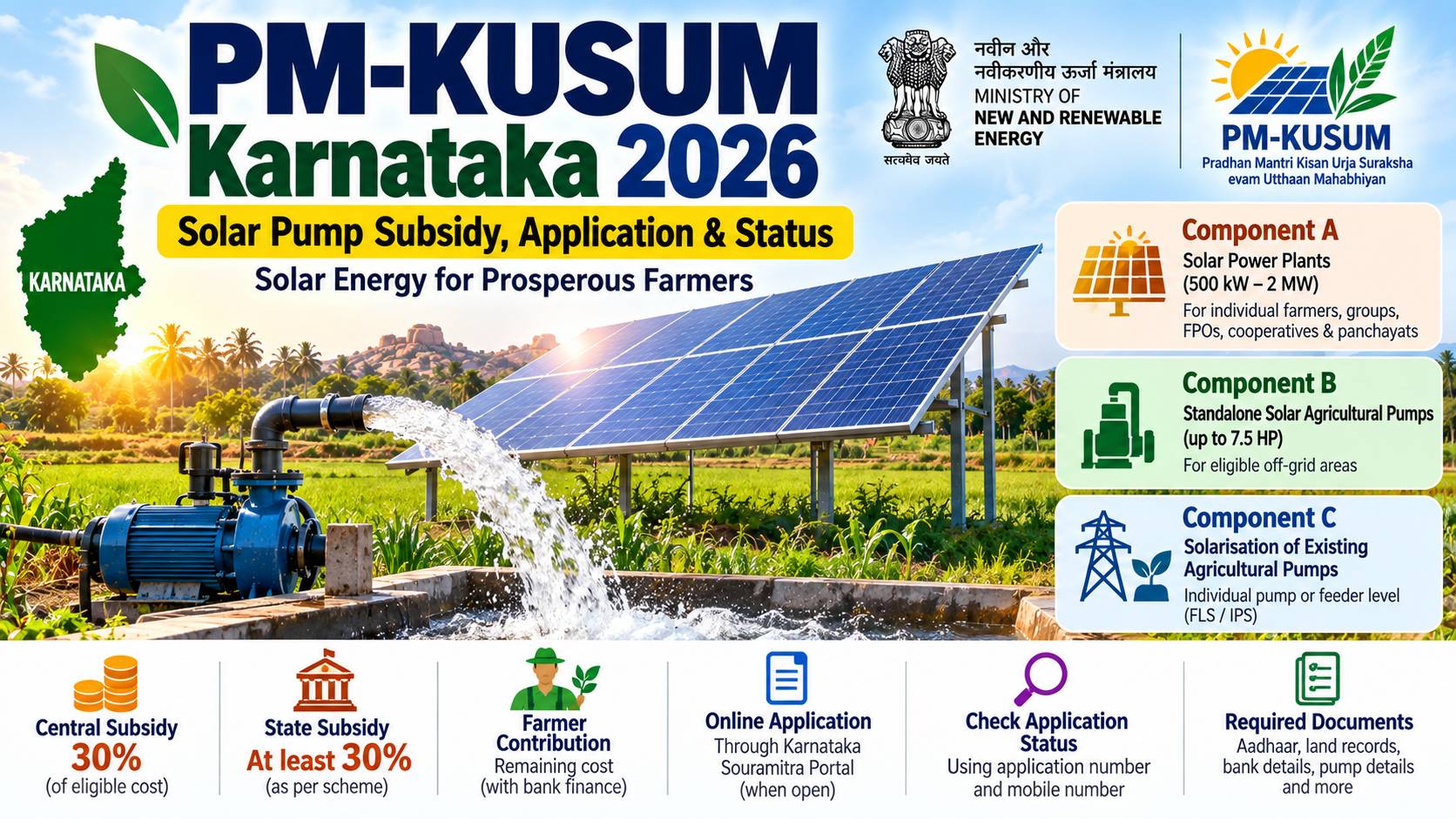
- Component A: Supports eligible decentralised solar power plants, generally from 500 kW to 2 MW.
- Component B: Supports standalone solar agricultural pumps in eligible off-grid areas.
- Component C: Supports solarisation of existing grid-connected agricultural pumps and agricultural feeders.
- Central subsidy: Generally 30% of eligible benchmark or tender cost for Components B and C, subject to the scheme conditions.
- State contribution: The original framework provides for a state subsidy of at least 30%, subject to implementation and funding arrangements.
- Farmer contribution: The remaining eligible cost is paid by the farmer, potentially with bank finance.
These are the original central scheme provisions. The actual subsidy, availability and farmer contribution for a Karnataka application depend on the sanctioned project, current state arrangements and applicable government orders.
Check the current Karnataka application status before paying an installer or agent.
What Are the Three Components of PM-KUSUM?
Component A: Solar power plants on suitable land
Component A supports decentralised, grid-connected renewable-energy plants with capacities generally ranging from 500 kW to 2 MW.
Eligible participants under the original guidelines include individual farmers, groups of farmers, cooperatives, panchayats, Farmer Producer Organisations (FPOs) and Water User Associations.
Farmers may develop an eligible project themselves or work with a developer. Where a developer leases land, the lease rent is determined by agreement between the parties. Electricity is purchased by the DISCOM at the applicable tariff approved by the state electricity regulator.
This component is different from a subsidy for an ordinary small irrigation pump.
Component B: Standalone solar agricultural pumps
Component B supports standalone solar pumps in eligible off-grid areas where grid electricity is unavailable.
Under the original central framework, eligible standalone pumps can have a capacity of up to 7.5 HP. The applicable guidelines and sanctioned project determine the final equipment and eligibility requirements.
This component may be relevant to farmers who currently depend on diesel pumps or need irrigation in locations without grid supply.
Component C: Solarisation of existing agricultural pumps
Component C supports solarisation of existing grid-connected agricultural pumps.
It includes two approaches:
- Individual Pump Solarisation (IPS): Solar PV is installed to serve an eligible existing agricultural pump.
- Feeder Level Solarisation (FLS): An agricultural electricity feeder is supplied through a suitable solar power project.
Under the original guidelines, an eligible farmer can use generated solar electricity for irrigation, and surplus electricity may be sold to the DISCOM under the applicable arrangement.
PM-KUSUM Subsidy in Karnataka: How Much Can Farmers Get?
The original central scheme framework for Components B and C generally provides the following funding structure:
| Funding source | Original framework |
|---|---|
| Central Financial Assistance | 30% of eligible benchmark or tender cost, whichever is lower |
| State government subsidy | At least 30%, under the original framework |
| Farmer contribution and financing | Remaining eligible amount, subject to the approved arrangement |
For example, suppose an approved solar pump project has an eligible cost of ₹2,00,000.
| Component | Illustrative amount |
|---|---|
| Central assistance at 30% | ₹60,000 |
| State assistance at 30% | ₹60,000 |
| Remaining farmer share | ₹80,000 |
| Total | ₹2,00,000 |
This is an illustration, not a current Karnataka quotation or guaranteed subsidy. Actual assistance is calculated using the applicable benchmark or tender cost, and the state share and funding arrangement must be confirmed for the specific sanctioned project.
Do not assume that every farmer will receive the same rupee subsidy regardless of pump capacity, tender, location or scheme component.
Who Is Eligible for PM-KUSUM?
Eligibility depends on the component and the currently approved state implementation plan.
Under the central framework, eligible participants can include:
- Individual farmers
- Groups of farmers
- Farmer Producer Organisations (FPOs)
- Cooperatives
- Water User Associations
- Panchayats and other specified entities for eligible projects
For a standalone pump under Component B, the original framework focuses on eligible off-grid agricultural locations. Component C concerns existing grid-connected agricultural pumps or feeder-level projects. Component A has separate requirements for land, project capacity, grid connection and power purchase.
Before applying, confirm:
- Which component applies to your farm.
- Whether your location and pump connection qualify.
- Whether Karnataka has an approved allocation or open application window.
- Whether your pump capacity and water source meet the technical requirements.
- Whether your application must be submitted through a designated agency or DISCOM.
How to Apply for PM-KUSUM in Karnataka
First verify that the relevant component is accepting applications. The central MNRE page lists the original scheme period as ending March 31, 2026, so the existence of a portal alone does not establish that fresh applications are open in October 2026.
Step 1: Check the official Karnataka solar-pump portal
Visit the Souramitra Karnataka solar water pumping portal.
The portal provides PM-KUSUM-related information and a facility to track an application using an application number and consumer mobile number.
Step 2: Check the Karnataka Renewable Energy Development Limited website
Visit KREDL’s official website to check current notifications, implementing-agency details and scheme announcements. The Souramitra portal also lists KREDL and Karnataka DISCOM links.
Step 3: Identify the correct component
- For a new standalone pump in an eligible off-grid area, check Component B.
- For an existing grid-connected agricultural pump, check Component C.
- For a larger grid-connected solar plant on suitable land, check Component A.
Step 4: Follow the current application instructions
If the relevant application window is open, use the official process specified in the current notification. Submit the required documents, choose only an authorised vendor where required, and retain your acknowledgement or application number.
Step 5: Wait for verification and approval
The implementing agency may verify your eligibility, land or pump details, technical requirements and other documentation before sanctioning the project.
Do not buy a pump or pay a vendor on the assumption that a subsidy will be approved retrospectively.
Documents Farmers Should Keep Ready
The precise document list depends on the component and the current Karnataka notification. Commonly requested documents can include:
- Aadhaar or another accepted identity document
- Farmer and landholding records, where required
- Recent photograph
- Mobile number
- Bank account details and accepted proof
- Existing agricultural electricity connection or pump details, for applicable Component C projects
- Pump capacity and water-source details
- Application acknowledgement or registration number
- Other declarations or certificates listed in the official notification
For a solar power plant under Component A, additional land, project, grid-connectivity, financial and contractual documents may be required.
Use the document checklist in the current official application notice. Do not upload identity or bank documents to an unverified website or share OTPs with agents.
How to Check PM-KUSUM Application Status in Karnataka
Karnataka’s Souramitra portal provides an application-tracking facility.
Track your application
- Open Souramitra.com.
- Find the PM-KUSUM application-tracking section.
- Enter your application number.
- Enter the consumer mobile number requested by the portal.
- Submit the details and review the displayed status.
The portal indicates that applicants can view application progress and related pump or agency information.
If the application does not appear, verify that the application number and mobile number match the submitted record. Then contact the implementing agency identified in your acknowledgement or the official Karnataka department.
Do not publish your application number, Aadhaar number, bank details or mobile number in a public comment.
How to Check Whether New Applications Are Open in 2026
This is especially important for farmers searching for “PM-KUSUM Karnataka apply online 2026.”
The MNRE page lists the original scheme period as ending on March 31, 2026. Its national portal continues to publish programme information and implementation data, but that does not itself confirm a fresh application window in Karnataka.
To verify current availability:
- Check the latest notifications on MNRE.
- Check KREDL for Karnataka-specific orders.
- Check Souramitra for the relevant application or tracking facility.
- Contact the implementing agency or DISCOM named in the official notice.
- Confirm the last date, component, district allocation, approved vendor list and subsidy arrangement before proceeding.
If no current notification confirms an open window, treat the application status as unverified, not as open.
Which Solar Pump Is Suitable for Your Farm?
The right pump depends on more than acreage.
The national PM-KUSUM FAQ identifies factors including the area to be irrigated, water requirement, cropping cycle, irrigation method and availability of shade-free space for solar modules. Pump discharge also varies with solar radiation and operating conditions.
Before selecting a pump, assess:
- Borewell or open-well depth
- Water level and seasonal variation
- Required water discharge
- Total dynamic head
- Irrigated area
- Crop and irrigation schedule
- Drip or sprinkler requirements
- Shade-free panel installation area
- Availability of grid electricity
- Pump and controller compatibility
A vendor should assess the actual water source and pumping conditions before recommending a capacity.
PM-KUSUM vs Ordinary Solar Pumps
| Feature | PM-KUSUM-supported project | Ordinary privately purchased solar pump |
|---|---|---|
| Government assistance | Available only under an approved and eligible scheme arrangement | Not automatic |
| Application or sanction | Required where specified by the scheme | Depends on the purchase and local rules |
| Vendor requirements | Must follow the applicable tender or approved-vendor process | Depends on the project |
| Farmer contribution | Determined by the approved project and subsidy structure | Based on the full purchase price and financing |
| Approval certainty | Depends on eligibility, allocation and sanction | Purchase is separate from subsidy approval |
Buying a solar pump privately does not automatically make the installation eligible for PM-KUSUM assistance.
Common Mistakes Farmers Should Avoid
1. Assuming every solar pump receives a subsidy
Assistance depends on the approved component, allocation, eligibility and funding arrangement.
2. Confusing the central scheme with a Karnataka application window
Central guidelines describe the programme, but a farmer still needs to verify current state implementation and application availability.
3. Paying an agent who promises guaranteed approval
No agent can guarantee a government sanction merely in exchange for a fee. Use the official process and keep receipts.
4. Selecting a pump only by HP
Pump capacity must match the water source, head, required discharge and irrigation plan.
5. Assuming a portal means applications are open
An operational information or tracking portal does not prove that new registrations are currently being accepted.
6. Ignoring warranty and after-sales service
Check the pump, controller and module warranties, installation terms, service contacts and complaint procedure in writing.
Frequently Asked Questions
1. Is PM-KUSUM Karnataka open for applications in October 2026?
The original MNRE scheme page lists the scheme period through March 31, 2026. A new extension or open Karnataka application window needs confirmation through a current official notification. The presence of the Souramitra portal alone does not establish that fresh applications are open.
2. How much subsidy is available for a solar pump under PM-KUSUM?
Under the original framework for Components B and C, central assistance is generally 30% of the eligible benchmark or tender cost, whichever is lower, with a state contribution of at least 30% under the framework. Actual assistance depends on the sanctioned project and current state arrangements.
3. Can a farmer apply for a 5 HP solar pump?
A 5 HP pump falls within the original Component B framework’s capacity limit of up to 7.5 HP. Eligibility still depends on the location, technical requirements, available allocation and current application rules.
4. Can a farmer with an existing electricity connection benefit?
Potentially. Component C covers eligible existing grid-connected agricultural pumps and feeder-level solarisation. The farmer must check the applicable Karnataka implementation and eligibility conditions.
5. Where can I check my Karnataka solar-pump application status?
Use the Souramitra portal and enter the application number and consumer mobile number requested by the tracking facility.
6. Which department implements PM-KUSUM in Karnataka?
The state implementation involves designated agencies. KREDL and the Karnataka DISCOM links are listed on the Souramitra portal. Check the current notification for the agency responsible for your specific component and district.
7. Does PM-KUSUM pay farmers to install solar panels on agricultural land?
Component A supports eligible decentralised grid-connected solar power plants. Farmers or eligible entities may develop projects or work with developers, and land lease rent can be mutually agreed where land is leased. This is different from the standalone irrigation-pump subsidy under Component B.
8. Is the subsidy paid directly to the farmer?
Under the original framework, central assistance and state subsidy are adjusted against eligible system cost, with the beneficiary paying the remaining amount under the approved implementation arrangement. Follow the specific Karnataka project instructions for the payment process.
9. Can I choose any solar pump vendor?
No. Where the scheme uses an approved vendor or tender process, the farmer must follow those requirements. Verify the authorised vendor list and current rates through the official portal or implementing agency before paying.
10. Does PM-KUSUM cover solar panels for a farmhouse or ordinary home?
PM-KUSUM is designed around agricultural pumps, agricultural feeders and eligible decentralised power plants. A household rooftop-solar installation generally falls under a different programme, such as PM Surya Ghar, if the household and system qualify.
Official Links for Karnataka Farmers
- MNRE PM-KUSUM scheme guidelines: https://mnre.gov.in/en/pradhan-mantri-kisan-urja-suraksha-evam-utthaan-mahabhiyaan-pm-kusum/
- National PM-KUSUM portal: https://pmkusum.mnre.gov.in/
- Karnataka Souramitra solar-pump portal: https://souramitra.com/
- KREDL: https://kredl.karnataka.gov.in/
- BESCOM: https://bescom.karnataka.gov.in/
- HESCOM: https://hescom.karnataka.gov.in/
- CESC Mysore: https://cescmysore.karnataka.gov.in/
Use the DISCOM serving your location and follow the implementing agency specified in the current notification.
Final Takeaway
PM-KUSUM can support eligible farmers through standalone solar pumps, solarisation of existing agricultural pumps and decentralised solar power plants. The original framework provides for central assistance and a state contribution, but the exact benefit depends on the approved project and implementation rules.
For Karnataka farmers in October 2026, the first step is to verify whether a valid extension and a fresh application window are available for the required component. Then check the official vendor process, required documents and application status before paying anyone.
The most important rule is simple: confirm the current official notification and your eligibility before committing money to a solar pump.
Suggested internal links:
1 thought on “PM-KUSUM Karnataka 2026: Solar Pump Subsidy, Application & Status”