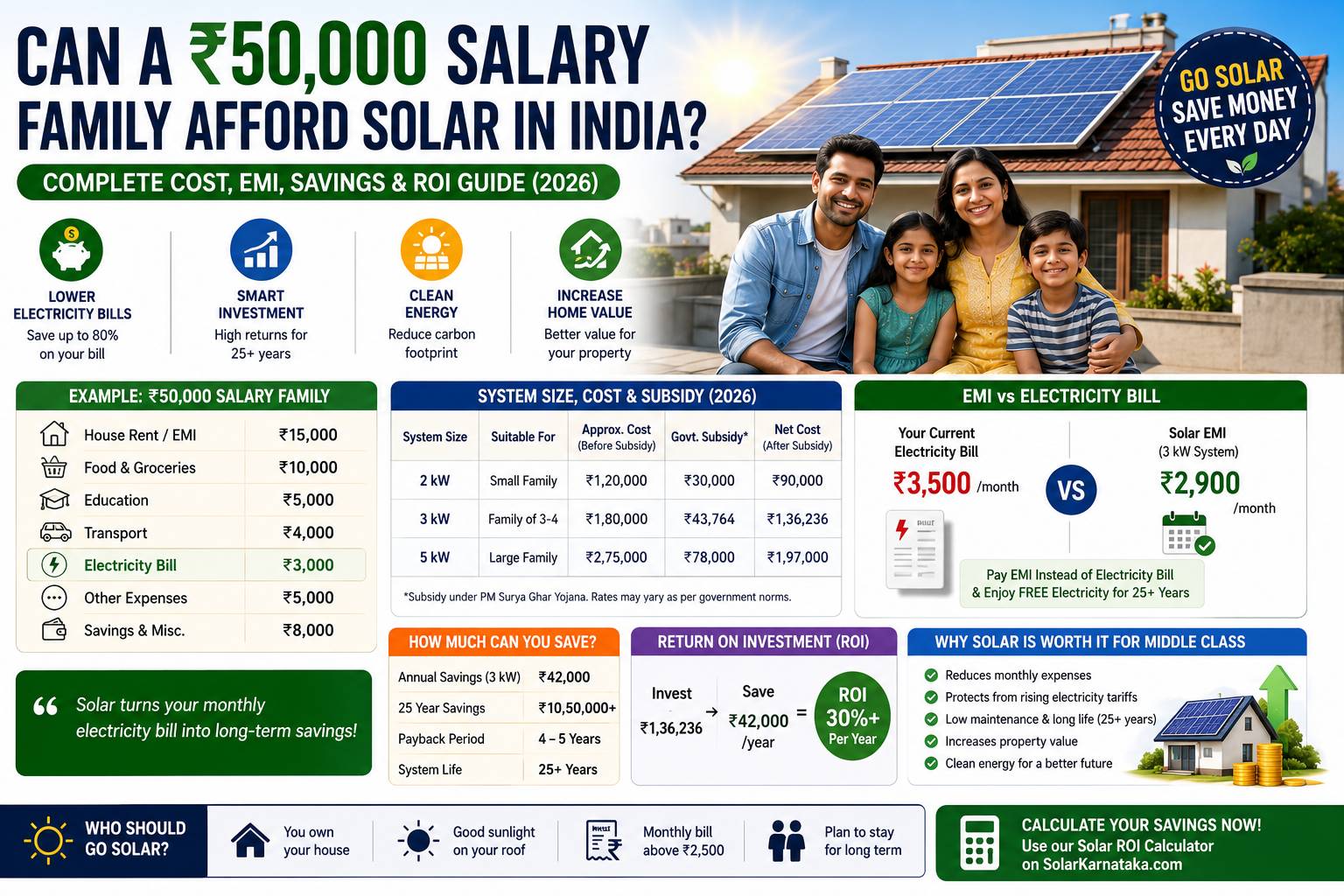
💡 Is Rooftop Solar Only for Rich Families?
For many middle-class families in India, a monthly salary of ₹50,000 has to cover almost everything:
- 🏠 Home loan or rent
- 🍛 Groceries
- 🎓 Children’s education
- 🚗 Fuel expenses
- ⚡ Electricity bills
- 💊 Medical costs
- 💰 Savings and investments
Now imagine adding another expense:
A rooftop solar system costing ₹2–5 lakh.
It naturally raises an important question:
Can a family earning ₹50,000 per month really afford solar?
The short answer is:
✅ Yes—but only if it is planned properly.
For many middle-income households, rooftop solar is no longer just an environmental choice. It has become a long-term financial investment that can reduce electricity bills for decades.
This guide explains the real costs, EMI options, government subsidy, savings, payback period and whether solar is worth it for a ₹50,000 salary household.
Quick Answer
Can a ₹50,000 Salary Family Install Solar?
Yes, if:
- You own your house.
- Your roof receives adequate sunlight.
- Your monthly electricity bill is generally above ₹2,500–₹3,000.
- You plan to stay in the same home for several years.
A well-sized rooftop solar system can significantly reduce electricity costs over time.
Monthly Budget of a ₹50,000 Salary Family
A typical example might look like this:
| Expense | Approximate Monthly Cost |
|---|---|
| House Rent / EMI | ₹12,000–18,000 |
| Food & Groceries | ₹10,000 |
| School / Education | ₹5,000 |
| Transport | ₹4,000 |
| Electricity | ₹3,000 |
| Internet & Mobile | ₹1,500 |
| Medical | ₹2,000 |
| Savings | Remaining balance |
One recurring expense that solar can help reduce is the electricity bill.
How Much Does a Home Solar System Cost?
The total cost depends on:
- System size
- Panel quality
- Inverter
- Roof type
- Installation
- Government subsidy
Typical residential systems:
| System Size | Suitable For |
|---|---|
| 2 kW | Small family |
| 3 kW | Family of 3–4 |
| 5 kW | Larger family / higher electricity use |
Instead of focusing only on the purchase price, consider the lifetime savings the system can provide.
Government Subsidy Can Reduce Initial Cost
Under eligible residential rooftop solar schemes, financial assistance may be available for qualifying systems.
Benefits vary depending on:
- Scheme rules
- State
- Capacity installed
- Eligibility
Always verify current subsidy details through the official government portal before making a purchase.
EMI vs Electricity Bill
Many banks and financial institutions offer financing for rooftop solar.
Instead of paying one large amount upfront, some homeowners compare:
Monthly Solar EMI
vs
Monthly Electricity Bill
Example:
Electricity Bill:
₹3,500/month
Possible Solar EMI:
₹3,000/month
Instead of paying the utility company, you’re gradually paying for an asset that can continue generating electricity long after the loan is repaid.
Example: Family of Four
Monthly salary:
₹50,000
Electricity bill:
₹3,500
Suitable system:
3–5 kW (depending on consumption)
Potential benefits:
✔ Reduced electricity bills
✔ Lower exposure to future tariff increases
✔ Increased home value
Can Solar Reduce the Electricity Bill to Zero?
Not always.
The final bill depends on:
- System size
- Electricity usage
- Fixed utility charges
- Net metering policy
- Weather conditions
Many households aim for substantial bill reduction rather than expecting a permanent ₹0 bill.
How Long Does It Take to Recover the Investment?
The payback period depends on:
- Installation cost
- Subsidy
- Electricity tariff
- Annual generation
- Household consumption
Many residential systems recover their investment over several years and continue generating electricity well beyond that.
What Happens During Monsoon?
Solar panels continue generating electricity during cloudy weather, but output is lower than on bright sunny days.
Annual production—not a single rainy month—determines long-term savings.
Should You Buy a Battery?
Most homes install on-grid solar without batteries because it costs less and is suitable for reducing electricity bills.
A battery becomes useful if:
- Power cuts are frequent.
- You need backup during outages.
- You want to run essential appliances at night without grid power.
Is Solar Better Than Investing the Money Elsewhere?
This depends on your goals.
Solar is not a high-return financial investment like equities.
Instead, it offers:
- Lower electricity expenses
- Predictable long-term savings
- Protection from rising energy costs
- Reduced dependence on the grid
For many families, these practical benefits are the primary reason to invest.
Who Should Install Solar?
Solar is a good option if you:
✔ Own an independent house
✔ Receive good sunlight
✔ Have moderate to high electricity usage
✔ Plan to stay in the home long term
Who Should Wait?
You may want to reconsider if:
❌ You live in a rented house
❌ Your electricity usage is very low
❌ The roof has significant shading
❌ You expect to move soon
Solar Savings Calculator
Before making a decision, calculate:
- Recommended system size
- Estimated installation cost
- Subsidy
- Monthly savings
- Annual savings
- Payback period
- 25-year savings
👉 Add your Solar ROI Calculator here
Is Solar Good for the Middle Class?
Absolutely.
Middle-class households often benefit the most because:
- Electricity is a recurring monthly expense.
- Savings accumulate year after year.
- A quality rooftop solar system can continue producing electricity for around 25 years.
The key is selecting the correct system size and working with a reputable installer.
Real-Life Example
Imagine two families, each earning ₹50,000 per month.
Family A
Pays ₹3,500 every month for electricity for many years.
Family B
Invests in rooftop solar.
After the system is installed:
- Monthly electricity expenses reduce significantly.
- Savings accumulate over time.
- The solar system continues generating electricity long after the initial investment has been recovered.
While the exact numbers differ for every household, the long-term financial impact can be substantial.
Frequently Asked Questions
Can a ₹50,000 salary family afford rooftop solar?
Yes. For many homeowners with suitable roofs and moderate electricity usage, rooftop solar can be affordable through savings, financing options, or government subsidy.
How much salary is needed to install solar?
There is no fixed salary requirement. The decision depends more on electricity usage, financing options, roof suitability and long-term plans than income alone.
Is EMI better than paying electricity bills forever?
Some homeowners prefer financing because they gradually pay for an asset instead of continuing to pay recurring electricity bills. The right choice depends on your financial situation.
Is rooftop solar a good investment for middle-class families?
For many households, rooftop solar offers long-term savings, reduced dependence on grid electricity and protection against future tariff increases.
How much roof space is needed?
The required roof area depends on the system size, panel efficiency and installation design.
Related Articles
- Solar ROI Calculator India (2026)
- PM Surya Ghar After 6 Months: Real-World Analysis
- Solar Panel Reality Check: 10 Things Companies Don’t Tell Customers
- Solar Powered Home + EV: No Petrol Bill, No Electricity Bill?
- Solar Battery vs Generator
- Solar During Monsoon Karnataka
Final Verdict
A ₹50,000 monthly salary does not automatically make rooftop solar unaffordable.
What matters more is:
- Your electricity consumption
- Available roof space
- Long-term financial planning
- Choosing the right system size
- Taking advantage of eligible government incentives
For many middle-class homeowners, rooftop solar transforms a recurring monthly expense into a long-term household asset.
Instead of thinking only about “How much does solar cost today?”, a better question is:
“How much will I spend on electricity over the next 20–25 years if I don’t install solar?”
For families planning to stay in their homes and manage rising energy costs, rooftop solar can be a practical step toward greater financial stability and energy independence.